
Pauls Valley, OK (PVL)
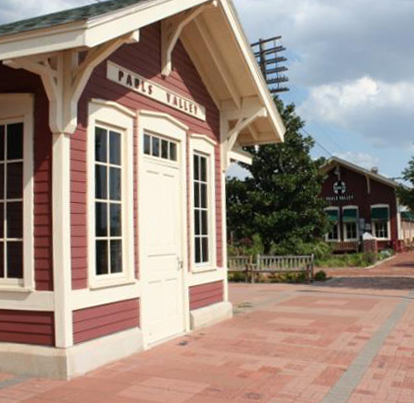
The Amtrak facility stands adjacent to the 1905 Santa Fe Railway depot, which was saved from demolition by townspeople in the 1980s and converted into a local history museum.
South Santa Fe Street and East Paul Avenue
Pauls Valley, OK 73075
- Facility Ownership: City of Pauls Valley
- Parking Lot Ownership: City of Pauls Valley
- Platform Ownership: BNSF Railway
- Track Ownership: BNSF Railway
Todd Stennis
Regional Contact
governmentaffairsnol@amtrak.com
For information about Amtrak fares and schedules, please visit Amtrak.com or call 1-800-USA-RAIL (1-800-872-7245).
The Pauls Valley Amtrak station includes a waiting room and is adjacent to the 1905 wood-frame depot erected by the Atchison, Topeka and Santa Fe Railway (commonly known as the “Santa Fe”). The design of the newer building echoes its older neighbor through the incorporation of a gabled roof, large eaves supported by brackets and framed windows.
Amtrak served the 1905 building until the Lone Star was discontinued in 1979, and the state of Oklahoma lost all passenger rail service. Afterward, the fate of the depot was uncertain. In 1985, the Santa Fe acquired a permit to tear down the building, but Adrienne Grimmett, then-president of the local historical society, mobilized Pauls Valley citizens to save it. That year, the depot was added to the National Register of Historic Places.
In 1989 the city purchased the facility and conveyed it to the historical society to use as a museum, and it was partially restored for that purpose, beginning in 1991. Workers volunteered and businesses discounted or donated supplies for the restoration. Even the Department of Corrections volunteered labor.
When the Heartland Flyer started service on June 14, 1999, the city commissioners approved a new passenger facility with parking area to be built next to the old depot, and it opened in June 2002. Construction was made possible by the Oklahoma Department of Transportation, which provided funding assistance through the federal Transportation Equity Act for the 21st Century for renovation or construction of new depots along the Heartland Flyer route.
In late summer 2026, Amtrak completed a $5 million improvement project at the Pauls Valley station. The work was part of Amtrak’s Americans With Disabilities Act Stations Program – an ongoing effort to proactively provide all customers with an accessible and safe experience at stations. These projects receive specific congressional funding directed by the Federal Railroad Administration.
Crews at Pauls Valley installed a new 290-foot-long concrete boarding platform with an embedded brick paver surface. There are also sloped accessible walkways and safety barriers, energy efficient LED light fixtures that provide full coverage lighting at the platform, detectable warning systems and new signage. The designer of record for the project was HDR Inc., specializing in architecture, engineering, environmental and construction services.
The historic Santa Fe depot continues to showcase the historical society’s collection of photos, memorabilia and pioneer collectibles. Additionally, Santa Fe 2-8-0 locomotive No. 1951, originally built in 1911, rebuilt in 1932 and donated to the city in 1995, is on display just north of the depot with the red Frisco Railway caboose No. 593.
Smith Paul, from whose farm Pauls Valley was named, was born in 1809 in New Bern, North Carolina, and lived for 17 years with the Chickasaw of northern Mississippi. When the Tri-Party Treaty of 1837 ceded this fertile land in what would become Oklahoma to the Chickasaw, Paul went with them when they were removed to Indian Territory. He married Ela-Teecha, a Chickasaw woman, after arriving. In 1857, the Pauls settled in the Washita Valley, and their large plantation-like farm gradually became known as Smith Paul’s Valley to the locals. Thus, when the railroad came through in 1887, they shortened the name of the station, a mile north of the original town site, to Pauls Valley.
Sam Paul, Smith’s son, had town lots platted near the depot and sold patents to lots fronting the railroad. The town plat was finally approved in 1903, and the town became the Garvin County seat in 1907 during statehood elections – because flood waters at that time prevented the opposing voters from reaching the polling place.
The railroad made Pauls Valley a regional trading spot, and today, as county seat, retail and public administration form the bulk of the city’s economic engine.
The Heartland Flyer is financed primarily through funds made available by the Oklahoma and Texas Departments of Transportation.
Station Building (with waiting room)
Features
- ATM not available
- No elevator
- Payphones
- No Quik-Trak kiosks
- No Restrooms
- Unaccompanied child travel not allowed
- No vending machines
- No WiFi
- Arrive at least 30 minutes prior to departure
Baggage
- Amtrak Express shipping not available
- No checked baggage service
- No checked baggage storage
- Bike boxes not available
- No baggage carts
- Ski bags not available
- No bag storage
- Shipping boxes not available
- No baggage assistance
Parking
- Same-day parking is available; fees may apply
- Overnight parking is available; fees may apply
Accessibility
- Payphones
- Accessible platform
- Accessible restrooms
- No accessible ticket office
- Accessible waiting room
- No accessible water fountain
- Same-day, accessible parking is available; fees may apply
- Overnight, accessible parking is available; fees may apply
- No high platform
- No wheelchair
- Wheelchair lift available
Hours
Station Waiting Room Hours
| Mon | 09:34 am - 08:26 pm |
| Tue | 09:34 am - 08:26 pm |
| Wed | 09:34 am - 08:26 pm |
| Thu | 09:34 am - 08:26 pm |
| Fri | 09:34 am - 08:26 pm |
| Sat | 09:34 am - 08:26 pm |
| Sun | 09:34 am - 08:26 pm |
 Amtrak established the Great American Stations Project in 2006 to educate communities on the benefits of redeveloping train stations, offer tools to community leaders to preserve their stations, and provide the appropriate Amtrak resources.
 Amtrak is seizing a once-in-a-lifetime opportunity to transform rail and Retrain Travel. By modernizing, enhancing and expanding trains, stations and infrastructure, Amtrak is meeting the rising demand for train travel. Amtrak offers unforgettable experiences to more than 500 destinations across 46 states and parts of Canada. Learn more at