

Norman, OK (NOR)
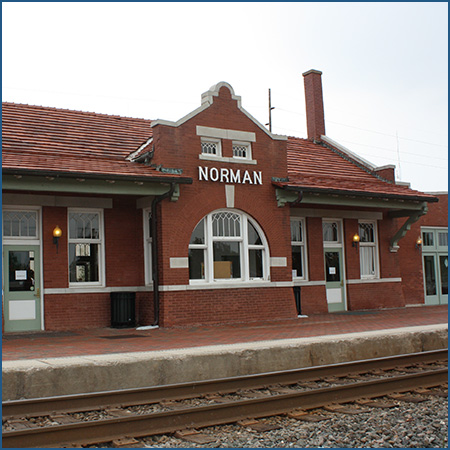
Lovingly restored, this 1909 red brick depot now hosts passengers as well as a community arts group and gallery. The lawns display sculptures in wood and bronze by Oklahoma artists.
200 South Jones Avenue
Norman, OK 73069-6023
- Facility Ownership: City of Norman
- Parking Lot Ownership: City of Norman
- Platform Ownership: BNSF Railway
- Track Ownership: BNSF Railway
Todd Stennis
Regional Contact
governmentaffairsnol@amtrak.com
For information about Amtrak fares and schedules, please visit Amtrak.com or call 1-800-USA-RAIL (1-800-872-7245).
The Amtrak station in Norman was built for the Atchison, Topeka and Santa Fe Railway (ATSF) in 1909 by Lungsren & Carlson. Sitting in the heart of historic Norman, the Santa Fe depot is a well-preserved example of Mission Revival architecture, composed of brick and limestone, with a cross-gable and clay tile roof. The station is just a short walk from numerous Embark Norman bus routes serving the city.
When passenger rail service was discontinued in Oklahoma in 1979, the depot closed. Ownership was conveyed to the city on October 16, 1986, and the Santa Fe Depot Preservation Committee, which later became Norman Depot, Inc., formed that year. It worked to reopen the building as a multipurpose community facility in 1990, and in 1991 the Norman Santa Fe depot was added to the National Register of Historical Places. When the Heartland Flyer began service in June 1999, the depot was reconverted to use as a passenger facility.
Today, the south side of the depot is used as the Amtrak station, with an unstaffed waiting room. The north side is home to the Performing Arts Studio (PAS)/The Depot, a non-profit organization dedicated to creating and presenting innovative fine arts programs for the public, such as poetry readings and visual arts shows. PAS/The Depot oversees the rental of the building and grounds for weddings, parties and other events, and its volunteers also greet rail passengers twice a day. The adjacent lawns display public art sculptures in wood and bronze by Oklahoma artists, which are part of the Legacy Trail urban park. Also on the property is a statue of Norman native and actor James Garner as he appeared as Bret Maverick on the television series “Maverick,” which ran from 1957 to 1962 and again in 1981-82.
The station’s most recent renovation, completed in 2003, was under the direction of Arn Henderson, University of Oklahoma architecture professor emeritus. Renovations included installation of new baggage doors, lighting, heat and air conditioning, general repairs, landscaping and other improvements. This $480,000 project was funded with 80% of the federal money coming from the Federal Surface Transportation Funds ($384,000) and the remaining 20% provided by Soft Match Credit funds available to the Oklahoma Department of Transportation. The city also made a contribution from its capital fund.
In late summer 2026, Amtrak completed a $3 million improvement project at the Norman station. The work was part of Amtrak’s Americans With Disabilities Act Stations Program – an ongoing effort to proactively provide all customers with an accessible and safe experience at stations. These projects receive specific congressional funding directed by the Federal Railroad Administration.
Crews at Norman built a new 300-foot-long boarding platform with reinstalled brick pavers and accessible paths of travel to and from the depot. There are also sloped accessible walkways and safety barriers, energy efficient LED light fixtures that provide full coverage lighting at the platform, detectable warning systems and new signage. The designer of record for the project was WSP USA, one of the world’s leading engineering, science and infrastructure solutions firms.
In 1870, the U.S. Land Office contracted for the newly formed Indian Territories to be surveyed. Abner E. Norman, a young professional surveyor, led the central survey area, including the grassy hills and bottom lands that would become Norman. The surveyor’s camp on Bishop’s Creek retained its name of Norman’s Camp over the years. The ATSF planned a station there in 1886-87, and the railroad platted a town, assigning the name “Norman” to that station, and on June 13, 1887, the first northbound passenger train passed Norman station. However, no European-American settlers came until the Great Land Run of 1889; and on April 22, 1889, Norman station was selected by railroad engineer Charles Chamberlin to become the site for the new town of Norman.
While Norman is the largest city in and the county seat of Cleveland County, it is also home to the University of Oklahoma, which was founded in Norman in 1890, one of three state-mandated colleges and universities for higher education chartered at that time. Today, with about 30,000 students, it is not only the largest institution of higher learning in the state, but also a nationally-respected university. Along with substantial scientific and technological research and its athletics program, the university is well-known for the Fred Jones Jr. Museum of Art. It houses the largest collection of French Impressionist works belonging to a university and also has a focus on Native American art.
Located on the Research Campus at Oklahoma University is the National Weather Center, a confederation of the University of Oklahoma, National Oceanic and Atmospheric Administration and state organizations that study atmospheric events over a wide range of space and times. The center’s annual National Weather Festival is open to the public and features the Storm Chaser Car Show, with awards for Most Hail Damage, Most Working Sensors, Most Unique, Most Cutting Edge, Best Looking, and Meatwagon (most beat up but reliable on short notice).
The Heartland Flyer is financed primarily through funds made available by the Oklahoma and Texas Departments of Transportation.
Platform only (no shelter)
Features
- ATM not available
- No elevator
- No payphones
- No Quik-Trak kiosks
- No Restrooms
- Unaccompanied child travel not allowed
- No vending machines
- No WiFi
- Arrive at least 30 minutes prior to departure
Baggage
- Amtrak Express shipping not available
- No checked baggage service
- No checked baggage storage
- Bike boxes not available
- No baggage carts
- Ski bags not available
- No bag storage
- Shipping boxes not available
- No baggage assistance
Parking
- Same-day parking is available; fees may apply
- Overnight parking is available; fees may apply
Accessibility
- No payphones
- Accessible platform
- No accessible restrooms
- No accessible ticket office
- No accessible waiting room
- No accessible water fountain
- Same-day, accessible parking is available; fees may apply
- Overnight, accessible parking is available; fees may apply
- No high platform
- No wheelchair
- Wheelchair lift available
Hours
Station Waiting Room Hours
| Mon | 08:50 am - 09:11 pm |
| Tue | 08:50 am - 09:11 pm |
| Wed | 08:50 am - 09:11 pm |
| Thu | 08:50 am - 09:11 pm |
| Fri | 08:50 am - 09:11 pm |
| Sat | 08:50 am - 09:11 pm |
| Sun | 08:50 am - 09:11 pm |
 Amtrak established the Great American Stations Project in 2006 to educate communities on the benefits of redeveloping train stations, offer tools to community leaders to preserve their stations, and provide the appropriate Amtrak resources.
 Amtrak is seizing a once-in-a-lifetime opportunity to transform rail and Retrain Travel. By modernizing, enhancing and expanding trains, stations and infrastructure, Amtrak is meeting the rising demand for train travel. Amtrak offers unforgettable experiences to more than 500 destinations across 46 states and parts of Canada. Learn more at