
Wells, ME (WEM)
The Wells Regional Transportation Center is located about a mile and a half west of downtown Wells and is easily accessible from Interstate 95.
- Facility Ownership: Maine Turnpike Authority
- Parking Lot Ownership: Maine Turnpike Authority
- Platform Ownership: Northern New England Passenger Rail Authority
- Track Ownership: CSX Transportation
Margaret Clark
Regional Contact
governmentaffairsnyc@amtrak.com
For information about Amtrak fares and schedules, please visit Amtrak.com or call 1-800-USA-RAIL (1-800-872-7245).
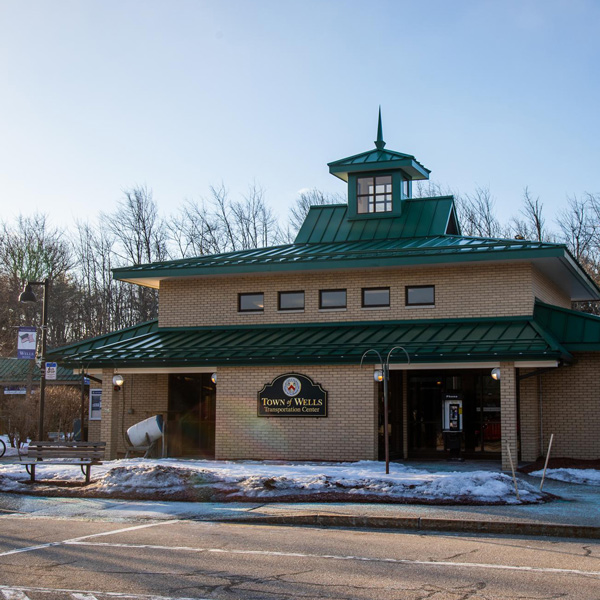
The Wells Regional Transportation Center is located about a mile and a half west of downtown Wells and is easily accessible from Interstate 95. The facility, built of cream-colored brick with a hipped green roof crowned by a small cupola, is also served by a local bus route operated by the York County Community Action Corporation, and it includes a large parking lot. It opened in June 2003 and was designed and built by the Maine Turnpike Authority.
As early as 1993, the town had voted in favor of building a new transportation center, thanks in part to the efforts of the TrainRiders/Northeast rail advocacy organization. The current building was constructed after the Maine Turnpike Authority won a $1 million federal grant, which it combined with $400,000 in state funds. The town of Wells and its Chamber of Commerce sponsor the transportation center waiting area and restrooms and also provide visitor information. A station host is often available to assist with travel needs and connecting transportation.
In October 2026, the Northern New England Passenger Rail Authority (NNEPRA), which provides financial support to operate the Amtrak Downeaster service, marked the substantial completion of platform and other improvements at the transportation center that had begun in March 2025. NNEPRA was joined by federal, state and local transportation leaders and project partners to cut the ribbon on facility improvements.
The Wells Area Improvement Project included both platform and track construction. The existing high-level boarding platform adjacent to the transportation center was rebuilt and a second platform was erected on the south side of the tracks. A new pedestrian bridge, accessible by elevators and stairs, spans the railroad to connect the two platforms. This new configuration means that trains in both directions can stop at Wells at the same time, improving operational efficiency.
Prior to the start of platform work, CSX Transportation, which owns the tracks used by Amtrak Downeaster trains, undertook a 6-mile extension of the 2-mile passing track in Wells. This additional track capacity, completed in December 2024, improves train reliability and increases schedule flexibility for passenger and freight trains. Ultimately, the improvement project will support additional Downeaster service between Brunswick and Wells.
The $31 million project was largely funded through a federal Consolidated Rail Infrastructure and Safety Improvement Grant awarded to NNEPRA by the Federal Railroad Administration in 2019. It was matched by a 20% contribution from the Maine Department of Transportation (MaineDOT) and a 6.5% contribution from CSX.
The return of passenger service to Portland and northern New England in 2001 began as a grass-roots movement with the founding in 1989 of TrainRiders/Northeast by Wayne Davis, who possessed a strong vision of what that passenger service could be. On July 14, 1989, the Maine State Legislature enacted the Passenger Rail Service Act directing the MaineDOT to take all actions necessary to establish regularly scheduled passenger rail service within and outside the State of Maine. The act further directed that the expenditure of funds to carry out this mandate would be spent first to restore passenger rail service between Portland, Maine, and Boston, Mass.
In 1995, the legislature further established NNEPRA to develop and provide passenger rail service between Maine and Boston and points within Maine. Davis’s work came to fruition with the beginning of the Downeaster service in December 2001. Maine Governor Angus King and U.S. Senators Olympia Snowe and Susan Collins as well as Amtrak officials and many of the train-riding public attended the Downeaster’s inauguration. TrainRiders/Northeast today also provides volunteer train hosts on the Downeaster.
Wells was one of Maine’s earliest English settlements, being the third to incorporate in the state. Located in the portion of Maine awarded to Sir Ferdinando Gorges in 1622 by the Plymouth Company of England, the area was granted to agents from Exeter, New Hampshire, in 1641 by his young cousin and agent, Thomas Gorges. By 1643, Edmund Littlefield, who is recognized as the town’s founder, had erected a sawmill on the Webhannet River near the center of the present-day town. Following Gorges’s death and upheavals in English politics, the Massachusetts Bay Colony claimed all of Maine; however Wells incorporated at that time to retain some of its independence. Wells was named for Wells, Somerset, a small cathedral town in England.
Wells was originally somewhat larger. When Maine became a state in 1820, Kennebunk, on the north, separated from the town to become its own municipality. Ogonquitt, on the south side, separated in 1980 to become its own town as well.
The Webhannet River provided an inlet past the coastal barrier islands and through the salt marshes for the settlers, and its several tributaries made good mill streams. By the time of the French and Indian wars, due to the ravages from the French-backed tribes on the coast, Wells became the northernmost English-speaking outpost in coastal New England, having held out despite repeated attacks. The town’s Storer Park commemorates the town’s successful resistance in those conflicts with help from Lieutenant Storer’s garrison. Hostilities continued on and off until after the Battle of Louisburg in 1745. Unlike other towns in the area, Wells was never abandoned.
The town largely made its living with farming, hay production from the marshes, ship building and fishing. The Boston and Maine (B&M) Railroad arrived in the 1840s, and in time it brought summer visitors attracted to the barrier islands’ beaches. Seaside tourism and the town’s commercial shipyard and recreational fishing still provide a livelihood for the townspeople. Visitors are also attracted to the Wells Reserve at Laudholm, which provides walking trails and various activities, in addition to being a center for research in estuaries and coastal salt marsh habitats. The Wells Reserve monitoring program collects, analyzes and makes available weather, water quality and nutrient data from all National Estuarine Research Reserves. This small preserve to the north of the town is sited next to the much larger Rachel Carson National Wildlife Refuge.
The Rachel Carson National Wildlife Refuge was established in 1966 in cooperation with the state of Maine to protect valuable salt marshes and estuaries for migratory birds. Located along 50 miles of coastline in York and Cumberland counties, the refuge consists of 11 divisions between Kittery and Cape Elizabeth. The proximity of the refuge to the coast and its location between the eastern deciduous forest and the boreal forest creates a composition of plants and animals not found elsewhere in Maine. Major habitat types present on the refuge include forested upland, barrier beach/dune, coastal meadows, tidal salt marsh and the distinctive rocky coast.
The Downeaster is financed primarily through funds made available by the Northern New England Passenger Rail Authority.
Station photo courtesy of Bill Lord.
Station Building (with waiting room)
Features
- ATM available
- No elevator
- Payphones
- Quik-Trak kiosks
- Restrooms
- Unaccompanied child travel not allowed
- Vending machines
- No WiFi
- Arrive at least 30 minutes prior to departure
Baggage
- Amtrak Express shipping not available
- No checked baggage service
- No checked baggage storage
- Bike boxes not available
- No baggage carts
- Ski bags not available
- No bag storage
- Shipping boxes not available
- No baggage assistance
Parking
- Same-day parking is available; fees may apply
- Overnight parking is available; fees may apply
Accessibility
- Payphones
- Accessible platform
- Accessible restrooms
- Accessible ticket office
- Accessible waiting room
- Accessible water fountain
- Same-day, accessible parking is available; fees may apply
- Overnight, accessible parking is available; fees may apply
- High platform
- No wheelchair
- No wheelchair lift
Hours
Station Waiting Room Hours
| Mon | 05:30 am - 09:00 pm |
| Tue | 05:30 am - 09:00 pm |
| Wed | 05:30 am - 09:00 pm |
| Thu | 05:30 am - 09:00 pm |
| Fri | 05:30 am - 09:00 pm |
| Sat | 06:30 am - 09:00 pm |
| Sun | 06:30 am - 09:00 pm |
Ticket Office Hours
Passenger Assistance Hours
Checked Baggage Service
Parking Hours
Quik-Track Kiosk Hours
| Mon | 05:30 am - 09:00 pm |
| Tue | 05:30 am - 09:00 pm |
| Wed | 05:30 am - 09:00 pm |
| Thu | 05:30 am - 09:00 pm |
| Fri | 05:30 am - 09:00 pm |
| Sat | 06:30 am - 09:00 pm |
| Sun | 06:30 am - 09:00 pm |
 Amtrak established the Great American Stations Project in 2006 to educate communities on the benefits of redeveloping train stations, offer tools to community leaders to preserve their stations, and provide the appropriate Amtrak resources.
 Amtrak is seizing a once-in-a-lifetime opportunity to transform rail and Retrain Travel. By modernizing, enhancing and expanding trains, stations and infrastructure, Amtrak is meeting the rising demand for train travel. Amtrak offers unforgettable experiences to more than 500 destinations across 46 states and parts of Canada. Learn more at