
Windsor Locks, CT (WNL)
The community boasts a rich transportation heritage including a canal, railroad and international airport; the New England Air Museum is a popular local destination.
- Facility Ownership: Forthcoming
- Parking Lot Ownership: Forthcoming
- Platform Ownership: Forthcoming
- Track Ownership: Amtrak
Margaret Clark
Regional Contact
governmentaffairsnyc@amtrak.com
For information about Amtrak fares and schedules, please visit Amtrak.com or call 1-800-USA-RAIL (1-800-872-7245).
The Windsor Locks station, located in the heart of the community, stands between Main Street and the Connecticut River. In addition to Amtrak, it’s served by CTrail Hartford Line commuter trains between New Haven and Springfield, Massachusetts. CTrail trains complement Amtrak service to offer travelers greater flexibility and choice along this busy rail corridor.
The station also offers connections to local CTtransit buses, including a route serving nearby Bradley International Airport. In addition, it is easily accessed from Interstate 91 and a multi-use trail that connects to the Windsor Locks Canal State Park Trail via a pedestrian crossing at Bridge Street.
The current 9,500-square-foot facility was built by the Connecticut Department of Transportation (CTDOT) and opened to passengers on October 18, 2026. It replaced a small open shelter and concrete platform about one mile to the south. Elements of the one-story brick building echo the historic 1875 Windsor Locks depot (and a former freight house) located directly south of the new station. These include cupolas with finials along the ridge of the roof, paired brackets supporting overhangs that protect customers from inclement weather, and arched openings on the main facades.
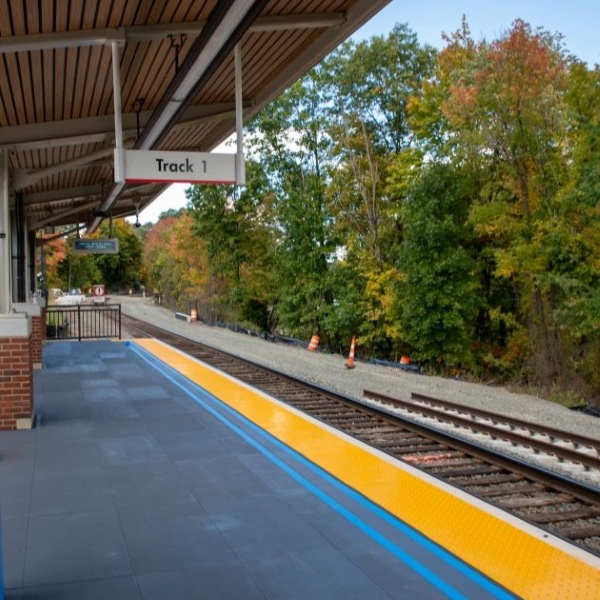
Rail customers have access to sheltered, heated waiting areas with seating. The platform, which has a canopy for much of its length, is high-level, meaning that its height matches the floors of the railcars, making it easy for passengers to quickly enter and exit the train. A surface parking lot, passenger drop-off area, electric vehicle chargers and bicycle racks are also available.
The passenger station was just one component of a larger $121 million project funded with approximately 85% state funds and 15% federal funds. It also included reconstruction of 1,800 feet of Main Street (Route 159) between the station and Bridge Street with improved sidewalks, drainage, traffic signals and a multiuse trail.
In addition, the railroad through the area – part of Amtrak’s Springfield Line (New Haven-Springfield) – is receiving track and signal enhancements to improve operational flexibility, reliability and capacity. This work, coordinated between CTDOT and Amtrak, is expected to be completed by spring 2028.
State, local and Amtrak officials joined residents to dedicate the new station on October 13, 2026, five days before trains started making regular stops. In attendance were Governor Ned Lamont, U.S. Senator Richard Blumenthal and Connecticut Transportation Commissioner Garrett Eucalitto.
The celebration also highlighted a planned, state-supported, $85 million transit-oriented development directly northwest of the new station. It will replace a strip mall with a mix of apartments and retail uses on more than three acres within easy walking distance of train and bus connections.
Concurrently with the design and construction of the new rail station, the Town of Windsor Locks received a $4.8 million award of Community Investment Funds in 2023 from the Connecticut Department of Economic and Community Development. About half of this money is dedicated to improving and reopening the 1875 New York, New Haven and Hartford Railroad (the “New Haven”) depot to the public.
The layout of the historic one-and-a-half story brick depot was typical for its time: it contained a large, open waiting room in the center with baggage and parcel express offices to the south and restrooms to the north. Trackside, a three-sided canted bay projects onto the platform area; through its numerous windows, the station master would have monitored traffic on the rail line. Facing Main Street, a similar bay indicates the location of the former telegraph office.
A simple gabled roof extends past the walls of the building to form deep eaves that are supported by large, curved wooden brackets. Three dormers punctuate the roof on each slope, allowing light to penetrate the attic level. At the gabled ends, the architect indulged in a flight of fancy with the addition of elaborate, decorative bargeboard cut into a geometric pattern featuring circles. Secured by brackets, the woodwork draws the eye up to the roof’s ridgeline and adds a bit of sophistication.
Historic accounts reveal that the station was originally painted a creamy yellow while the exterior woodwork was covered in complementary dark brown and green. Inside, the finishes are simple. Durable bead board wainscoting covering the lower end of the waiting room walls would have been easy to dust and polish. Above, the rest of the walls were finished with plaster. The canted walls of the two bays continued into the interior to enclose the ticket and telegraph offices, but they did not reach all the way to the ceiling.
A two-story brick freight house was built to the north. Four cupolas crowned the ridge of the gabled roof, creating a profile that was recognizable from a distance. Wide double doors could be slid open to allow carts laden with crates and parcels to be wheeled directly from trains and into the building where their contents were sorted for distribution. Although this structure was severely damaged in the Great Hurricane of 1938, it was later rebuilt.
The station remained active until after World War II. In 1971 it was closed to passengers, but the Penn Central Railroad (PC), which had absorbed the bankrupt New Haven, used part of the building as a signal workshop. A plan to demolish the station was thwarted by residents who set up a “Save the Station Committee.” Recognizing that the station was remarkably intact, the group then worked to have the structure listed on the National Register of Historic Places just in time for its centennial.
After Amtrak began operations in 1971, the station stop was moved south to the site near I-91. When the PC went out of business soon thereafter, Amtrak inherited the Springfield Line, which also included structures such as the historic Windsor Locks depot.
Attempts to lease and rehabilitate the former station were long unsuccessful, and an arson in 2000 brought greater attention to the building’s fate. Boarded up for more than 30 years, the structure needed a new roof, windows, plumbing and electrical systems, and repointing of its brickwork. In 2004, another citizen-led group, the non-profit Windsor Locks Preservation Association (WLPA), was formed to advocate for reuse of the building. The WLPA worked to purchase and preserve the old depot and entered into discussions with officials from the town and Amtrak.
Ultimately, after years of consultation, it was determined that Amtrak, the town and the WLPA could not come to a satisfactory agreement concerning the future use of the depot or the sale of the land, and in 2011 the preservation group dissolved itself. The town subsequently took on the task of negotiating a purchase or long-term lease of the historic structure, and in December 2014, the property was transferred from Amtrak to the town.
The first Europeans to explore the shores of the Connecticut River were Dutch sailors and traders led by navigator Adriaen Block, who worked to map much of the New England coast. In 1614, he and Cornelius Hendricksen sailed from New Amsterdam (New York City), and made their way up the river to the present site of Hartford where a decade later the Dutch established a fort and trading post called “Goede Hoop,” or “Good Hope.”
Although the Dutch wanted to control the fur trade with the Pequot American Indians and other local tribes, their plans were soon thwarted by groups of English settlers moving west from coastal Massachusetts.
The first wave of English colonists arrived from Plymouth. According to early histories, they had been asked to settle in the area by American Indian tribes who had recently come under the control of the Pequots, a powerful group that had moved into southern New England from the north. In the fall of 1633, a band of settlers led by William Holmes traveled upriver, passed the Fort of Goede Hoop and staked a claim to land where the Farmington River empties into the Connecticut.
Within two years, these settlers were joined by a large party of Puritans that had arrived in the Massachusetts Bay Colony from England in 1630. Led by the Reverend John Wareham, they believed that royal actions had made it impossible for them to “purify” the Church of England of its remaining Roman Catholic influences and thus decided to set out for the New World to build a community grounded in their religious beliefs.
In the fall of 1635, the company headed overland from the Boston area to join the Plymouth settlers, but a harsh winter sent many back in search of shelter and food, only to return in better weather the following year. The third and final group of European pioneers to make its way to the Windsor area was sponsored by Sir Richard Saltonstall, an assistant to John Winthrop, governor of the Massachusetts Bay Colony.
The settlement at the confluence of the two rivers was first known by its American Indian name, Matianuck, then Dorchester, and finally Windsor, chosen in 1637 to honor the Berkshire town where the royal family maintained a castle. Windsor occupied a fair amount of land on both sides of the Connecticut River, but as time went on, new towns formed and broke away.
Within a few years, Windsor was joined by the settlements at Hartford and Wethersfield. Known as the “River Towns,” they were under the control of Massachusetts Bay until 1637 when they came together to form their own system of government, partly in response to the need for common security. As the English communities expanded, the Dutch presence in the region waned and by 1654 Fort Goede Hoop was abandoned.
The area now referred to as Windsor Locks was known to early colonists as Pine Meadow. In 1663, Henry Denslow moved north from Windsor to establish a farm. He was later joined by a couple of other settlers after the conclusion of King Philip’s War between English colonists and local American Indian groups.
A century later, only a dozen families were counted in the area, and it remained agricultural. The banks of the Connecticut were prone to spring flooding that left behind deposits of rich soil perfectly suited for nutrient intensive crops such as tobacco. Usually associated with more southern colonies such as Maryland and Virginia, the leafy plant was introduced to Connecticut in 1640 and continues to be cultivated in the Windsor region today.
The mouth of the Farmington River developed as an important port where ships set sail to trade with downstream communities; navigation further north was made difficult by the 30-foot drop posed by Enfield Falls. Towards the end of the 18th century, ships made it as far south as British possessions in the Caribbean where New England agricultural goods and animals were exchanged for sugar, molasses and rum.
Due to its abundant and fast flowing streams and rivers, New England was the first region of the United States to industrialize, starting in the late 18th century. In the 1740s, Denslow descendants established a sawmill on Kettle Brook. Twenty years later, Jabez Haskell and his brother-in-law Seth Dexter came down from Massachusetts. They purchased the former Denslow property and subsequently added a wool-carding and cloth-dressing mill. These operations laid the foundation for the development of the Dexter Corporation in the 19th century. It became nationally known for its specialty paper products, including tissues used to make toilet paper, tea bags and meat casings.
Much of that initial economic growth was made possible by the construction of the Enfield Canal around its namesake falls on the Connecticut River. Stretching all the way north into the far interior of New England, the river was an important transportation corridor along which agricultural and manufactured products, people and ideas moved. Although goods could be portaged around the falls, that was a time and people intensive process.
In 1825, work was begun on the New Haven and Northampton Canal to the west, which was envisioned as a watercourse linking southern Massachusetts with Long Island Sound. To counter this attempt to steer traffic away from the river, a group of Hartford investors founded the Connecticut River Company to construct a canal north of Windsor.
Built between 1827 and 1829, the 5.5-mile waterway was designed not only for traditional flat-bottom boats, but also the new steamships that had begun to ply the river. The main trench, 4.5 feet deep, was dug by hand principally through the labor of Irish immigrants. They lined the banks with stone walls that could withstand the churning water left in the wake of the steamboats.
Around the locks north of Pine Meadow, a new settlement formed, and in 1854 it was incorporated as Windsor Locks. The name recognized the mother town as well as the physical infrastructure that made its growth possible.
Waterborne prosperity lasted but a short 15 years as railroads began to make inroads. One of those competitors was the Hartford and New Haven (H&NH), chartered in 1833 to link its namesake cities. Despite delays caused by the financial panic of 1837, the line was in full operation by 1839. That December, it hosted the first steam locomotive in the state, ushering in a new era of transportation. Five years later, the Windsor area was connected to Hartford via the 6-mile Hartford and Springfield Railroad (H&S), thus allowing passengers to transfer to the H&NH and continue southward.
For much of its route, the H&S paralleled the Enfield Canal, with trains rushing by the slower going boats. In 1847, the two rail lines merged but kept the H&NH name – their combined right-of-way forms the base of the Amtrak Springfield Line. A combination depot to accommodate passengers and freight in Windsor Locks was constructed on a spit of land between the tracks and Main Street near the intersection with Oak Street (close to the 1875 depot).
Many of Connecticut’s early railroads, such as the H&NH, were oriented north-south due to the undulating coastline which was marked by numerous streams and rivers that would have to be bridged. The challenge was not undertaken until the New York and New Haven Railroad (NY&NH) was chartered in 1844; by 1849, the line had opened between the two named endpoints, with access over the New York and Harlem Railroad into Manhattan.
Realizing the value in helping one another and shutting out rivals, the H&NH and the NY&NH agreed to merge in 1872, resulting in the New York, New Haven and Hartford Railroad, or the “New Haven.” Over the next few decades, the New Haven became the dominant freight and passenger line in southern New England, absorbing smaller railroads to control the route linking Boston and New York City. By the 1920s, the New Haven had more than 2,000 miles in its portfolio, and it was estimated that the railroad carried 10% of American passenger rail traffic.
As shipping on the canal decreased, industrial concerns expanded to take advantage of the steady waterpower. Historic maps and business directories reveal that a handful of paper, wire and textile mills set up along the waterway. One of the last remaining mill buildings in Windsor Locks was erected by J.R. Montgomery & Company. Established in 1871, the business focused on the production of cotton warps and yarns, as well as decorative and electric tinsels. In 1891, a new five-story mill was constructed; it was expanded in 1904-1905 with an addition noted for its fireproofing and electrical system. The company remained in Windsor Locks until 1989.
Abandoned, the former mill buildings were the subject of various adaptive reuse schemes intended to help jumpstart the revitalization of downtown. Private and public financing was secured to convert the mill into mixed-income apartments, with the first units completed in 2020.
Although the canal and the railroad put Windsor Locks on the map, the town is best known today as the home of Bradley International Airport which serves the metropolitan area stretching between Hartford and Springfield.
The New England Air Museum, located adjacent to the airport, contains over 125 aircraft and 200 engines, and it offers numerous kid-friendly programs that explore various aspects of aviation. For those wishing to explore Windsor Locks’ transportation past, a bike ride or walk along the Windsor Locks Canal State Park Trail fits the bill. The 4.5-mile trail follows the towpath of the canal and offers beautiful views of the Connecticut River in all seasons. It also passes through areas reclaimed by nature as well as former industrial sites, some of which are mere ruins.
Service between Greenfield, Massachusetts, Springfield and New Haven, Connecticut, is financed primarily through funds made available by the CTDOT and the Massachusetts Department of Transportation. The Vermonter is financed primarily through funds made available by the Vermont Agency of Transportation, the CTDOT and the Massachusetts Department of Transportation.
Image courtesy of CTDOT.
Station Building (with waiting room)
Features
- ATM not available
- No elevator
- Payphones
- No Quik-Trak kiosks
- No Restrooms
- Unaccompanied child travel not allowed
- No vending machines
- No WiFi
- Arrive at least 30 minutes prior to departure
Baggage
- Amtrak Express shipping not available
- No checked baggage service
- No checked baggage storage
- Bike boxes not available
- No baggage carts
- Ski bags not available
- No bag storage
- Shipping boxes not available
- No baggage assistance
Parking
- Same-day parking is available; fees may apply
- Overnight parking is available; fees may apply
Accessibility
- Payphones
- Accessible platform
- No accessible restrooms
- No accessible ticket office
- No accessible waiting room
- No accessible water fountain
- Same-day, accessible parking is available; fees may apply
- Overnight, accessible parking is available; fees may apply
- No high platform
- No wheelchair
- Wheelchair lift available
Hours
 Amtrak established the Great American Stations Project in 2006 to educate communities on the benefits of redeveloping train stations, offer tools to community leaders to preserve their stations, and provide the appropriate Amtrak resources.
 Amtrak is seizing a once-in-a-lifetime opportunity to transform rail and Retrain Travel. By modernizing, enhancing and expanding trains, stations and infrastructure, Amtrak is meeting the rising demand for train travel. Amtrak offers unforgettable experiences to more than 500 destinations across 46 states and parts of Canada. Learn more at