

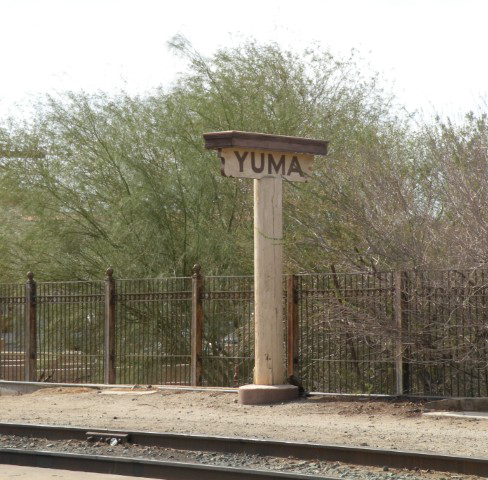
Yuma, AZ (YUM)
Located below the confluence of the Colorado and Gila rivers, Yuma has long been an important crossing point for explorers and travelers.
- Facility Ownership: N/A
- Parking Lot Ownership: N/A
- Platform Ownership: Union Pacific Railroad
- Track Ownership: Union Pacific Railroad
Alex Khalfin
Regional Contact
governmentaffairsoak@amtrak.com
For information about Amtrak fares and schedules, please visit Amtrak.com or call 1-800-USA-RAIL (1-800-872-7245).
The Amtrak stop in downtown Yuma consists of a platform waiting area adjacent to the site of the old Southern Pacific Railway passenger station. When Amtrak took over passenger service in 1971, the original station became home to the Yuma Fine Arts Museum. Designed in 1926 by architects Ceril H. Wakefield and A.L. Arguello, the building was conceived in the then popular Spanish Revival style, with a hipped red tile roof and expansive wrap around porches that overlooked the tracks. In 1976, it was added to the National Register of Historic Places. Unfortunately, a devastating 1995 fire gutted the structure, and the remains had to be razed.
In 2021, the city won $10.6 million through the U.S. Department of Transportation’s Rebuilding American Infrastructure with Sustainability and Equity (RAISE) discretionary grants program. The funding will be put toward the proposed Yuma Multi-Modal Transportation Center, which will convert the historic 1926 Hotel del Sol – located across the street from the current Amtrak platform – into a regional transportation hub served by Amtrak, intercity buses and local transit.
Yuma lies at a strategic point in the Sonoran Desert on the Colorado River, the border between Arizona and California. Here below its confluence with the Gila River, the mighty Colorado broadens and slows, providing a prime spot at which to cross it. In 1540, Spanish explorer Hernando de Alarcon visited the area on his search for the legendary Seven Cities of Gold, and encountered the native Yuma Indians. In 1850, Ft. Yuma was established on the California bank of the Colorado River, and present day Yuma developed on the opposite bank, then part of Mexico. The town became a bustling crossing point for settlers heading for California by land.
In 1854, through the Gadsden Purchase, southern Arizona became part of the United States. The town grew into a busy port, as supply ships from California would sail around Baja to the mouth of the Colorado River where it meets the Sea of Cortez. From there steamboats would transfer supplies upstream to Yuma, which was by that time site of the U.S. Army Quartermaster Supply Depot, which stocked military depots throughout the southwestern United States. With the arrival of the Southern Pacific Railroad in 1877 and its first of many bridges across the river, the steamboat era came to an end. The Arizona Territorial Prison was established at Yuma in 1876, and its adobe and rock buildings can be visited today as a museum. In later years, the town became an agricultural hub, as the Colorado River was dammed, providing irrigation for various crops.
Today Yuma is best known for its proximity to numerous wildlife refuge and wilderness areas, as well as the fact that the Guinness Book of World Records declared it the sunniest place on earth—the sun shines about 90 percent of the year. The clear skies also attracted the U.S. armed forces; Marine Corps Air Station Yuma is famous for its annual air show.
Platform only (no shelter)
Features
- ATM not available
- No elevator
- Payphones
- No Quik-Trak kiosks
- No Restrooms
- Unaccompanied child travel not allowed
- No vending machines
- No WiFi
- Arrive at least 30 minutes prior to departure
Baggage
- Amtrak Express shipping not available
- No checked baggage service
- No checked baggage storage
- Bike boxes not available
- No baggage carts
- Ski bags not available
- No bag storage
- Shipping boxes not available
- No baggage assistance
Parking
- Same-day parking is available for free
- Overnight parking is available for free
Accessibility
- Payphones
- Accessible platform
- No accessible restrooms
- No accessible ticket office
- No accessible waiting room
- No accessible water fountain
- Same-day, accessible parking is available for free
- Overnight, accessible parking is available for free
- No high platform
- No wheelchair
- Wheelchair lift available
Hours
 Amtrak established the Great American Stations Project in 2006 to educate communities on the benefits of redeveloping train stations, offer tools to community leaders to preserve their stations, and provide the appropriate Amtrak resources.
 Amtrak is seizing a once-in-a-lifetime opportunity to transform rail and Retrain Travel. By modernizing, enhancing and expanding trains, stations and infrastructure, Amtrak is meeting the rising demand for train travel. Amtrak offers unforgettable experiences to more than 500 destinations across 46 states and parts of Canada. Learn more at