

Whitehall, NY (WHL)
The first permanent European settlement on Lake Champlain, the township, originally known as Skenesborough for land owner Philip Skene, was granted a charter in March 1765.
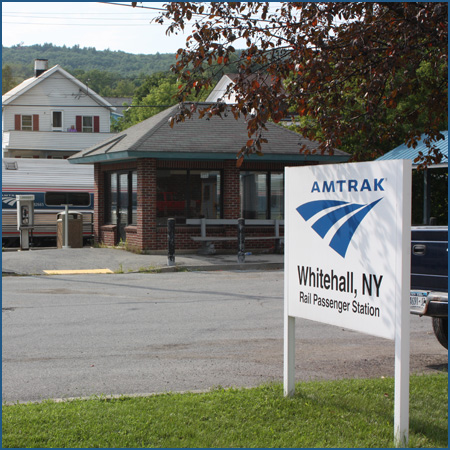
- Facility Ownership: Amtrak
- Parking Lot Ownership: D&H Railway Company, Inc.
- Platform Ownership: Canadian Pacific Railway Co.
- Track Ownership: Canadian Pacific Railway Co.
Margaret Clark
Regional Contact
governmentaffairsnyc@amtrak.com
For information about Amtrak fares and schedules, please visit Amtrak.com or call 1-800-USA-RAIL (1-800-872-7245).
The Amtrak station in Whitehall is a platform with a brick shelter. Amtrak built this structure in approximately 1989 on land leased from the Delaware and Hudson (D&H, succeeded by Canadian Pacific) Railway. The site also includes a paved parking area, walkways and ramps.
The first permanent European settlement on Lake Champlain, sits at the very southern end of the lake, close to the border of Vermont and just to the east of New York’s Adirondack Mountain Preserve. In 1759, British Army Captain Philip Skene received a grant of 25,000 acres from King George III, where he settled. The township of Skenesborough was granted a charter on March 13, 1765 on the stipulation that it have a democratic government and that Wood Creek, which flowed north into Lake Champlain, remain a public waterway.
This region, while fertile, was difficult to navigate, being broken up considerably by streams, small lakes and steep mountains, and therefore navigation by waterway was quite important. In order to attract settlers, Skene offered three years free rent. He had already constructed a sawmill, to which a gristmill was added in 1765. Skene had a vision of forming a Crown Colony from a portion of the Adirondack Mountain area and much of present day Vermont, and so went to London in 1775 to petition the Crown. However, while he was away, American forces under Samuel Herrick captured Skenesborough in the first aggressive Revolutionary War action in New York State, and confiscated Skenes’ trading schooner, Katherine, to be rechristened Liberty and later used by Continental naval forces on the lake.
In 1776, Congress ordered General Philip Schuyler to construct a fleet of ships capable of countering an expected British invasion. The Americans took advantage of the region’s lumber and sawmills and set up shipyards at Skenesborough for quickly constructing 13 ships which, with the four already patrolling the lake, were to counter the expected invasion. The fledgling navy, under Benedict Arnold, would oppose a British force twice its size at the Battle of Lake Champlain in late 1776. This conflict slowed the British southward march, and was of strategic importance in the later victory over the British forces at Saratoga.
In March 1786, after Skene had returned to England, the name Skenesborough was changed to Whitehall Landing, probably to honor its principal citizens, Nathaniel White and Daniel Hall. In 1820, the word “Landing” was dropped, and the village was then known as Whitehall.
The first U.S.S. Ticonderoga, built in nearby Vermont, was commissioned to fight on Lake Champlain. Taken out of service in 1825, she was sold a year later. Only in recent decades have the remains of that hull come to light, and it is now on display in Whitehall on the waterfront. Recognizing this village’s naval history, Whitehall was designated the birthplace of the American Navy in 1960.
In the early 19th century, shipbuilding continued to be the major industry in Whitehall, and it supported four boatyards, between trade on Lake Champlain and the Champlain Canal. This canal along Woods Creek was authorized in 1817 and opened in 1819, creating a permanent throughway between Lake Champlain at Whitehall and the Hudson River at Fort Edward. The canal facilitated considerable trade between New York City and Canada. Still operational today, with lock 12 directly on the village waterfront, the canal provides boaters a route up to Canada and the St. Lawrence Seaway, which can be reached via the Chambly Canal above Champlain.
The Saratoga and Rensselaer Railroad extended to Whitehall in 1848, and the Rutland and Washington connected Whitehall to Vermont thereafter, branching to the east just below the village. For a time, the preferred route up into the Adirondacks was transferring between rail and steamship on the lakes. As the lake steamers stopped regular service, the New York and Canada Railroad came to extend from Whitehall up into the Adirondack Mountains.
A freight house was built in Whitehall in 1850, and it stood where the later station was built. In 1892, it was moved back to the east side, remodeled, and used as a storehouse. In 1870, the entire line of the Saratoga and Rensselaer (S&R) was leased to the Delaware and Hudson Canal Company, and the railroad was Whitehall’s largest industry for decades. The S&R passenger station, also built in 1850, was built directly opposite the freight house; it was torn down in 1890. The S&R station was replaced by a D&H station built in 1892-1893 on the old freight house site. The D&H station still stands, south of the current station, and is in use as a business.
A railway realignment in 1932 split North and South Canal Streets (now Main and Broadway), and businesses along that road suffered. Then, in the 1960s, the D&H began removing buildings and services from Whitehall. Silk mills, which had been running in Whitehall since 1874, declined when synthetic fibers came into common use. These turns of events and the building of a major highway past the village shifted Whitehall’s economic base in the 20th century, as shipping moved to the highways in the 1970s. Today, its marinas and the interest in historical tourism have largely replaced the railroad and mills in this region as economic forces.
Perhaps from being so close to the Adirondack wilderness, there have been numerous alleged sightings of Sasquatch, or Bigfoot, in the Whitehall area. With a nod toward publicity, the Town Council has passed ordinances making it illegal to hunt the (mythical) creature within the town borders. In 2008, an episode of the History Channel series MonsterQuest was devoted to this “Bigfoot in New York.” Whitehall has celebrated a Sasquatch Festival annually since 2004.
Service on the Adirondack is financed primarily through funds made available by the New York State Department of Transportation.
Platform only (no shelter)
Features
- ATM not available
- No elevator
- No payphones
- No Quik-Trak kiosks
- No Restrooms
- Unaccompanied child travel not allowed
- No vending machines
- No WiFi
- Arrive at least 30 minutes prior to departure
Baggage
- Amtrak Express shipping not available
- No checked baggage service
- No checked baggage storage
- Bike boxes not available
- No baggage carts
- Ski bags not available
- No bag storage
- Shipping boxes not available
- No baggage assistance
Parking
- Same-day parking is available; fees may apply
- Overnight parking is available; fees may apply
Accessibility
- No payphones
- Accessible platform
- No accessible restrooms
- No accessible ticket office
- No accessible waiting room
- No accessible water fountain
- Same-day, accessible parking is available; fees may apply
- Overnight, accessible parking is available; fees may apply
- No high platform
- No wheelchair
- Wheelchair lift available
Hours
 Amtrak established the Great American Stations Project in 2006 to educate communities on the benefits of redeveloping train stations, offer tools to community leaders to preserve their stations, and provide the appropriate Amtrak resources.
 Amtrak is seizing a once-in-a-lifetime opportunity to transform rail and Retrain Travel. By modernizing, enhancing and expanding trains, stations and infrastructure, Amtrak is meeting the rising demand for train travel. Amtrak offers unforgettable experiences to more than 500 destinations across 46 states and parts of Canada. Learn more at