

Vancouver, BC Canada - Pacific Central Station (VAC)
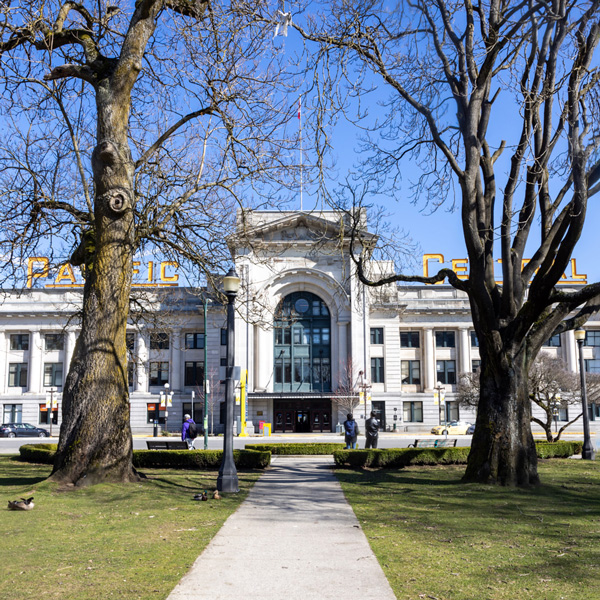
Pacific Central Station
1150 Station Street
Vancouver, BC V6A 4C7
- Facility Ownership: VIA Rail Canada
- Parking Lot Ownership: N/A
- Platform Ownership: VIA Rail Canada
- Track Ownership: Canadian National Railway Company, VIA Rail Canada
Alex Khalfin
Regional Contact
governmentaffairssea@amtrak.com
For information about Amtrak fares and schedules, please visit Amtrak.com or call 1-800-USA-RAIL (1-800-872-7245).
The neoclassical revival Pacific Central Station was completed in 1919 for the Canadian Northern Railway, and designed by Pratt and Ross. The station serves as the terminus for both the Amtrak Cascades and VIA Rail’s The Canadian. In 1993, the station was converted to a multi-modal transportation facility that includes intercity buses; it stands across Thornton Park from the Skytrain monorail stations. A bus concourse has been added in the rear of the building.
In June 2026, Pacific Central Station became the first rail station in North America to offer U.S. preclearance, representing a new chapter for rail travel. The ability to complete U.S. preclearance before boarding creates a more streamlined experience for customers traveling into the United States by eliminating an en route border screening. Delivered in partnership with the Washington State Department of Transportation (WSDOT), VIA Rail and numerous agencies in both countries that include U.S. Customs and Border Protection, the Canada Border Services Agency, Transport Canada, and Public Safety Canada, the preclearance process consolidates inspection, security and customs procedures into a single step prior to departure.
Vancouver is sited at the confluence of the Fraser and Pitt rivers, near the mouth of the Fraser River, and on the waterways of the Straits of Georgia, Howe Sound and Burrard Inlet. When George Vancouver and his officer, Peter Puget, arrived on this peninsula in 1792, they found a sophisticated indigenous culture, as the area had been a meeting and trafficking spot for thousands of years prior. Because of the power of the Squamish chiefs over the area, European-American settlements did not really start until after the 1858 Fraser Gold rush, at McCleery’s Farm in 1862.
As in much of the Pacific Northwest, lumbering was one of the first industries. The first sawmill opened in 1863 at Moodyville, and the first exports in 1865. The largest trees in the world grew up around the south shores of False Creek and English Bay, and provided, among other things, masts for the world’s sailing fleets and the increasingly large vessels of the British Royal Navy. One famous sale of cut trees from Vancouver was a special order for the Celestial Emperor of China, consisting of a dozen immense beams for construction of the Gate of Heavenly Peace in the Forbidden City.
Vancouver grew up around its waterfront, and in 1867 a former river boat pilot, Jack Deighton, set up a small saloon just off mill property, on the waterfront at Burrard Inlet, on today’s Alexander Street. Being a loquacious and friendly person, he got the nickname of “Gassy Jack,” and the settlement that grew up around his saloon became Gastown (as the neighborhood is still known). Because of the natural harbor, the Canadian Pacific Railway (CPR) decided to make this its western terminus. While the town had been officially named Granville, the CPR president, William Van Horne, decided that Granville wouldn’t do. Since people back East knew where Vancouver Island was, but not Granville (not to mention its association with Gastown), he influenced the renaming when the city incorporated on April 6, 1886. Three months later, most of the city burned in a spectacular blaze that destroyed most of the buildings along the swampy shore of Burrard Inlet in 25 minutes. Service to Vancouver was delayed, but the city was able to rebuild along more modern lines, and the CPR arrived in May 1887.
The first CPR station was near the present (second) Waterfront Station, which is now a commuter rail station connecting to buses and the automated heavy rail system, Sky Train. The Waterfront Station was built in 1910 and was used as a passenger terminal until around 1979, when trains were re-routed to the Union Station near False Creek, now known as the Pacific Central Station. The Waterfront Station began its life as an intermodal facility in 1977, and in late 1985, the Sky Train was added in time for the last World’s Fair in North America, Expo 1986.
Vancouver has been a destination during the depressions of the 1890s and later, as well as a gateway to the world, as it is the busiest seaport in Canada and exports more cargo than any other in North America. The economy has traditionally relied on British Columbia’s resources: forestry, mining, fishing and agriculture. However, it has diversified over time and today has become “Hollywood North,” the third largest film-producing center in North America after Los Angeles and New York City.
In 1968, the Canada Council awarded a $3,500 grant to “revive the ancient and time-honored tradition of town fool.” He thereafter made a habit of attending all city council meetings in full traditional jester’s outfit, adding wit and rhyme to the normally pedestrian meetings.
The Amtrak Cascades are primarily financed through funds made available by the WSDOT and the Oregon Department of Transportation.
Station Building (with waiting room)
Features
- ATM available
- No elevator
- Payphones
- No Quik-Trak kiosks
- Restrooms
- Ticket sales office
- Unaccompanied child travel not allowed
- No vending machines
- No WiFi
- Arrive at least 60 minutes prior to departure
Baggage
- Amtrak Express shipping not available
- Checked baggage service available
- Checked baggage storage available
- Bike boxes for sale
- Baggage carts available
- Ski bags not available
- Bag storage
- Shipping boxes not available
- Baggage assistance provided by Station staff
Parking
- Same-day parking is available; fees may apply
- Overnight parking is not available
Accessibility
- Payphones
- Accessible platform
- Accessible restrooms
- Accessible ticket office
- Accessible waiting room
- Accessible water fountain
- Same-day, accessible parking is available; fees may apply
- Overnight, accessible parking is not available
- No high platform
- Wheelchair available
- Wheelchair lift available
Hours
Station Waiting Room Hours
| Mon | 12:00 am - 01:00 am 05:00 am - 11:59 pm |
| Tue | 12:00 am - 01:00 am 05:00 am - 11:59 pm |
| Wed | 12:00 am - 01:00 am 05:00 am - 11:59 pm |
| Thu | 12:00 am - 01:00 am 05:00 am - 11:59 pm |
| Fri | 12:00 am - 01:00 am 05:00 am - 11:59 pm |
| Sat | 12:00 am - 01:00 am 05:00 am - 11:59 pm |
| Sun | 12:00 am - 01:00 am 05:00 am - 11:59 pm |
Ticket Office Hours
| Mon | 06:15 am - 05:15 pm |
| Tue | 06:15 am - 05:15 pm |
| Wed | 06:15 am - 05:15 pm |
| Thu | 06:15 am - 05:15 pm |
| Fri | 06:15 am - 05:15 pm |
| Sat | 06:15 am - 05:15 pm |
| Sun | 06:15 am - 05:15 pm |
Passenger Assistance Hours
| Mon | 06:15 am - 05:15 pm |
| Tue | 06:15 am - 05:15 pm |
| Wed | 06:15 am - 05:15 pm |
| Thu | 06:15 am - 05:15 pm |
| Fri | 06:15 am - 05:15 pm |
| Sat | 06:15 am - 05:15 pm |
| Sun | 06:15 am - 05:15 pm |
Checked Baggage Service
| Mon | 06:15 am - 05:15 pm |
| Tue | 06:15 am - 05:15 pm |
| Wed | 06:15 am - 05:15 pm |
| Thu | 06:15 am - 05:15 pm |
| Fri | 06:15 am - 05:15 pm |
| Sat | 06:15 am - 05:15 pm |
| Sun | 06:15 am - 05:15 pm |
 Amtrak established the Great American Stations Project in 2006 to educate communities on the benefits of redeveloping train stations, offer tools to community leaders to preserve their stations, and provide the appropriate Amtrak resources.
 Amtrak is seizing a once-in-a-lifetime opportunity to transform rail and Retrain Travel. By modernizing, enhancing and expanding trains, stations and infrastructure, Amtrak is meeting the rising demand for train travel. Amtrak offers unforgettable experiences to more than 500 destinations across 46 states and parts of Canada. Learn more at