

Texarkana, AR (TXA)
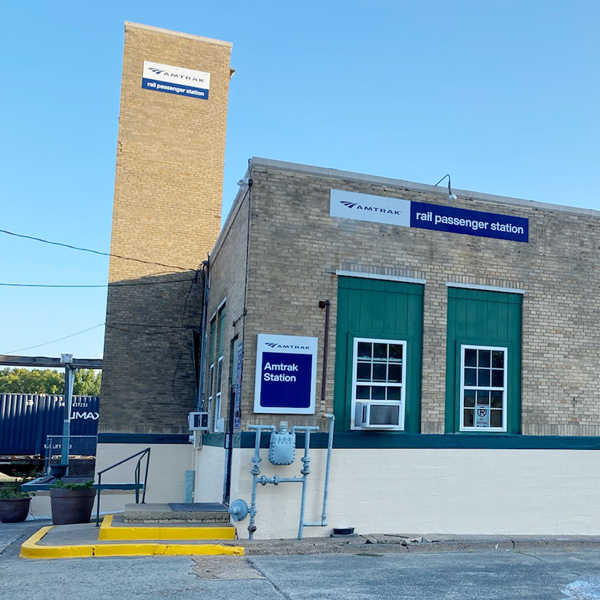
Passengers use the east end of Union Station, a historic structure built in 1930. When stopped at the station, the Texas Eagle straddles the state line between Arkansas and Texas.
100 East Front Street
Texarkana, AR 71854-5907
- Facility Ownership: Jeff Sandefur
- Parking Lot Ownership: Jeff Sandefur
- Platform Ownership: Union Pacific Railroad
- Track Ownership: Union Pacific Railroad
Todd Stennis
Regional Contact
governmentaffairsnol@amtrak.com
For information about Amtrak fares and schedules, please visit Amtrak.com or call 1-800-USA-RAIL (1-800-872-7245).
The Amtrak Texarkana stop is located at the east end of Texarkana Union Station, an historic buff brick structure built in 1930. When stopped at the station, the Texas Eagle straddles the state line between Arkansas and Texas.
In spring 2023, community members taking part in a program sponsored by the non-profit Leadership Texarkana completed a station beautification project. The self-styled “Amtrak Station Exterior Beautification Team” planned and executed a vision over a year-and-a-half that included power washing the station area, restriping the parking spaces, hanging festive string lighting, installing a welcome mural visible from the platform and train, planting new landscaping and painting the part of the building used by Amtrak customers.
These improvements were made possible through $20,000 of in-kind services and financial donations from local businesses, the two municipal governments and citizens. Amtrak Government Affairs staff, who work with communities across the country interested in improving their stations, advised the project team as planning got underway.
The station renewal fits into a broader downtown revitalization initiative that seeks to fill empty buildings and storefronts with new residential, commercial and cultural activity while strengthening connections among existing anchors including the train station, farmers’ market, historic Perot Theatre and the Regional Arts Center.
The intense focus on station improvements has also fostered ongoing discussions between the two Texarkanas about working together to pursue a joint development of the largely vacant Union Station. This would involve purchasing the building from its private owner.
In line with that effort, Amtrak plans to construct a modern new facility to serve Texarkana. Its passenger platform would end close to the historic depot, allowing for easy access between the Amtrak station and the redeveloped Union Station. This Amtrak investment in the community would be another element helping to spur private sector revitalization efforts in downtown Texarkana.
A predecessor Union Station was built in 1888 by the Missouri Pacific Railroad (MoPac) and Texas & Pacific Railway. The Cotton Belt Railroad became a tenant there in 1908, and spent considerable amounts on refurbishing the facility. In 1913, the Cotton Belt became a part-owner in the building. As pressure began to build for the creation of a new station, the Cotton Belt, MoPac, Texas & Pacific and Kansas City Southern created the Texarkana Union Station Trust to construct and operate a modern union passenger terminal.
The design and construction was funded by the sale of securities of the joint terminal at a cost of $1,667,000. On May 12, 1930, the Texarkana Chamber of Commerce sponsored a cornerstone laying celebration. A chamber spokesperson stated that the completion of Union Station was “one of the most momentous events in the history of the city.”
The imposing 44,000-square foot station features Renaissance revival architecture. Three large, arched windows flanked by decorative columns highlight its north façade. The building was added to the National Register of Historic Places in 1978.
Amtrak did not begin serving Texarkana until 1974 when the Inter-American (St. Louis-Laredo) was introduced. It was decided at that time the main waiting room and ticket counter would not be used because of the lack of access into the building for individuals with disabilities, and it was too large for Amtrak’s purpose. Therefore, the baggage end of the building was retrofitted to include a ticket counter and waiting room for Amtrak patrons.
Today, Union Station’s former main waiting room remains dormant as it has been since the last MoPac passenger train left in 1971. The building was purchased in 2003 by Jeff Sandefur and is one of the few privately owned active train stations in the country. The west portion of the station has been adaptively reused as a correctional institution.
The first settlers in the Texarkana area were the sedentary Caddo Indians, yet the city did not gain its name until European-Americans arrived. Texarkana is a portmanteau of the words “Texas,” “Arkansas” and “Louisiana.” When the land was first surveyed, it seemed that Texarkana would be on the border of all three states. Some credit surveyor Colonel Gus Knobel of the Iron Mountain Railroad (a predecessor to MoPac) with giving Texarkana its name. In 1876, Texarkana was granted a charter by the Texas Legislature.
The city’s slogan, “Twice as Nice,” is fitting for a place with two mayors and two sets of city officials, yet the two sides share a courthouse, federal building, jail, post office, chamber of commerce and several other offices. The state line bisects the Amtrak platform. At the stop, if you are on the west end of the train, you’re in Texas. If you’re on the east side, you’re in Arkansas.
Local lore suggests that Boggy Creek, a swampy area southeast of Texarkana, is home to an anthropoid swamp monster, similar to Bigfoot or Sasquatch. A film dramatizing the stories, The Legend of Boggy Creek, was released in 1972. Two sequels have also been produced. Ragtime composer and pianist Scott Joplin resided in this city and former presidential hopefuls Mike Huckabee and Ross Perot were born in Texarkana.
Image courtesy of Vashil Fernandez, City of Texarkana, Texas.
Station Building (with waiting room)
Features
- ATM not available
- No elevator
- No payphones
- No Quik-Trak kiosks
- Restrooms
- Unaccompanied child travel not allowed
- No vending machines
- No WiFi
- Arrive at least 30 minutes prior to departure
Baggage
- Amtrak Express shipping not available
- No checked baggage service
- No checked baggage storage
- Bike boxes not available
- No baggage carts
- Ski bags not available
- No bag storage
- Shipping boxes not available
- No baggage assistance
Parking
Accessibility
- No payphones
- Accessible platform
- No accessible restrooms
- No accessible ticket office
- No accessible waiting room
- No accessible water fountain
- No high platform
- Wheelchair available
- No wheelchair lift
Hours
Station Waiting Room Hours
| Mon | CLOSED |
| Tue | CLOSED |
| Wed | CLOSED |
| Thu | CLOSED |
| Fri | CLOSED |
| Sat | CLOSED |
| Sun | CLOSED |
Ticket Office Hours
Passenger Assistance Hours
| Mon | CLOSED |
| Tue | CLOSED |
| Wed | CLOSED |
| Thu | CLOSED |
| Fri | CLOSED |
| Sat | CLOSED |
| Sun | CLOSED |
Checked Baggage Service
| Mon | CLOSED |
| Tue | CLOSED |
| Wed | CLOSED |
| Thu | CLOSED |
| Fri | CLOSED |
| Sat | CLOSED |
| Sun | CLOSED |
Parking Hours
| Mon | CLOSED |
| Tue | CLOSED |
| Wed | CLOSED |
| Thu | CLOSED |
| Fri | CLOSED |
| Sat | CLOSED |
| Sun | CLOSED |
Quik-Track Kiosk Hours
Lounge Hours
Amtrak Express Hours
| Mon | CLOSED |
| Tue | CLOSED |
| Wed | CLOSED |
| Thu | CLOSED |
| Fri | CLOSED |
| Sat | CLOSED |
| Sun | CLOSED |
 Amtrak established the Great American Stations Project in 2006 to educate communities on the benefits of redeveloping train stations, offer tools to community leaders to preserve their stations, and provide the appropriate Amtrak resources.
 Amtrak is seizing a once-in-a-lifetime opportunity to transform rail and Retrain Travel. By modernizing, enhancing and expanding trains, stations and infrastructure, Amtrak is meeting the rising demand for train travel. Amtrak offers unforgettable experiences to more than 500 destinations across 46 states and parts of Canada. Learn more at