

Topeka, KS (TOP)
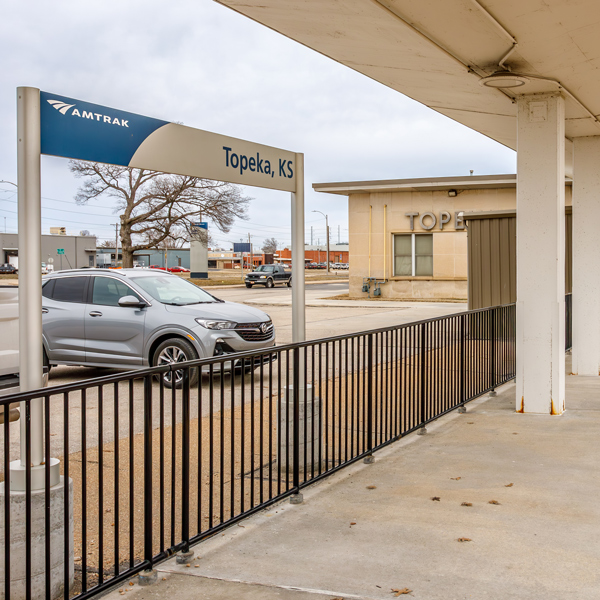
Topeka has long been a convergence point for transportation modes. The depot, a fine example of sleek mid-century modern style, opened in 1950 and was built by the Santa Fe Railway.
- Facility Ownership: BNSF Railway
- Parking Lot Ownership: BNSF Railway
- Platform Ownership: BNSF Railway
- Track Ownership: BNSF Railway
Marty Sandoval
Regional Contact
governmentaffairschi@amtrak.com
For information about Amtrak fares and schedules, please visit Amtrak.com or call 1-800-USA-RAIL (1-800-872-7245).
The railroad has been integral to the history of Topeka, as this city was the origin of the Atchison, Topeka & Santa Fe Railway (ATSF) that followed the famous Santa Fe Trail across the American West.
The present depot opened in 1950, during a time when the ATSF was attempting to modernize its infrastructure and image. Designed in the sleek mid-century modern style, marked by clean lines and minimal ornamentation, the Topeka depot is similar to others that the railroad erected in Lawrence and Hutchinson, Kan. and La Junta, Colo.
Unlike those examples, which are constructed of brick, the Topeka depot is clad in an off-white stone cut into squares. This geometric motif carries over into the windows too, which are composed of large square panes of glass. Typical features of the mid-century modern aesthetic found in the building include a flat roof, panoramic corner windows, glass block, streamlined metal lettering, terrazzo flooring and the prominent use of neon.
In June 2006, the depot was reopened amid much fanfare after current owner BNSF Railway undertook a remodeling that included new ceiling tile, painting and a new water fountain.
Topeka has long been a convergence point for transportation. A ferry established in this area in 1842 to cross the Kansas River on the Oregon Trail. In the 1850s, trade increased along a military road from Fort Leavenworth to Fort Riley through this area.
The city was founded by a group of Free State settlers in 1854 from Lawrence and New England, and chartered as a city in 1857. The city was prominent in the political conflict between pro-slavery groups and the anti-slavery Free Soil Party. Among the city’s founders was Cyrus K. Holliday, who would become mayor of Topeka and founder of the Atchison, Topeka and Santa Fe Railroad. In 1859, Holliday went on to establish the headquarters in the city for the construction of the Atchison Topeka & Santa Fe Railroad. By the 1860s, Topeka became a commercial and transportation hub because of the prolific trade upon the river as well as the railroad.
When Kansas was admitted to the Union in 1861, Topeka had already become the state capital. It is also the seat of Shawnee County. The name “Topeka” comes from a Kansas tribal name meaning, “a good place to grow (prairie) potatoes.” Today, Topeka is an important shipping point for cattle and wheat, and is a marketing and processing center for farm products, as well as being a manufacturing center and headquarters for many well-known retail brands. The Menninger family established their world-famous clinic there, which operated in the city from 1919 to 2003; thus, Topeka has been an important location for psychiatric research and therapy.
In 1869, after the close of the Civil War, the ATSF started moving west from Topeka. General offices and machine shops were established in Topeka in 1878, and a passenger depot was operating there by 1880. The Topeka Harvey House, the second such, opened in 1878 as part of the Santa Fe depot and remained open until 1940. In the days before dining cars became common, passengers had to detrain in order to eat a meal at a trackside restaurant. The food was generally of poor quality until Fred Harvey revolutionized the offerings starting in the 1870s.
By the turn of the twentieth century, the ATSF and Fred Harvey began to build a series of grand trackside hotels and restaurants meant to attract tourists and help generate money for both companies. The buildings often adhered to fanciful designs that looked to the region’s American Indian and Spanish past. Drawing on these traditions, the railroad and Fred Harvey created resorts replete with a bit of exoticism that attracted tourists from across the United States and even from abroad.
Station Building (with waiting room)
Features
- ATM not available
- No elevator
- No payphones
- No Quik-Trak kiosks
- Restrooms
- Ticket sales office
- Unaccompanied child travel not allowed
- No vending machines
- No WiFi
- Arrive at least 45 minutes prior to departure if you're checking baggage or need ticketing/passenger assistance
- Arrive at least 15 minutes prior to departure if you're not checking baggage or don't need assistance
Baggage
- Amtrak Express shipping not available
- Checked baggage service available
- Checked baggage storage available
- Bike boxes for sale
- No baggage carts
- Ski bags not available
- No bag storage
- Shipping Boxes for sale
- Baggage assistance provided by
Parking
- Same-day parking is available; fees may apply
- Overnight parking is available; fees may apply
Accessibility
- No payphones
- Accessible platform
- Accessible restrooms
- No accessible ticket office
- Accessible waiting room
- Accessible water fountain
- Same-day, accessible parking is available; fees may apply
- Overnight, accessible parking is available; fees may apply
- No high platform
- Wheelchair available
- Wheelchair lift available
Hours
Station Waiting Room Hours
| Mon | 12:00 am - 07:00 am 11:00 pm - 11:59 pm |
| Tue | 12:00 am - 07:00 am 11:00 pm - 11:59 pm |
| Wed | 12:00 am - 07:00 am 11:00 pm - 11:59 pm |
| Thu | 12:00 am - 07:00 am 11:00 pm - 11:59 pm |
| Fri | 12:00 am - 07:00 am 11:00 pm - 11:59 pm |
| Sat | 12:00 am - 07:00 am 11:00 pm - 11:59 pm |
| Sun | 12:00 am - 07:00 am 11:00 pm - 11:59 pm |
Ticket Office Hours
| Mon | 12:00 am - 07:00 am 11:00 pm - 11:59 pm |
| Tue | 12:00 am - 07:00 am 11:00 pm - 11:59 pm |
| Wed | 12:00 am - 07:00 am 11:00 pm - 11:59 pm |
| Thu | 12:00 am - 07:00 am 11:00 pm - 11:59 pm |
| Fri | 12:00 am - 07:00 am 11:00 pm - 11:59 pm |
| Sat | 12:00 am - 07:00 am 11:00 pm - 11:59 pm |
| Sun | 12:00 am - 07:00 am 11:00 pm - 11:59 pm |
Passenger Assistance Hours
| Mon | 12:00 am - 07:00 am 11:00 pm - 11:59 pm |
| Tue | 12:00 am - 07:00 am 11:00 pm - 11:59 pm |
| Wed | 12:00 am - 07:00 am 11:00 pm - 11:59 pm |
| Thu | 12:00 am - 07:00 am 11:00 pm - 11:59 pm |
| Fri | 12:00 am - 07:00 am 11:00 pm - 11:59 pm |
| Sat | 12:00 am - 07:00 am 11:00 pm - 11:59 pm |
| Sun | 12:00 am - 07:00 am 11:00 pm - 11:59 pm |
Checked Baggage Service
| Mon | 12:00 am - 07:00 am 11:00 pm - 11:59 pm |
| Tue | 12:00 am - 07:00 am 11:00 pm - 11:59 pm |
| Wed | 12:00 am - 07:00 am 11:00 pm - 11:59 pm |
| Thu | 12:00 am - 07:00 am 11:00 pm - 11:59 pm |
| Fri | 12:00 am - 07:00 am 11:00 pm - 11:59 pm |
| Sat | 12:00 am - 07:00 am 11:00 pm - 11:59 pm |
| Sun | 12:00 am - 07:00 am 11:00 pm - 11:59 pm |
 Amtrak established the Great American Stations Project in 2006 to educate communities on the benefits of redeveloping train stations, offer tools to community leaders to preserve their stations, and provide the appropriate Amtrak resources.
 Amtrak is seizing a once-in-a-lifetime opportunity to transform rail and Retrain Travel. By modernizing, enhancing and expanding trains, stations and infrastructure, Amtrak is meeting the rising demand for train travel. Amtrak offers unforgettable experiences to more than 500 destinations across 46 states and parts of Canada. Learn more at