

Salem, OR - Amtrak Station (SLM)
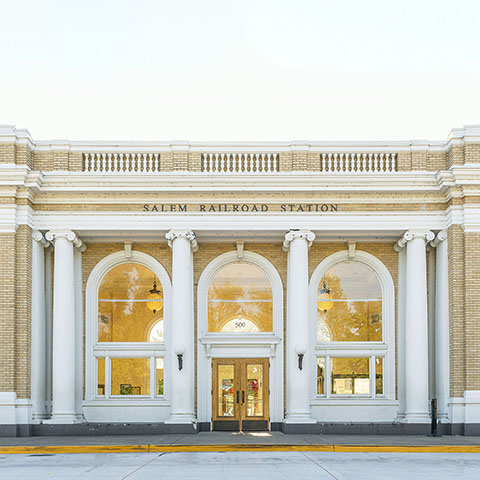
The 1918 Neoclassical station creates a grand entryway to the "Cherry City." Restored in 1999, the building features tall columns, decorative plasterwork and terrazzo and marble floors.
Amtrak Station
500 13th Street SE
Salem, OR 97301
- Facility Ownership: State of Oregon
- Parking Lot Ownership: State of Oregon
- Platform Ownership: Union Pacific Railroad
- Track Ownership: Union Pacific Railroad
Alex Khalfin
Regional Contact
governmentaffairssea@amtrak.com
For information about Amtrak fares and schedules, please visit Amtrak.com or call 1-800-USA-RAIL (1-800-872-7245).
Salem’s station was built for the Southern Pacific Railroad and opened in 1918 as a replacement for a wood frame Queen Anne-style depot built in 1888. Southern Pacific architect J.H. Christie designed the station, and Stebbinger Brothers of Portland built it for $25,000. The Neoclassical masonry structure conveys the idea of a “gateway to the city” with its double-height Ionic columns framing large, arched Roman windows. The central pavilion dominates, with its 1,500 square-foot main waiting room. Originally, smaller wings to both sides housed ticketing, baggage and a women’s waiting room. Decorative plasterwork, coved corner entries and terrazzo marble floor patterns add to the elegance of the structure.
Famous visitors to the station included presidents Woodrow Wilson and Warren G. Harding, future presidents Franklin D. Roosevelt and Dwight D. Eisenhower and former President Herbert Hoover. Many of these presidential visits occurred as part of whistle-stop campaigns during which the candidates traveled the country by train.
The 1999 Salem Depot Project—managed by the Oregon Department of Transportation (ODOT)—fully rehabilitated the 1918 depot. Ceilings and architectural features were restored. A black marble ticket counter was added and two 30-inch globe chandeliers were recreated from drawings of the originals. More modern features were also added, including improvement of parking facilities, and lighting and landscaping for both rail system and park-and-ride operations. The $2.6 million renovation project was paid for by federal and state grants.
In preparation for the building’s centennial in 2018, it received new paint inside and out; through paint analysis, ODOT was able to determine the original color scheme. Historic photos were added to the waiting room, and Wi-Fi was installed for customers waiting for a train or Amtrak Connection bus.
Situated along the banks of the Willamette River in the midst of the Willamette Valley, Salem, known as the “Cherry City,” is also the state capital and seat of Marion County. The local Kalapuyan American Indians called the area “Chemeketa,” meaning “meeting or resting place.” When a Methodist mission moved to the plain by the river in 1840, the new establishment was called Chemeketa. There, the Oregon Institute was formed in 1842 and the community was just known as “the Institute.” However, the Institute dissolved within two years, and in 1844 the trustees decided to lay out a town site on Institute lands. It is thought that either trustee David Leslie, from Salem, Mass., or William H. Willson, who filed the plats in 1850-51, suggested that the name be changed to Salem. It derives from a Hebrew word, “shalom,” for peace.
Salem became territorial capital in 1851 after it was moved from Oregon City. Salem incorporated as a city in 1857, and when statehood came in 1859, remained the capital. The Oregon and California Railroad (O&C) reached Salem in 1870, with the first passenger train arriving in town on Sept. 27. The O&C was envisioned as the first line to connect its namesake states: construction began at Portland in 1868 and proceeded south, but due to a lack of funds, the railroad did not reach the California border until late 1887. The company by then had been taken over by the Southern Pacific Railroad.
In addition to government, agriculture was important to Salem’s growth, and was celebrated yearly in a Cherry Festival from 1903 until World War I – and briefly revived in the 1940s. Today, the state government is the city’s largest employer, but it remains a hub for agricultural food processing.
While the maraschino cherry was invented in Europe, it is agreed that Salem is the birthplace of the modern maraschino cherry industry. An Oregon State University professor, Ernest H. Wiegand, perfected the art of preserving the cherry. Today, two of the leading maraschino cherry producers call Oregon home, and one of them, the Oregon Cherry Growers, is in Salem. Together, Oregon Cherry Growers and Gray & Co. are responsible for most of those famous neon-red garnishes used in the United States.
The Amtrak Cascades are primarily financed through funds made available by the Washington State Department of Transportation and the Oregon Department of Transportation.
Image courtesy of the Oregon Department of Transportation.
Station Building (with waiting room)
Features
- ATM not available
- No elevator
- No payphones
- Quik-Trak kiosks
- Restrooms
- Ticket sales office
- Unaccompanied child travel allowed
- Vending machines
- No WiFi
- Arrive at least 45 minutes prior to departure if you're checking baggage or need ticketing/passenger assistance
- Arrive at least 30 minutes prior to departure if you're not checking baggage or don't need assistance
Baggage
- Amtrak Express shipping not available
- Checked baggage service available
- Checked baggage storage available
- Bike boxes for sale
- Baggage carts available
- Ski bags not available
- Bag storage with Fee
- Shipping Boxes for sale
- Baggage assistance provided by Station Staff
Parking
- Same-day parking is available; fees may apply
- Overnight parking is available; fees may apply
Accessibility
- No payphones
- Accessible platform
- Accessible restrooms
- Accessible ticket office
- Accessible waiting room
- Accessible water fountain
- Same-day, accessible parking is available; fees may apply
- Overnight, accessible parking is available; fees may apply
- No high platform
- Wheelchair available
- Wheelchair lift available
Hours
Station Waiting Room Hours
| Mon | 06:00 am - 07:45 pm |
| Tue | 06:00 am - 07:45 pm |
| Wed | 06:00 am - 07:45 pm |
| Thu | 06:00 am - 07:45 pm |
| Fri | 06:00 am - 07:45 pm |
| Sat | 06:00 am - 07:45 pm |
| Sun | 06:00 am - 07:45 pm |
Ticket Office Hours
| Mon | 06:00 am - 07:45 pm |
| Tue | 06:00 am - 07:45 pm |
| Wed | 06:00 am - 07:45 pm |
| Thu | 06:00 am - 07:45 pm |
| Fri | 06:00 am - 07:45 pm |
| Sat | 06:00 am - 07:45 pm |
| Sun | 06:00 am - 07:45 pm |
Passenger Assistance Hours
| Mon | 06:00 am - 07:45 pm |
| Tue | 06:00 am - 07:45 pm |
| Wed | 06:00 am - 07:45 pm |
| Thu | 06:00 am - 07:45 pm |
| Fri | 06:00 am - 07:45 pm |
| Sat | 06:00 am - 07:45 pm |
| Sun | 06:00 am - 07:45 pm |
Checked Baggage Service
| Mon | 06:00 am - 07:30 pm |
| Tue | 06:00 am - 07:30 pm |
| Wed | 06:00 am - 07:30 pm |
| Thu | 06:00 am - 07:30 pm |
| Fri | 06:00 am - 07:30 pm |
| Sat | 06:00 am - 07:30 pm |
| Sun | 06:00 am - 07:30 pm |
Parking Hours
Quik-Track Kiosk Hours
| Mon | 06:00 am - 07:45 pm |
| Tue | 06:00 am - 07:45 pm |
| Wed | 06:00 am - 07:45 pm |
| Thu | 06:00 am - 07:45 pm |
| Fri | 06:00 am - 07:45 pm |
| Sat | 06:00 am - 07:45 pm |
| Sun | 06:00 am - 07:45 pm |
Lounge Hours
Amtrak Express Hours
| Mon | CLOSED |
| Tue | CLOSED |
| Wed | CLOSED |
| Thu | CLOSED |
| Fri | CLOSED |
| Sat | CLOSED |
| Sun | CLOSED |
 Amtrak established the Great American Stations Project in 2006 to educate communities on the benefits of redeveloping train stations, offer tools to community leaders to preserve their stations, and provide the appropriate Amtrak resources.
 Amtrak is seizing a once-in-a-lifetime opportunity to transform rail and Retrain Travel. By modernizing, enhancing and expanding trains, stations and infrastructure, Amtrak is meeting the rising demand for train travel. Amtrak offers unforgettable experiences to more than 500 destinations across 46 states and parts of Canada. Learn more at