

Savannah, GA (SAV)
A fine example of mid-century modern architecture, the station is embellished with brightly-colored murals depicting the history of the city and port of Savannah.
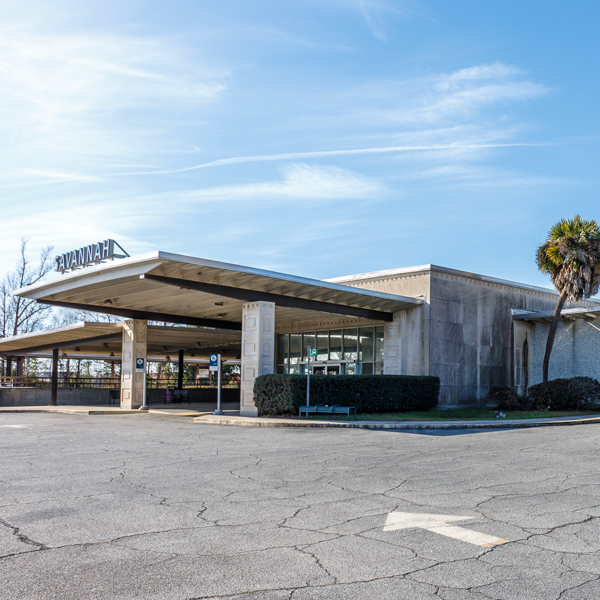
2611 Seaboard Coastline Drive
Savannah, GA 31401-1634
- Facility Ownership: Amtrak
- Parking Lot Ownership: Amtrak
- Platform Ownership: Amtrak
- Track Ownership: Amtrak
Todd Stennis
Regional Contact
governmentaffairsnol@amtrak.com
For information about Amtrak fares and schedules, please visit Amtrak.com or call 1-800-USA-RAIL (1-800-872-7245).
The Savannah station is located to the west of the city and slightly south and west of the Savannah River. Constructed in 1962 by the Savannah District Authority, the city’s redevelopment agency, the building was meant to replace the former downtown Union Station, which was demolished the following year to make way for an interstate highway exchange.
Designed by architect Frank Pierce Milburn, Savannah Union Station was completed in 1902 at a cost of $150,000. It was an example of Spanish Renaissance and Elizabethan styles, the main feature of which was an octagonal rotunda measuring 80 feet in diameter that served as the general waiting room. Exterior walls were made of pressed brick with granite and terracotta trim.
Originally leased to the Atlantic Coast Line and Seaboard Airline railroads, the new $1.5 million Savannah station was an example of mid-century modern architecture, characterized by clean lines and minimal ornamentation. The building has a flat, cantilevered roof, large porte-cochere supported by square columns with inset geometric designs, and panoramic window walls that allow natural light to flood the interior. The richly textured exterior incorporates orange brick, large limestone blocks and ceramic tile; at the entrance, the tiled wall is accented by a playful mosaic of a steam locomotive. Along the tracks, a deep and long porch shelters passengers from inclement weather and the strong summer sun.
Inside, the waiting room has terrazzo flooring, popular with Modernist designers for its variegated patterns, but also intensely practical since it is hard and durable. Across from the wall of windows is the ticket counter, presided over by a stylized clock high on the wall. Gleaming, streamlined metal letters spell out “Tickets” and “Baggage.” Along the perimeter of the room, rows of lights have decorative metal shades with circular cutwork designs.
On the two remaining walls, murals in bright colors by Tattersfield Associates, a Philadelphia-based design firm, depict the history of the city and port of Savannah. The former includes Fort Pulaski, the Forsyth Park fountain and a full portrait of Nathanael Greene, the Revolutionary War commander known for his successful campaigns in defense of the southern colonies. The latter depicts waterfront landmarks such as the Cotton Exchange and Factor’s Walk where many of the cotton brokers had offices.
The city of Savannah is the largest city and county seat for Chatham County, Georgia. On February 12, 1733, General James Oglethorpe and his settlers landed on Yamacraw Bluff, and were greeted by Tomochichi, the Yamacraw chief and John and Mary Musgrove, Indian traders. While the founding of the city dates from this event, European incursion into the coastal Georgia area dates from the late sixteenth century, when the Spanish explored the southeastern American coast. In 1751, Georgia became a Royal Colony, and Savannah its capital. Between 1764 and 1773, a flourishing export trade in deer hides from upriver established the city as a significant commercial port on the South Atlantic coast.
During the American Revolutionary War, Savannah came under British and Loyalist control; American and French troops were unsuccessful in attempts to take the city. During the American Civil War, Savannah is remembered as the destination of General Sherman’s devastating Union Army March to the Sea from Atlanta, with more than 62,000 men, where he arrived on December 22, 1864. Sherman sent a famous Christmas telegram to President Abraham Lincoln, in which he presented the city of Savannah with 25,000 bales of cotton.
By 1870, three principal railroads connected the city to markets along the coast and the interior. Cotton brokerage as well as rail transportation to Savannah’s port made the city quite wealthy in the nineteenth century. Heavy industry and manufacturing replaced cotton transport and trade in the late nineteenth and early twentieth centuries, and the city’s economy shifted as more heavy industry was added upriver.
In the 1930s and 1940s, many of the distinguished buildings in the historic district were demolished to create parking lots, and many of the city’s squares bisected to allow automobile traffic. The demolition of the 1870 City Market and the attempted demolition of the 1821 Davenport House prompted seven Georgia women to create the Historic Savannah Foundation, which was able to preserve the city from further destruction. The founding of the Savannah College of Art and Design in 1979 also began a process of renovation and adaptive reuse that has contributed much to the city’s rebirth.
The city’s popularity as a tourist destination was solidified by the best-selling book and subsequent movie, Midnight in the Garden of Good and Evil, which were set in Savannah. The Girl Scouts of America was founded in Savannah in 1912 by Juliette Gordon Low. Her childhood home now serves as the Girl Scouts’ National Headquarters and is open for tours.
Station Building (with waiting room)
Features
- ATM not available
- No elevator
- No payphones
- No Quik-Trak kiosks
- Restrooms
- Ticket sales office
- Unaccompanied child travel allowed
- Vending machines
- No WiFi
- Arrive at least 45 minutes prior to departure if you're checking baggage or need ticketing/passenger assistance
- Arrive at least 30 minutes prior to departure if you're not checking baggage or don't need assistance
Baggage
- Amtrak Express shipping not available
- Checked baggage service available
- Checked baggage storage available
- Bike boxes for sale
- Baggage carts available
- Ski bags not available
- No bag storage
- Shipping Boxes for sale
- Baggage assistance provided by Ticket Clerk and Baggageman
Parking
- Same-day parking is available; fees may apply
- Overnight parking is available; fees may apply
Accessibility
- No payphones
- Accessible platform
- Accessible restrooms
- Accessible ticket office
- Accessible waiting room
- Accessible water fountain
- Same-day, accessible parking is available; fees may apply
- Overnight, accessible parking is available; fees may apply
- No high platform
- Wheelchair available
- Wheelchair lift available
Hours
Station Waiting Room Hours
| Mon | 12:00 am - 08:00 am 03:30 pm - 11:59 pm |
| Tue | 12:00 am - 08:00 am 03:30 pm - 11:59 pm |
| Wed | 12:00 am - 08:00 am 03:30 pm - 11:59 pm |
| Thu | 12:00 am - 08:00 am 03:30 pm - 11:59 pm |
| Fri | 12:00 am - 08:00 am 03:30 pm - 11:59 pm |
| Sat | 12:00 am - 08:00 am 03:30 pm - 11:59 pm |
| Sun | 12:00 am - 08:00 am 03:30 pm - 11:59 pm |
Ticket Office Hours
| Mon | 12:00 am - 08:00 am 03:30 pm - 11:59 pm |
| Tue | 12:00 am - 08:00 am 03:30 pm - 11:59 pm |
| Wed | 12:00 am - 08:00 am 03:30 pm - 11:59 pm |
| Thu | 12:00 am - 08:00 am 03:30 pm - 11:59 pm |
| Fri | 12:00 am - 08:00 am 03:30 pm - 11:59 pm |
| Sat | 12:00 am - 08:00 am 03:30 pm - 11:59 pm |
| Sun | 12:00 am - 08:00 am 03:30 pm - 11:59 pm |
Passenger Assistance Hours
| Mon | 12:00 am - 08:00 am 03:30 pm - 11:59 pm |
| Tue | 12:00 am - 08:00 am 03:30 pm - 11:59 pm |
| Wed | 12:00 am - 08:00 am 03:30 pm - 11:59 pm |
| Thu | 12:00 am - 08:00 am 03:30 pm - 11:59 pm |
| Fri | 12:00 am - 08:00 am 03:30 pm - 11:59 pm |
| Sat | 12:00 am - 08:00 am 03:30 pm - 11:59 pm |
| Sun | 12:00 am - 08:00 am 03:30 pm - 11:59 pm |
Checked Baggage Service
| Mon | 12:00 am - 08:00 am 03:30 pm - 11:59 pm |
| Tue | 12:00 am - 08:00 am 03:30 pm - 11:59 pm |
| Wed | 12:00 am - 08:00 am 03:30 pm - 11:59 pm |
| Thu | 12:00 am - 08:00 am 03:30 pm - 11:59 pm |
| Fri | 12:00 am - 08:00 am 03:30 pm - 11:59 pm |
| Sat | 12:00 am - 08:00 am 03:30 pm - 11:59 pm |
| Sun | 12:00 am - 08:00 am 03:30 pm - 11:59 pm |
Parking Hours
Quik-Track Kiosk Hours
Lounge Hours
Amtrak Express Hours
| Mon | CLOSED |
| Tue | CLOSED |
| Wed | CLOSED |
| Thu | CLOSED |
| Fri | CLOSED |
| Sat | CLOSED |
| Sun | CLOSED |
 Amtrak established the Great American Stations Project in 2006 to educate communities on the benefits of redeveloping train stations, offer tools to community leaders to preserve their stations, and provide the appropriate Amtrak resources.
 Amtrak is seizing a once-in-a-lifetime opportunity to transform rail and Retrain Travel. By modernizing, enhancing and expanding trains, stations and infrastructure, Amtrak is meeting the rising demand for train travel. Amtrak offers unforgettable experiences to more than 500 destinations across 46 states and parts of Canada. Learn more at