

Royal Oak, MI (ROY)
Royal Oak is home to the Detroit Zoo which today cares for more than 270 species spread over 125 acres. The zoo's beloved “Bear Fountain" has become one of its unofficial symbols.
- Facility Ownership: City of Royal Oak
- Parking Lot Ownership: City of Royal Oak
- Platform Ownership: Canadian National Railway Company (CN) Grand Trunk Western (GTW) (A subsidiary of CN)
- Track Ownership: Canadian National Railway Company (CN) Grand Trunk Western (GTW) (A subsidiary of CN)
Marty Sandoval
Regional Contact
governmentaffairschi@amtrak.com
For information about Amtrak fares and schedules, please visit Amtrak.com or call 1-800-USA-RAIL (1-800-872-7245).
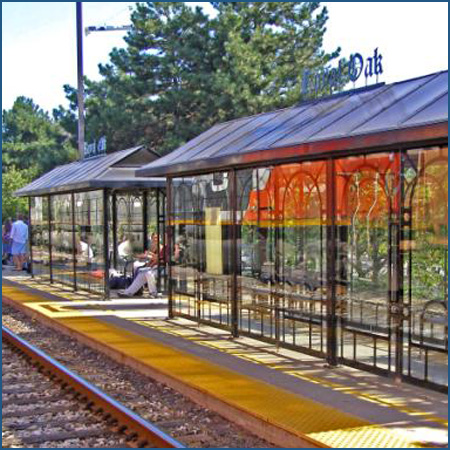
Travelers at Royal Oak wait for trains at a set of twin shelters. These structures are made of transparent plastic walls accented by graceful metalwork, and each is capped with a low, peaked roof crowned with large letters spelling “Royal Oak” in evocative Gothic script. In the colder months, passengers may wait at the nearby Royal Oak Transit Center which serves SMART buses and also has an Amtrak Quik-Trak automated ticketing machine.
Located north of Detroit, Royal Oak was named by Lewis Cass, Michigan’s Territorial Governor. In 1819, he and a party of surveyors ventured north of Detroit to verify reports that described the area as a swampy, desolate wasteland unfit for agriculture. Cass and his associates found the accounts to be untrue, especially when they came to a high ground marked by an unusually large oak tree. Cass associated the tree with the historic “royal oak” that provided King Charles II of England with a hiding place during a 1651 battle. Today, the approximate location of the famed oak is marked by a plaque.
The small settlement received train service by horse power in 1838 along the nascent Detroit and Pontiac Railroad. Construction on the thirteen mile line from Detroit to Royal Oak was temporarily thwarted by swampy terrain pocked by numerous sink holes. Steam locomotives were introduced when an engine purchased from Philadelphia’s Baldwin Locomotive Works arrived in 1839. In the last decades of the nineteenth century, the village became a stop on the Grand Trunk Railway (GTR) that linked southern Canada with Chicago and the upper Midwest. The railroad encouraged the development of industries such as logging and milling. Like many communities around Detroit, Royal Oak benefitted from the development and growth of the automobile industry during the twentieth century. Job creation prompted a demand for housing in nearby commuter suburbs like Royal Oak.
As part of the Grand Trunk Western Railway system (GTW, a successor to the GTR), Royal Oak received a one story wood frame passenger and freight depot whose exterior was sealed with clapboard. The building was marked by a gable with a peaked roof that visually divided the façade into two parts—the freight room and the waiting room. The waiting area was indicated on the exterior by a large arched, tripartite window with upper sashes divided into small square panes. The freight area was easily identified by its sturdy wood doors and lack of windows, a design measure meant to discourage theft. A hipped roof with deep eaves provided some shelter for those entering or exiting the depot.
In 1950, this depot was replaced with a new GTW station constructed of buff, tan brick with stone accents designed according to a spare, streamlined aesthetic. Built into a gentle hillside, its assertive cubic volumes were further emphasized by the main doorway which was framed with a two story stone surround that unmistakably announced the railway’s presence. Passengers moved up through the building to the platform, which was sheltered by a gleaming metal marquee reminiscent of those used on glittering Art Deco movie palaces. Although no longer used, this second depot still stands.
To many generations of Detroiters, Royal Oak is closely associated with the Detroit Zoo which today cares for more than 270 species spread over 125 acres. Its famous “Bear Fountain” by sculptor Corrado Parducci is a popular attraction and an unofficial zoo symbol. Known as “Tree City USA,” Royal Oak is recognized as a leader in the field of urban tree canopy conservation and restoration. Returning to its roots, in 1938, the city received sixty acorns that were direct descendants of the famed English “royal oak.” Nurtured and grown at the zoo, today many of the large specimen oak trees are found in Memorial Park.
The Wolverine Service is financed primarily through funds made available by the Michigan State Department of Transportation.
Platform with Shelter
Features
- ATM not available
- No elevator
- No payphones
- No Quik-Trak kiosks
- Restrooms
- Unaccompanied child travel not allowed
- No vending machines
- No WiFi
- Arrive at least 0 minutes prior to departure
Baggage
- Amtrak Express shipping not available
- No checked baggage service
- No checked baggage storage
- Bike boxes not available
- No baggage carts
- Ski bags not available
- No bag storage
- Shipping boxes not available
- No baggage assistance
Parking
- Same-day parking is available; fees may apply
- Overnight parking is available; fees may apply
Accessibility
- No payphones
- Accessible platform
- No accessible restrooms
- No accessible ticket office
- No accessible waiting room
- No accessible water fountain
- Same-day, accessible parking is available; fees may apply
- Overnight, accessible parking is available; fees may apply
- No high platform
- No wheelchair
- Wheelchair lift available
Hours
 Amtrak established the Great American Stations Project in 2006 to educate communities on the benefits of redeveloping train stations, offer tools to community leaders to preserve their stations, and provide the appropriate Amtrak resources.
 Amtrak is seizing a once-in-a-lifetime opportunity to transform rail and Retrain Travel. By modernizing, enhancing and expanding trains, stations and infrastructure, Amtrak is meeting the rising demand for train travel. Amtrak offers unforgettable experiences to more than 500 destinations across 46 states and parts of Canada. Learn more at