

Rochester, NY - Louise M. Slaughter Station (ROC)
A new, light-filled intermodal station, inspired by the design of an early 20th century New York Central depot, opened in 2017. It features classic red brick with cast stone and granite accents including quoins and an elegant rusticated entrance.
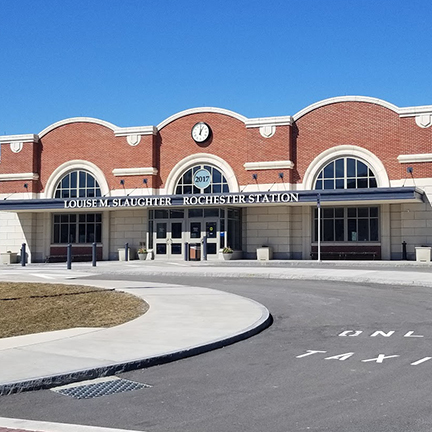
Louise M. Slaughter Station
320 Central Avenue
Rochester, NY 14605
- Facility Ownership: Amtrak
- Parking Lot Ownership: Amtrak
- Platform Ownership: CSX Transportation (CSXT)
- Track Ownership: CSX Transportation (CSXT)
Margaret Clark
Regional Contact
governmentaffairsnyc@amtrak.com
For information about Amtrak fares and schedules, please visit Amtrak.com or call 1-800-USA-RAIL (1-800-872-7245).
Located north of downtown right off of the Inner Loop, the Rochester station is one of the busiest Amtrak stops in the state. The new intermodal station opened in October 2017, the result of nearly 15 years of visioning and planning by stakeholders including the city, residents, New York State Department of Transportation (NYSDOT), Amtrak, CSXT, the Federal Railroad Administration (FRA) and the Rochester Genesee Regional Transportation Authority.
NYSDOT led the design and construction of the new station, which cost $44 million and took two years to complete. Local architectural firm LaBella Associates, which oversaw the design work, was inspired by the city’s former 1914 New York Central Railroad station, created by Claude Fayette Bragdon and demolished in the mid-1960s.
The 9,500-square foot station features classic red brick construction with cast stone and granite used for rustication around the main entrance, quoins, coping and other accents. Bragdon’s work is specifically referenced through the principal façade’s three vaulted sections with inset round-arch windows. A broad canopy over the main entrance protects travelers from inclement weather, while a large clock is another nod to train stations of the past. New sidewalks make it easier to reach the station on foot, and there is plenty of bicycle parking. Local and intercity buses also stop nearby.
Passengers enjoy a spacious and inviting waiting room with walls faced in cream-colored stone. Retail areas include a Taste NY kiosk featuring locally made food and beverages, and there are also Amtrak ticketing, baggage and office spaces. Hanging in the public areas are colorful murals and photographs depicting the city and the surrounding Finger Lakes Region. Large windows and skylights allow natural light to flood the interior throughout the day.
A tunnel connects the passenger building with the covered platform. The facility includes two new dedicated passenger tracks, versus one at the old station. This reduces delays by allowing two passenger trains traveling in opposite directions to stop at the station, and permits freight trains to pass when passenger trains are stopped. A two-sided, high-level passenger platform is level with the train car doors, letting customers easily enter and exit the train.
In March 2019, the station was officially named in honor of U.S. Representative Louise M. Slaughter who served the greater Rochester community in local, state and federal government for nearly 50 years. Slaughter was a member of the Monroe County Legislature, the New York State Assembly and the U.S. House of Representatives, the last for more than three decades. She was also instrumental in advancing the design and construction of the new station building and securing $18.5 million in federal funding for the project, including the first round of funding in 2010 for preliminary engineering. U.S. Senator Charles Schumer, Lt. Governor Kathy Hochul and Mayor Lovely Warren joined Slaughter family members and other dignitaries in unveiling new exterior signage and dedication plaques.
NYSDOT contributed $23.4 million toward the project, and federal funding amounted to $20.4 million. The latter included a $15 million Transportation Investment Generating Economic Recovery (TIGER) grant won by the city and NYSDOT from the U.S. Department of Transportation and secured by Congresswoman Slaughter. The city put $500,000 toward the intermodal station, and Amtrak contributed to the new Passenger Information Display System.
The former one-story Amtrak depot, which was used from 1978 until it was demolished in 2015, was typical of those constructed by the railroad during its first decade of service and was composed of textured, precast concrete panels. A prominent, cantilevered, flat black metal roof created deep eaves that protected passengers from inclement weather. Around much of the station, the top edge of the walls was beveled, leading the eye to a band of clerestory windows that allowed light to enter the interior. Viewed from a distance, the clerestory windows had the visual effect of making the roof appear as if it was floating above the structure.
Founded in 1812 along the upper falls of the Genesee River seven miles south of Lake Ontario, Rochester quickly became a transportation hub for northwestern New York. Only a generation earlier, the fate of the area was uncertain. It was claimed by both Massachusetts and New York, a result of unclear colonial land grants and boundaries. Although long occupied by the peoples of the Iroquois Confederation, many tribes sold the rights to their land after the destruction brought on by the Clinton-Sullivan Campaign of 1779. The Iroquois were primarily allies of the British during the Revolutionary War and thus raided colonial frontier settlements in New York and Pennsylvania. In summer and fall of 1779, American forces responded by entering Confederation territory in western New York and destroying more than 40 villages.
The area along the lower Genesee was first settled by a European-American settler in 1789-90; he built a saw-mill and grist-mill on the river banks, but they were only in operation about ten years before they fell into disrepair. At the beginning of the 19th century, three merchants from Maryland travelled to western New York State to examine land for purchase. One of the men was Colonel Nathaniel Rochester, a businessman who had settled in North Carolina and then Maryland; during his life, he held important government posts in those two states as well as New York.
In 1802 the entrepreneurs bought a 100-acre parcel containing the ruins of the first mills for $1,750. The falls had the potential to power new mills, and any goods shipped down river would have to be portaged over the falls, thus providing business opportunities. The buyers did not immediately move to the area, but rather held the land as an investment. Rochester returned a few years later and settled to the south in Dansville where he constructed a saw-mill, grist-mill, and a paper-mill. In 1811, he surveyed and platted the land along the upper falls of the Genesee and began to advertise it to settlers. Early referred to as “Genesee Falls” or “Falls Town,” the village soon took the name of Rochesterville; the colonel moved to the town in 1818 and in time the official name was shortened to “Rochester.”
With the power available from the three waterfalls and access to the Great Lakes, the city soon became a flour-milling center and earned the moniker of “Flour City.” The route of the Erie Canal through town was surveyed in 1819 and it officially opened in 1825. The canal crossed the Genesee with an aqueduct above the upper falls; accounts recall that the first boats to traverse the structure were escorted by military companies and bands of local residents.
The second aqueduct, built from 1836-1842 and long devoid of water, now forms the base of the Broad Street Bridge. It was used for a light rail system for many years and in 1927 a roadway was built on top of it, giving the bridge a unique two tiered design. The canal gave local businessmen another effective piece of infrastructure for shipping their goods to markets on the East Coast and the town went through a period of dramatic growth. Rochester’s flour would remain a sought-after product until the opening of the Great Plains at mid-century—a process made possible by the railroads.
The Erie Canal offered people a vision of what was possible with improved infrastructure—faster movement of goods, people and ideas. Once their appetite was whetted, businessmen, politicians and the general population wanted more speed, and railroad promoters promised even better travel times and rates. The first railroad was chartered in 1825, opened in 1833 and closed six years later. The short line only ran three miles on the east side of the river, skirting the falls, and the cars were conveyed by horsepower.
Established by charter in 1832, the Rochester and Tonawanda Railroad was the area’s first steam-powered line meant to connect the bustling canal city with Batavia to the west, and then on to Attica and the headwaters of the Allegheny River. In May of 1837, a crowd of Rochesterians cheered the first train as it left for the 32-mile trip to Batavia where the passengers enjoyed a feast before returning. The wood-fired locomotive sped across the countryside at 10 miles per hour. By 1840, small railroads completed a path between Buffalo and Albany—a 25 hour trip that involved switching trains and stations in numerous towns. At the close of the century, Rochester could boast of five major railroads, including the Erie, New York Central (NYC), and the Pennsylvania.
The excellent rail connections plus access to Lake Ontario made it possible for the city’s manufacturers to ship their goods across the country. The city prided itself on its boot and shoe, ready-made clothing, lumber and fruit businesses. The last was made possible by the city’s position in New York’s “Fruit Belt,” a particularly temperate part of the lake’s south shore that provided prime conditions for fruit cultivation. While fresh fruit was always popular with consumers, so too were dried varieties—especially apples.
At this time, Rochester also transitioned from the “Flour” to the “Flower” City. When flour production moved west, the town developed a large nursery business that included 35 operations with 4,000 employees. Crossman Brothers, Hiram Sibley and Company, and James Vick grew plants for landscaping, but concentrated on the seed business. Their beautifully illustrated catalogs proved a lifeline to farmers and a temptation to the home gardener.
Served by five rail lines that each had their own depots, Rochester has seen many station buildings rise and fall over the last two centuries. The two most famous belonged to the New York Central, the influential railroad controlled by Cornelius Vanderbilt. In 1882, the NYC built its second facility on the east side of the Genesee not far from the riverbank. Costing $925,000, the station was constructed of red brick; the façade stretching along Central Avenue had a regular pattern of bays with paired windows contained within a large arch. A three-story tower capped with a steep roof reminiscent of a French chateau punctuated the composition and indicated the position of the main entrance. A large train shed behind the main facility displayed exposed iron arches. In conjunction with the construction of the new building, the NYC tracks through Rochester were elevated to avoid at-grade crossings with automobiles and trolleys.
Thirty years later, the NYC decided to expand its facility to include a new station and a large building for the Railway Express Company. The site shifted along Central Avenue to the east. The railroad chose local architect Claude Fayette Bragdon to design the new building, and the resulting structure was one of the grandest along the line. Raised in western New York, Bragdon eventually fell in with the American Arts and Crafts movement which advocated for truth in materials, handcrafted construction where possible, and endorsed regional architectural variation.
Bragdon was a prolific writer on both architecture and later on spiritual topics. In his autobiography he described his difficulty in coming up with an appropriate design for Rochester, but eventually had a breakthrough. He had gone down to the tracks to watch the locomotives and trains move along the rails when he suddenly “felt them.” This physical and mental connection to the machines inspired him to draw five circles on a piece of paper that resembled the driving-wheels of a locomotive.
The three central “wheels” became the three-story arches and windows that lighted the main waiting room, while the two remaining circles formed the two rectangular, four-story end pavilions that framed the recessed, central section of the building. The building displayed the three-part division common in classical architecture: base, shaft and capital. Constructed of dark clinker brick, the station was trimmed in brownstone which was used on the rusticated first floor, quoins and the surrounds of the arched windows. A deep marquee ran the length of the central portion of the station, sheltering passengers from inclement weather. Looking closely, one noticed that the brackets supporting the marquee incorporated locomotive wheels.
An expansive barrel vault spanned the main waiting room and was covered in interlocking, self-supporting Guastavino tiles so typical of monumental Beaux-Arts structures. Lighted by sunlight that streamed through “Diocletian” or “thermal” windows, the waiting room was graced by a grand double staircase and long rows of wood benches. The walls had nine-foot high wainscoting composed of Grueby tile; Boston-based Grueby Faience Company was renowned for its decorative tiles and ceramics which were sought out by the leading architects and designers of the Arts and Crafts period.
Like his contemporary Frank Lloyd Wright, Bragdon was intrigued by geometric patterns which he believed were devoid of any class or cultural associations and therefore universal and applicable to all design problems. Much of the building and its decoration was also inspired by Bragdon’s interest in musical ratios which he used to size and scale the building. The architect mastered all aspects of his design, noting that the Grueby tiles were chosen because the “friction” of passengers brushing past and touching them would keep the ceramics shiny. The overall color scheme of rich autumnal colors in brown, orange and gold was warm and inviting and inspired by the color tones of a grove of trees viewed through the window of the architect’s dining-room.
The majestic third NYC station had many famous visitors over the years, including numerous presidents and presidential candidates making their way across the country on whistle-stop tours. The former Bragdon-designed station occupied the current Amtrak site until it was sold by the railroad to a private party in 1959; six years later the new owner tore it down to create a parking lot.
In the twentieth century, Rochester would give birth to some of the most well-known American companies and brands, many of which are now active across the globe. Bausch and Lomb—a leader in eye health products—was founded in 1853 by German immigrants. Jacob Bausch was an optician but found financial backing in Henry Lomb. Starting with the production of eyeglasses, the company then expanded into microscopes, lenses used in science and the cinema, contact lenses, and even Ray-Ban sunglasses. The company’s headquarters tower graces the Rochester skyline. Optics research remains an important field of study in the region and the University of Rochester maintains the Laboratory for Laser Energetics. As a center for high-energy physics research, it houses OMEGA—the world’s highest-energy ultraviolet laser. Xerox, founded in Rochester in 1906, maintains a large facility in the city although it is now headquartered in Connecticut.
Taken up as a hobby, photography became an all-consuming passion for George Eastman. Any photographer devoted to film can thank him for simplifying the photographic process; his dry plate invention eliminated the need to carry around pounds worth of chemicals to create the emulsions formerly used in wet-plate photography. His Eastman-Kodak company was a leader in the development of photographic equipment and subsequently made Eastman a rich man. He gave away much of his fortune, and the results still line the streets of Rochester.
The Eastman School of Music at the University of Rochester was established in 1921 due to Eastman’s love of musical works. Now considered one of the finest professional music schools in the world, its founder was also committed to spreading musical appreciation. The institution continues to provide music education programs to the general public, and its concert halls are often filled with locals. Established in 1949, the International Museum of Photography and Film is housed at Eastman’s former estate; the assembled works include more than 400,000 photographs and negatives and 23,000 films.
For more than a century, visitors to Rochester have had their picture taken next to the Frederick Douglas statue which was dedicated by Theodore Roosevelt in 1899. Listed as an attraction in a 1909 guidebook, the statue of the famed abolitionist and the panels with quotes from his speeches were then located near the second NYC station, but were later moved to Highland Park. Douglas lived in Rochester for many years where he published the North Star, an abolitionist newspaper; there he interacted with other anti-slavery proponents such as Susan B. Anthony. While many may know Anthony from the dollar coin that bears her likeness, a tour of her west side Rochester home, now a National Historic Landmark and museum, paints a portrait of a multi-faceted woman who was prominent in the temperance, abolitionist, educational and labor reform, and women’s rights and suffrage movements.
Those wishing to explore the famous falls often head to the High Falls Museum which tells the story of the Genesee. Here the river cascades down 96 feet, its beautiful mist resembling a spray of crystals whose ever-changing hues mesmerize bystanders; no wonder the Seneca people called the area “Gen-nis-he-yo,” or “beautiful valley.” The museum operates the visitor’s center for the High Falls State Heritage Area which explores the history of the falls and river and their impact on the region’s development. Former mills and factories line the bluff and visitors can walk to an overlook to view the cataract just as people have done since the settlement’s first days.
The fragrant smell of lilacs seduces more than 500,000 people every year who flock to Rochester each May for the annual Lilac Festival in Highland Park. Two early horticulturists owned the land that is now Highland Park, and the famed landscape designer Frederick Law Olmsted laid it out in the late nineteenth century. In 1892, local horticulturist John Dunbar—also known as “Johnny Lilacseed”—began planting lilacs. By 1898, an informal event began and over the next century blossomed into a 10-day festival. Today there are in excess of 1,200 shrubs representing 500 varieties. Their delicate colors and the blooms—purples, pinks, whites and reds—are complemented by the park’s azaleas, laurels, rhododendron, magnolias and other trees. Attractions include a parade, 5K and 10K runs, and live performances. The crowning event is the designation of the “Lilac Queen;” the lucky young high-school student wins a college scholarship.
Empire Service trains are supported by funds made available by the New York State Department of Transportation.
Image courtesy of Bruce B. Becker.
Station Building (with waiting room)
Features
- ATM available
- Elevator
- No payphones
- No Quik-Trak kiosks
- Restrooms
- Ticket sales office
- Unaccompanied child travel allowed
- Vending machines
- No WiFi
- Arrive at least 45 minutes prior to departure if you're checking baggage or need ticketing/passenger assistance
- Arrive at least 30 minutes prior to departure if you're not checking baggage or don't need assistance
Baggage
- Amtrak Express shipping not available
- Checked baggage service available
- Checked baggage storage available
- Bike boxes for sale
- No baggage carts
- Ski bags for sale
- Bag storage with Fee
- Shipping Boxes for sale
- Baggage assistance provided by Ticket Agent
Parking
- Same-day parking is available; fees may apply
- Overnight parking is available; fees may apply
Accessibility
- No payphones
- Accessible platform
- Accessible restrooms
- Accessible ticket office
- Accessible waiting room
- Accessible water fountain
- Same-day, accessible parking is available; fees may apply
- Overnight, accessible parking is available; fees may apply
- High platform
- Wheelchair available
- No wheelchair lift
Hours
Station Waiting Room Hours
| Mon | 12:00 am - 12:30 am 05:00 am - 11:59 pm |
| Tue | 12:00 am - 12:30 am 05:00 am - 11:59 pm |
| Wed | 12:00 am - 12:30 am 05:00 am - 11:59 pm |
| Thu | 12:00 am - 12:30 am 05:00 am - 11:59 pm |
| Fri | 12:00 am - 12:30 am 05:00 am - 11:59 pm |
| Sat | 12:00 am - 12:30 am 05:00 am - 11:59 pm |
| Sun | 12:00 am - 12:30 am 05:00 am - 11:59 pm |
Ticket Office Hours
| Mon | 12:00 am - 12:30 am 05:00 am - 11:59 pm |
| Tue | 12:00 am - 12:30 am 05:00 am - 11:59 pm |
| Wed | 12:00 am - 12:30 am 05:00 am - 11:59 pm |
| Thu | 12:00 am - 12:30 am 05:00 am - 11:59 pm |
| Fri | 12:00 am - 12:30 am 05:00 am - 11:59 pm |
| Sat | 12:00 am - 12:30 am 05:00 am - 11:59 pm |
| Sun | 12:00 am - 12:30 am 05:00 am - 11:59 pm |
Passenger Assistance Hours
| Mon | 12:00 am - 12:30 am 05:00 am - 11:59 pm |
| Tue | 12:00 am - 12:30 am 05:00 am - 11:59 pm |
| Wed | 12:00 am - 12:30 am 05:00 am - 11:59 pm |
| Thu | 12:00 am - 12:30 am 05:00 am - 11:59 pm |
| Fri | 12:00 am - 12:30 am 05:00 am - 11:59 pm |
| Sat | 12:00 am - 12:30 am 05:00 am - 11:59 pm |
| Sun | 12:00 am - 12:30 am 05:00 am - 11:59 pm |
Checked Baggage Service
| Mon | 12:00 am - 12:30 am 05:00 am - 11:59 pm |
| Tue | 12:00 am - 12:30 am 05:00 am - 11:59 pm |
| Wed | 12:00 am - 12:30 am 05:00 am - 11:59 pm |
| Thu | 12:00 am - 12:30 am 05:00 am - 11:59 pm |
| Fri | 12:00 am - 12:30 am 05:00 am - 11:59 pm |
| Sat | 12:00 am - 12:30 am 05:00 am - 11:59 pm |
| Sun | 12:00 am - 12:30 am 05:00 am - 11:59 pm |
Parking Hours
Quik-Track Kiosk Hours
| Mon | CLOSED |
| Tue | CLOSED |
| Wed | CLOSED |
| Thu | CLOSED |
| Fri | CLOSED |
| Sat | CLOSED |
| Sun | CLOSED |
Lounge Hours
Amtrak Express Hours
| Mon | CLOSED |
| Tue | CLOSED |
| Wed | CLOSED |
| Thu | CLOSED |
| Fri | CLOSED |
| Sat | CLOSED |
| Sun | CLOSED |
 Amtrak established the Great American Stations Project in 2006 to educate communities on the benefits of redeveloping train stations, offer tools to community leaders to preserve their stations, and provide the appropriate Amtrak resources.
 Amtrak is seizing a once-in-a-lifetime opportunity to transform rail and Retrain Travel. By modernizing, enhancing and expanding trains, stations and infrastructure, Amtrak is meeting the rising demand for train travel. Amtrak offers unforgettable experiences to more than 500 destinations across 46 states and parts of Canada. Learn more at