

Poughkeepsie, NY (POU)
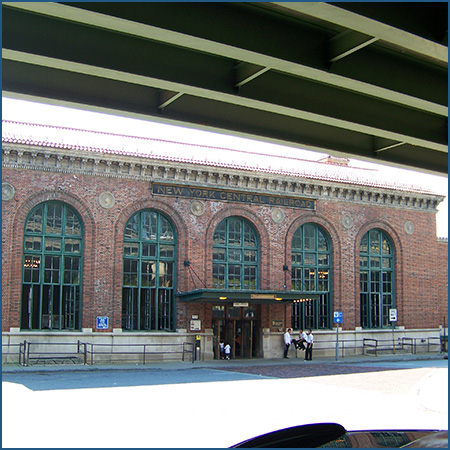
Designed by the firm Warren & Wetmore for the New York Central Railroad, the 1918 Beaux-Arts station features large arched windows, an elaborate terracotta cornice and fancy brickwork.
- Facility Ownership: Metropolitan Transportation Authority/Metropolitan Transportation Authority Metro-North
- Parking Lot Ownership: Metropolitan Transportation Authority/Metropolitan Transportation Authority Metro-North
- Platform Ownership: Metropolitan Transportation Authority/Metropolitan Transportation Authority Metro-North
- Track Ownership: Metropolitan Transportation Authority/Metropolitan Transportation Authority Metro-North
Margaret Clark
Regional Contact
governmentaffairsnyc@amtrak.com
For information about Amtrak fares and schedules, please visit Amtrak.com or call 1-800-USA-RAIL (1-800-872-7245).
The four-story red-brick Poughkeepsie station was designed by the firm Warren & Wetmore (the architects of the original Grand Central Terminal in New York City) for the New York Central Railroad. The city’s third station, it was proposed in 1913 and completed in 1918. The exterior of this Beaux-Arts style building is crowned with an elaborate terra cotta cornice, involving sculpted masonry designs over its five high arched front windows. Its airy waiting room was modeled on Grand Central Terminal and is lit by three original large chandeliers as well as its great windows. Fourteen original chestnut benches provide seating for waiting passengers and its visible wooden rafters are a stained walnut. Just to the west, a 450-foot steel-framed overhead walkway provides access to the tracks via stairs and elevators, as well as to the $18 million award winning parking structure built by Metro-North. The building, largely intact since its construction, was placed on the National Register of Historic Places in 1976.
At the time of its construction, the station served businesses along Main Street from its location along the banks of the Hudson River. However, in the late 1960s, the elevated north-south U.S. 9 highway was built directly to its east, overlooking the station. This isolated the station somewhat from the rest of the city.
Metro-North’s $22 million renovations in 2002 reconnected the entrance of the station to Poughkeepsie’s historic Main Street, built a pavilion there and added the large parking garage. These structures now directly link the station to the waterfront and were part of a long-term city transportation strategy to encourage economic development. The station is less than 75 miles from Manhattan, and is still heavily used by commuters riding the Hudson Line of the Metro-North Railroad into Grand Central Terminal. In 2009, Metro North replaced the station’s tile roof, restored the terra cotta cornice, repointed the brick, and replaced windows and doors throughout the building.
Poughkeepsie was first settled by the family of Barent Baltus in 1659, and the first house of record was built in 1702. The City proper was not incorporated, however, until 1854. During the Revolutionary War, it was the state capital for a time as well as site of the ratification of the United States Constitution by the state of New York. Sited on the Hudson River, Poughkeepsie early became an industrial hub: a center for whale rendering, and later, shipping, hat factories, paper mills and breweries. In 1847, Smith Brothers, once famous for their cough drops, established their business on Poughkeepsie’s Main Street, and remained in the city until 1972. Influential New York families such as the Astors, Rogers and Vanderbilts built palatial weekend homes north of the city in the town of Hyde Park on the Hudson River. These estates include the birthplace and home of Franklin Delano Roosevelt and Frederick W. Vanderbilt’s grand mansion, as well as the Eleanor Roosevelt National Historic Site.
In addition to the Roosevelt and Vanderbilt mansions, there is Locust Grove, built in 1771, the home of Samuel Morse, inventor of the telegraph. His home contains examples of the telegraph and how it was invented. Another residence of historical interest is the 18th-century George Clinton House, home of the first governor of New York and now the headquarters of the Dutchess County Historical Society.
Vassar College, a co-educational liberal arts college, was founded in 1861 in Poughkeepsie as a women’s college, one of the original “seven sisters” schools, by its namesake, brewer Matthew Vassar. Not until 1969, when the trustees declined to merge with Yale, did the school formally accept male matriculates. Vassar’s campus, a 1,000 acre arboretum, holds both period and modern buildings, as well as special collections from Albert Einstein, Mary McCarthy, and Elizabeth Bishop. Vassar is still ranked among the top liberal arts colleges today.
IBM, the well-known multi-national computer technology and IT consulting company, opened its Poughkeepsie plant in 1941 to meet wartime product demands. By 1985, the company employed 31,042 people at its plants in Poughkeepsie, East Fishkill, and Kingston. The site once built the IBM Stretch computer as well as later IBM mainframes. The RS/6000 SP2 family, while gained fame after one of them won the legendary chess match against world chess master Kasparov, was also manufactured in Poughkeepsie. However, in the early 1990s, IBM moved much of the workforce out of Duchess County. By 1995, the number employed had plummeted to 10,100, severely impacting the city’s well-being.
While the city’s economy remained fairly strong until the 1970s, it suffered in the next decades from big-city problems, including the emergence of mega-malls, urban renewal, and the conversion of the city’s Main Street into an unsuccessful pedestrian mall. Nonetheless, by the turn of the next century, the city government and citizens began to take the process of revitalization in hand. In 2001, the Main Mall was reopened to vehicular traffic. The Luckey Platt department store, an early-twentieth-century local landmark downtown, was renovated into apartments and retail space, leading the way toward a city renaissance. This was just the beginning, as the city’s Transportation Strategy shows.
The Metro North re-opening of train station’s access to Main Street started a process or renovation of the entire waterfront area. Next to the station, the Victorian Dooley Square warehouse has been converted to retail, office, and restaurants. Waterfront improvement projects have included a way to link the entire waterfront commercial complex into the park system, such the re-opened historical bridge to the north.
Built in 1889, the Poughkeepsie-Highland Railroad Bridge was at that time the longest river-crossing bridge in the world. Andrew Carnegie’s marvel of a steel railroad bridge lasted until 1974, when it was badly burned, and then closed. In 2009, the bridge reopened with much fanfare as the pedestrian Walkway Over the Hudson, an entirely unique park space that soars serenely over the river and connects to an expanding web of trails and parks up and down the Hudson.
Empire Service trains are supported by funds made available by the New York State Department of Transportation (NYSDOT). The Ethan Allen Express is financed primarily through funds made available by the Vermont Agency of Transportation and NYSDOT. The seasonal Berkshire Flyer (July-September) is supported by funds made available by the Massachusetts Department of Transportation and NYSDOT.
Station Building (with waiting room)
Features
- ATM available
- Elevator
- Payphones
- Quik-Trak kiosks
- Restrooms
- Unaccompanied child travel not allowed
- No vending machines
- No WiFi
- Arrive at least 30 minutes prior to departure
Baggage
- Amtrak Express shipping not available
- No checked baggage service
- No checked baggage storage
- Bike boxes not available
- No baggage carts
- Ski bags not available
- No bag storage
- Shipping boxes not available
- No baggage assistance
Parking
- Same-day parking is available; fees may apply
- Overnight parking is available; fees may apply
Accessibility
- Payphones
- Accessible platform
- Accessible restrooms
- No accessible ticket office
- Accessible waiting room
- Accessible water fountain
- Same-day, accessible parking is available; fees may apply
- Overnight, accessible parking is available; fees may apply
- High platform
- No wheelchair
- No wheelchair lift
Hours
Station Waiting Room Hours
| Mon | 05:00 am - 09:00 pm |
| Tue | 05:00 am - 09:00 pm |
| Wed | 05:00 am - 09:00 pm |
| Thu | 05:00 am - 09:00 pm |
| Fri | 05:00 am - 09:00 pm |
| Sat | 05:00 am - 09:00 pm |
| Sun | 05:00 am - 09:00 pm |
Ticket Office Hours
Passenger Assistance Hours
Checked Baggage Service
Parking Hours
Quik-Track Kiosk Hours
| Mon | 05:00 am - 09:00 pm |
| Tue | 05:00 am - 09:00 pm |
| Wed | 05:00 am - 09:00 pm |
| Thu | 05:00 am - 09:00 pm |
| Fri | 05:00 am - 09:00 pm |
| Sat | 05:00 am - 09:00 pm |
| Sun | 05:00 am - 09:00 pm |
 Amtrak established the Great American Stations Project in 2006 to educate communities on the benefits of redeveloping train stations, offer tools to community leaders to preserve their stations, and provide the appropriate Amtrak resources.
 Amtrak is seizing a once-in-a-lifetime opportunity to transform rail and Retrain Travel. By modernizing, enhancing and expanding trains, stations and infrastructure, Amtrak is meeting the rising demand for train travel. Amtrak offers unforgettable experiences to more than 500 destinations across 46 states and parts of Canada. Learn more at