

Portland, OR - Union Station (PDX)
Embellished with designs in fancy terra cotta and moulded brick, historic Portland Union Station is a regional landmark known for its glowing neon sign encouraging travelers to "Go By Train."
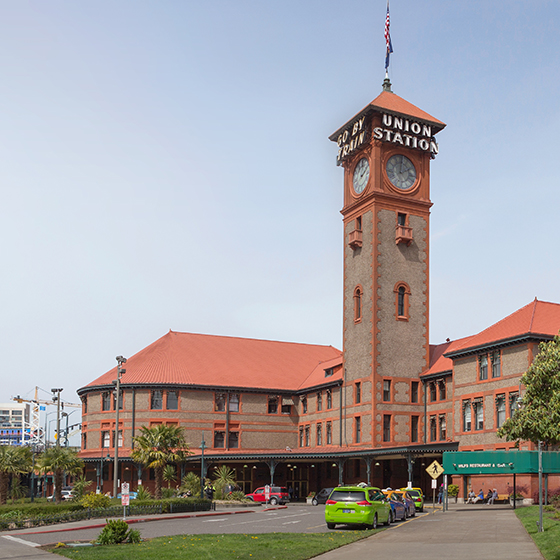
Union Station
800 NW Sixth Avenue
Portland, OR 97209-3789
- Facility Ownership: City of Portland
- Parking Lot Ownership: City of Portland
- Platform Ownership: City of Portland
- Track Ownership: City of Portland
Alex Khalfin
Regional Contact
governmentaffairssea@amtrak.com
For information about Amtrak fares and schedules, please visit Amtrak.com or call 1-800-USA-RAIL (1-800-872-7245).
Portland Union Station was constructed in 1896 and has been in continuous operation since that time. Originally constructed as part of the Northwest Pacific Terminal Company, it was owned jointly by the Northern Pacific, Union Pacific and Southern Pacific railroads. The centerpiece of the Romanesque and Queen Anne architecture is the 150-foot clock tower with its four-sided Seth Thomas clock that makes this landmark easily distinguishable. By 1922, every railroad passenger train serving Portland utilized Union Station. Today, Portland Union Station is situated in an area that boasts a variety of businesses and attractions which makes it an excellent arrival/departure point for people interested in the “’The City of Roses.” Portland Union Station was added to the National Register of Historic Places in 1975.
Between 1927 and 1930, the station’s interior received a major redesign. The main waiting hall was completely opened up by eliminating the cast iron columns and an entire mezzanine level. Italian marble was added to the walls and the floor. Dormers were added to the exterior to permit more natural light to enter the station. In 1948, the blue and gold neon “Go by Train” and “Union Station” lights on the exterior were installed and are operational today.
In 1987, the Portland Development Commission (PDC) purchased Union Station and 31 acres of former rail yards. A rehabilitation of the station occurred shortly after this acquisition including restoration of the painted flower patterns of the waiting room’s ornate ceilings, reopening the 1920s era phone booths and repairing the red metal tile roof. The most recent change in 2003 was the addition of a central plaza at the main entryway containing an island planted with local and native plants. The access to the station was changed, a new street was built and an Amtrak Connection bus boarding area was established. Today, the rail yard has become a residential and commercial district. Union Station has anchored one end of the downtown Portland Transit Mall since 1994.
Oregon Department of Transportation’s (ODOT) Enhancement program awarded the city of Portland $630,000 for another project at Portland Union Station in December, 2008. With $270,000 being provided by the PDC, this project, which will include replacing the roofs, eaves, and gutters, is estimated to total $900,000.
In 2009, Portland’s downtown transit mall was remodeled to include Union Station on the green and yellow light-rail lines. Amtrak travelers now have rail-to-rail access from Union Station to Hillsboro, Wilsonville, Clackamas and Portland Airport.
In October 2011, US Transportation Secretary Ray LaHood announced awards of $291.35 million in High-Speed and Intercity Passenger Rail (HSIPR) grants from the 2009 Recovery Act to six northeastern states and Washington state. Of this, Portland will get $13.6 million to modernize Portland Union Station. Waiting areas will be expanded, making the facility fully accessible to those with disabilities and improving its energy efficiency. A study will identify desired improvements to Portland-Eugene Amtrak service.
Portland began as a spot simply known as, “the clearing,” half-way between Oregon City and Fort Vancouver. William Overton, together with his partner, Asa Lovejoy of Boston, filed a claim in 1843 for 640 acres on the banks of the Willamette River. Overton later sold his half to Francis W. Pettygrove of Portland, Maine. The two partners flipped a coin to see which home-town their new city would be named for, and Pettygrove won two out of three tries. The coin used for this decision, the Portland Penny, is on display at the Oregon Historical Society. Portland was thus incorporated in 1851.
With its access to the Pacific via the Willamette and the agricultural Tualatin Valley via a plank road the city grew quickly as a trade nexus, and remained a major port for much of the 19th century, until Seattle’s deepwater port was connected to the interior by rail.
Portland is one of three cities in the contiguous United States that includes an extinct volcano within its city limits, Mount Tabor, known for its scenic views and historic reservoir. Portland, known as “Rose City,” is deservedly famous for its gardens and parks. Forest Park is the largest (more than 5,000 acres) wilderness park within city limits in the U.S. Portland is also home to the world’s smallest park, Mill End Park, which is only a two-foot circle.
Founded in 1917, Portland’s International Rose Test Garden is the oldest official and continuously operated public rose test garden in the United States. The primary purpose of the garden is to serve as a testing ground for new rose varieties. The garden is also one of only six testing grounds for the American Rose Society’s miniature rose test program.
The city is also well-known for its microbrewery beer, which exploded in popularity after passage of a 1980 law allowing beer to be consumed on brewery premises. Today, Portland is home to more than 20 breweries.
This is one of two cities with the same name served by Amtrak, which also serves this city’s namesake in Maine.
The Amtrak Cascades service is primarily financed through funds made available by ODOT and the Washington State Department of Transportation.
Station Building (with waiting room)
Features
- ATM available
- Elevator
- Metropolitan Lounge
- Payphones
- Quik-Trak kiosks
- Restrooms
- Ticket sales office
- Unaccompanied child travel allowed
- Vending machines
- Amtrak WiFi available
- Boarding gates close 5 Min before train departure time
- Arrive at least 45 minutes prior to departure if you're checking baggage or need ticketing/passenger assistance
- Arrive at least 30 minutes prior to departure if you're not checking baggage or don't need assistance
Baggage
- Amtrak Express shipping not available
- Checked baggage service available
- Checked baggage storage available
- Bike boxes for sale
- No baggage carts
- Ski bags for sale
- Bag storage with Fee
- Shipping Boxes for sale
- Baggage assistance provided by Red Cap
Parking
- Same-day parking is available for a fee
- Overnight parking is available for a fee
Accessibility
- Payphones
- Accessible platform
- Accessible restrooms
- Accessible ticket office
- Accessible waiting room
- Accessible water fountain
- Same-day, accessible parking is available for a fee
- Overnight, accessible parking is available for a fee
- No high platform
- Wheelchair available
- Wheelchair lift available
Hours
Station Waiting Room Hours
| Mon | 06:00 am - 11:00 pm |
| Tue | 06:00 am - 11:00 pm |
| Wed | 06:00 am - 11:00 pm |
| Thu | 06:00 am - 11:00 pm |
| Fri | 06:00 am - 11:00 pm |
| Sat | 06:00 am - 11:00 pm |
| Sun | 06:00 am - 11:00 pm |
Ticket Office Hours
| Mon | 06:00 am - 10:00 pm |
| Tue | 06:00 am - 10:00 pm |
| Wed | 06:00 am - 10:00 pm |
| Thu | 06:00 am - 10:00 pm |
| Fri | 06:00 am - 10:00 pm |
| Sat | 06:00 am - 10:00 pm |
| Sun | 06:00 am - 10:00 pm |
Passenger Assistance Hours
| Mon | 06:00 am - 10:00 pm |
| Tue | 06:00 am - 10:00 pm |
| Wed | 06:00 am - 10:00 pm |
| Thu | 06:00 am - 10:00 pm |
| Fri | 06:00 am - 10:00 pm |
| Sat | 06:00 am - 10:00 pm |
| Sun | 06:00 am - 10:00 pm |
Checked Baggage Service
| Mon | 07:00 am - 10:00 pm |
| Tue | 07:00 am - 10:00 pm |
| Wed | 07:00 am - 10:00 pm |
| Thu | 07:00 am - 10:00 pm |
| Fri | 07:00 am - 10:00 pm |
| Sat | 07:00 am - 10:00 pm |
| Sun | 07:00 am - 10:00 pm |
Parking Hours
| Mon | CLOSED |
| Tue | CLOSED |
| Wed | CLOSED |
| Thu | CLOSED |
| Fri | CLOSED |
| Sat | CLOSED |
| Sun | CLOSED |
Quik-Track Kiosk Hours
| Mon | 06:00 am - 11:00 pm |
| Tue | 06:00 am - 11:00 pm |
| Wed | 06:00 am - 11:00 pm |
| Thu | 06:00 am - 11:00 pm |
| Fri | 06:00 am - 11:00 pm |
| Sat | 06:00 am - 11:00 pm |
| Sun | 06:00 am - 11:00 pm |
Lounge Hours
| Mon | 07:00 am - 08:00 pm |
| Tue | 07:00 am - 08:00 pm |
| Wed | 07:00 am - 08:00 pm |
| Thu | 07:00 am - 08:00 pm |
| Fri | 07:00 am - 08:00 pm |
| Sat | 07:00 am - 08:00 pm |
| Sun | 07:00 am - 08:00 pm |
Amtrak Express Hours
| Mon | CLOSED |
| Tue | CLOSED |
| Wed | CLOSED |
| Thu | CLOSED |
| Fri | CLOSED |
| Sat | CLOSED |
| Sun | CLOSED |
 Amtrak established the Great American Stations Project in 2006 to educate communities on the benefits of redeveloping train stations, offer tools to community leaders to preserve their stations, and provide the appropriate Amtrak resources.
 Amtrak is seizing a once-in-a-lifetime opportunity to transform rail and Retrain Travel. By modernizing, enhancing and expanding trains, stations and infrastructure, Amtrak is meeting the rising demand for train travel. Amtrak offers unforgettable experiences to more than 500 destinations across 46 states and parts of Canada. Learn more at