

Orlando, FL (ORL)
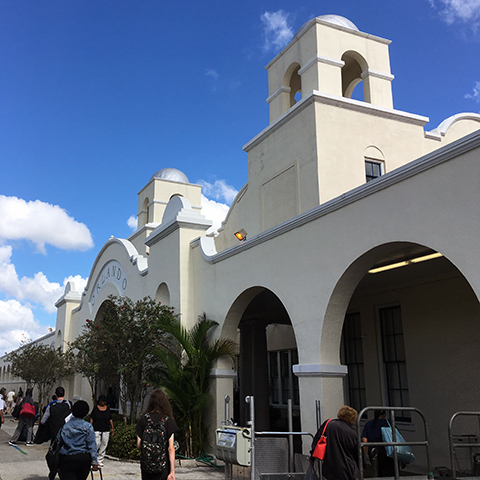
A fine example of Mission Revival style architecture, the Orlando station is a popular destination for those visiting central Florida's numerous theme parks and attractions.
1400 Sligh Boulevard
Orlando, FL 32806-3905
- Facility Ownership: Florida Department of Transportation
- Parking Lot Ownership: Florida Department of Transportation
- Platform Ownership: Florida Department of Transportation
- Track Ownership: Florida Department of Transportation
Todd Stennis
Regional Contact
governmentaffairsnol@amtrak.com
For information about Amtrak fares and schedules, please visit Amtrak.com or call 1-800-USA-RAIL (1-800-872-7245).
The Mission Revival style Orlando station was built for the Atlantic Coast Line Railroad (ACL) in 1926 at a cost of $500,000, and was later used by the Seaboard Coast Line Railroad following the 1967 merger of the ACL and the Seaboard Air Line Railroad. At the station’s opening in January 1927, more than 6,000 visitors came to tour the new facility.
One of the area’s best examples of Mission Revival style architecture, the stucco-faced station includes two domed towers flanking the entrance and a long, shady arcade. The sign that announces the city’s name, Orlando, is one of its finest features, having been hand-designed by the station’s architect, A. M. Griffith. The city designated the station a historic local landmark—a structure that represents Orlando’s history, culture and/or heritage—in 1978. In 1990, the city undertook a major building renovation.
Twenty-five years later, in June 2015, the city cut the ribbon on another significant station rehabilitation project. Skilled craftspeople repaired the tile roof, twin domes and stucco surfaces, while original light fixtures, wood doors and windows were restored. Replacement fixtures, windows and doors were crafted to blend seamlessly with their counterparts. By relocating the air conditioning system, the city was able to reopen a side entrance for better circulation. New sidewalks and ramps meet ADA requirements. A fresh coat of paint, based on historic color schemes, gives the building a bright and welcoming appearance, as does lush landscaping.
The project was made possible through a partnership between the Florida Department of Transportation (FDOT) and the city of Orlando. A $3 million FDOT Strategic Intermodal Systems (SIS) grant funded the design and improvements to the station. The SIS program focuses on transportation facilities and services of statewide and interregional significance. The city and Orlando Health subsequently partnered to provide a $3 million soft match utilizing the value of projects already built in the surrounding area.
A SunRail commuter rail station is located just north of the historic Orlando depot, and a transit plaza allows travelers to easily transfer between Amtrak, commuter trains and Lynx buses. The 61-mile SunRail system serves four Central Florida counties, and it opened in three phases from May 2014 through August 2024. Service in Orlando launched as part of Phase I in May 2014. In preparation, the city spent approximately $4 million to enhance streets, parking and sidewalks in the blocks near the Amtrak and commuter stations. The campus of Orlando Health and the Downtown South Main Street District are within easy walking distance of both transportation facilities.
Orlando, Florida’s largest inland city and seat of Orange County, was originally a settlement of cattlemen known as Jernigan, named after its first homesteader along Lake Holden. Most pioneers did not arrive until after the Third Seminole War in the 1850s. The name, “Orlando” is said to have originated from a tree carved to commemorate a soldier in the Third Seminole War, and the area was called “Orlando’s Grave” and then just “Orlando.”
Though the town suffered under the Union blockade, it prospered during Reconstruction, when it became the hub of Florida’s citrus industry. However, the Great Freeze of 1894 and 1895 forced many independent growers to give up their holdings, which were consolidated in the hands of a few “citrus barons” who shifted operations south into Polk County. During the Spanish-American War, Orlando became a popular resort destination. In the 1920s, the city grew extensively during the Florida land boom, which died off during the Depression of the 1930s. During the 1940s the establishment of Army air bases brought the military to the area, including many training facilities for the Navy and Marine Corps.
Most critical for the area’s economy was the announcement in 1965 of plans to build Walt Disney World. The renowned vacation resort opened in 1971, ushering in a period of explosive business and population growth for the Orlando area. Tourism is now the centerpiece of Central Florida’s economy, with the Orlando area welcoming more than 70 million visitors in 2023. Downtown Orlando, though several miles away from the main attractions, is undergoing a major redevelopment with a number of residential projects, commercial towers and major public works.
Station Building (with waiting room)
Features
- ATM available
- No elevator
- Payphones
- No Quik-Trak kiosks
- Restrooms
- Ticket sales office
- Unaccompanied child travel allowed
- Vending machines
- No WiFi
- Arrive at least 60 minutes prior to departure if you're checking baggage or need ticketing/passenger assistance
- Arrive at least 30 minutes prior to departure if you're not checking baggage or don't need assistance
Baggage
- Amtrak Express shipping not available
- Checked baggage service available
- Checked baggage storage available
- Bike boxes for sale
- Baggage carts available
- Ski bags not available
- Bag storage with Fee
- Shipping Boxes for sale
- Baggage assistance provided by Station Staff (upon checking in inside, no redcap service)
Parking
- Same-day parking is available for free
- Overnight parking is available for free
Accessibility
- Payphones
- Accessible platform
- Accessible restrooms
- Accessible ticket office
- Accessible waiting room
- Accessible water fountain
- Same-day, accessible parking is available; fees may apply
- Overnight, accessible parking is not available
- No high platform
- Wheelchair available
- Wheelchair lift available
Hours
Station Waiting Room Hours
| Mon | 09:15 am - 07:00 pm |
| Tue | 09:15 am - 07:00 pm |
| Wed | 09:15 am - 07:00 pm |
| Thu | 09:15 am - 07:00 pm |
| Fri | 09:15 am - 07:00 pm |
| Sat | 09:15 am - 07:00 pm |
| Sun | 09:15 am - 07:00 pm |
Ticket Office Hours
| Mon | 09:15 am - 07:00 pm |
| Tue | 09:15 am - 07:00 pm |
| Wed | 09:15 am - 07:00 pm |
| Thu | 09:15 am - 07:00 pm |
| Fri | 09:15 am - 07:00 pm |
| Sat | 09:15 am - 07:00 pm |
| Sun | 09:15 am - 07:00 pm |
Passenger Assistance Hours
| Mon | 09:15 am - 07:00 pm |
| Tue | 09:15 am - 07:00 pm |
| Wed | 09:15 am - 07:00 pm |
| Thu | 09:15 am - 07:00 pm |
| Fri | 09:15 am - 07:00 pm |
| Sat | 09:15 am - 07:00 pm |
| Sun | 09:15 am - 07:00 pm |
Checked Baggage Service
| Mon | 09:15 am - 07:00 pm |
| Tue | 09:15 am - 07:00 pm |
| Wed | 09:15 am - 07:00 pm |
| Thu | 09:15 am - 07:00 pm |
| Fri | 09:15 am - 07:00 pm |
| Sat | 09:15 am - 07:00 pm |
| Sun | 09:15 am - 07:00 pm |
Parking Hours
Quik-Track Kiosk Hours
Lounge Hours
Amtrak Express Hours
| Mon | CLOSED |
| Tue | CLOSED |
| Wed | CLOSED |
| Thu | CLOSED |
| Fri | CLOSED |
| Sat | CLOSED |
| Sun | CLOSED |
 Amtrak established the Great American Stations Project in 2006 to educate communities on the benefits of redeveloping train stations, offer tools to community leaders to preserve their stations, and provide the appropriate Amtrak resources.
 Amtrak is seizing a once-in-a-lifetime opportunity to transform rail and Retrain Travel. By modernizing, enhancing and expanding trains, stations and infrastructure, Amtrak is meeting the rising demand for train travel. Amtrak offers unforgettable experiences to more than 500 destinations across 46 states and parts of Canada. Learn more at