

Okeechobee, FL (OKE)
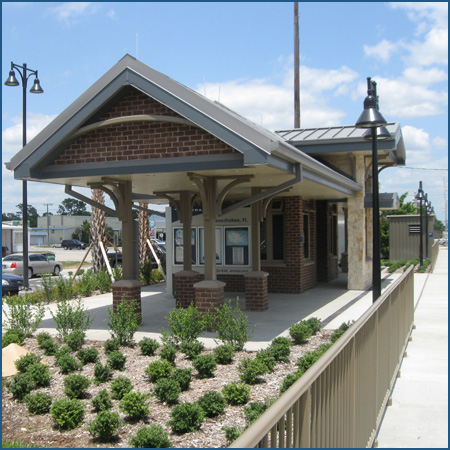
Completed in early 2011, the Okeechobee station was inspired by historic depots found in small towns across the nation; landscaping includes palms and other native plants.
801 North Parrott Avenue
Okeechobee, FL 34972-2130
- Facility Ownership: Seaboard Air Line Railway (CSX Transportation)
- Parking Lot Ownership: Seaboard Air Line Railway (CSX Transportation)
- Platform Ownership: CSX Transportation
- Track Ownership: CSX Transportation
Todd Stennis
Regional Contact
governmentaffairsnol@amtrak.com
For information about Amtrak fares and schedules, please visit Amtrak.com or call 1-800-USA-RAIL (1-800-872-7245).
The Okeechobee station consists of a concrete platform and a shelter completed in early 2011. Developed by d+A design+Architecture, LLC of Yardley, Pa., the new standard shelter design was inspired by historic late 19th and early 20th century depots found in small towns across the nation.
Composed primarily of rich red brick, the structure has an enclosed, one-story waiting room with large windows that keep out the wind, but also allow ample sunlight to flood and brighten the space. On the principal facades facing the street and tracks, the waiting room is marked by stylized projecting bays clad in creamy, rock-faced, coursed ashlar stonework that contrasts with the darkness of the brick, thereby adding texture to the overall elevation. Recessed canopies, supported by squared posts sporting curved brackets, flank the waiting room and visually expand the station’s presence. Landscaping around the structure includes small palms and other native plants.
The $1.5 million project was funded through Amtrak’s Mobility First initiative under the American Recovery and Reinvestment Act of 2009. Travelers with an eye for detail and knowledge of the Amtrak system might notice that the structure is a close cousin to a couple that were built during the same period along the route of the Floridian in Pennsylvania and Ohio.
Nearby stands a station built in 1924 and originally served by the Florida, Western and Northern Railroad, a subsidiary of the Seaboard Air Line Railway. The rail line, which hosted the famous Orange Blossom Special, was laid out in 1924-1925, between Coleman and West Palm Beach via Auburndale, West Lake Wales, Sebring, Okeechobee and Indiantown.
While forts were built and abandoned in the area north of Lake Okeechobee during the Seminole wars of the early 19th century, no real settlement took place until Hamilton Disston began dredging and draining lands overflowed by Lake Okeechobee, allowing the railroads to eventually enter the area. Lake Okeechobee is the second largest body of water entirely within the continental United States, second only to Lake Michigan, and covers 730 square miles. Both the lake and the land around it were swampy and difficult to navigate.
Disston originally arranged with the state of Florida to dredge in return for half the land so reclaimed. In 1881, Governor Braxton approached the Philadelphia businessman about purchasing reclaimed land, and Disston and his associates agreed to tentatively purchase four million acres of Florida’s Internal Improvement Fund land for 25 cents an acre—making him the largest land owner in the United States at the time, and considerably helping the bankrupt development fund. Disston’s dredging was supposed to open navigable waterways for steamboat traffic from Lake Okeechobee east to Kissimmee and west to the Gulf of Mexico. While draining peninsular Florida opened it up to settlement, it actually caused a drought north of Lake Okeechobee in the Kissimmee River valley and worse flooding in the lake and southwards. The canals westward and eastward were never completed.
Three miles north of Lake Okeechobee, the area that became Okeechobee City was laid out by the Florida East Coast Railway engineers in the early twentieth century at a place once called, “The Bend.” The town was first called Tantie, after the schoolmistress and postmaster, Tantie Huckaby, who came there in 1902. Local lore of those early days tells of pioneers who came by steamboat and Model T Ford as far as the roads would go, including Dr. Anna Darrow, one of the town’s two physicians, who was also the second woman licensed to practice medicine in Florida.
The railroad surveyed Okeechobee city in 1911 and 1912, and the city was renamed Okeechobee. The railroad engineers planned the town and laid it out by the time rails reached the area in 1914. The first passenger train through Okeechobee arrived in January of 1915, the same year the city was incorporated.
The area’s economics were built around fishing, trapping and cattle ranching—there were many wild cattle in the area even prior to American settlement—as well as dairy and citrus. In the 1940s, 1950s and 1960s, the Okeechobee canneries were also busy; during World War II, the Markham cannery alone packed about 10 percent of the national production of canned tomatoes. The modern preference for and ability to ship fresh tomatoes and vegetables has since closed the canneries. Today, this small city remains a ranching and fishing community.
Platform with Shelter
Features
- ATM not available
- No elevator
- Payphones
- No Quik-Trak kiosks
- No Restrooms
- Unaccompanied child travel not allowed
- No vending machines
- No WiFi
- Arrive at least 30 minutes prior to departure
Baggage
- Amtrak Express shipping not available
- No checked baggage service
- No checked baggage storage
- Bike boxes not available
- No baggage carts
- Ski bags not available
- No bag storage
- Shipping boxes not available
- No baggage assistance
Parking
- Same-day parking is available; fees may apply
- Overnight parking is available; fees may apply
Accessibility
- Payphones
- Accessible platform
- No accessible restrooms
- No accessible ticket office
- No accessible waiting room
- No accessible water fountain
- Same-day, accessible parking is available; fees may apply
- Overnight, accessible parking is available; fees may apply
- No high platform
- No wheelchair
- Wheelchair lift available
Hours
 Amtrak established the Great American Stations Project in 2006 to educate communities on the benefits of redeveloping train stations, offer tools to community leaders to preserve their stations, and provide the appropriate Amtrak resources.
 Amtrak is seizing a once-in-a-lifetime opportunity to transform rail and Retrain Travel. By modernizing, enhancing and expanding trains, stations and infrastructure, Amtrak is meeting the rising demand for train travel. Amtrak offers unforgettable experiences to more than 500 destinations across 46 states and parts of Canada. Learn more at