

Oklahoma City, OK (OKC)
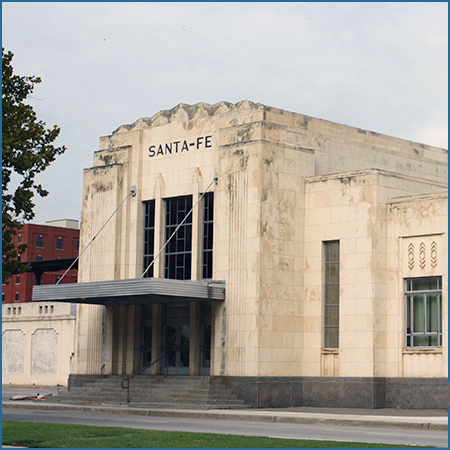
Located in the heart of this "mighty pretty city," the depot epitomizes jazzy Art Deco style through carved and painted geometric designs and luxurious interior finishes.
100 South E.K. Gaylord Boulevard
Oklahoma City, OK 73102
- Facility Ownership: City of Oklahoma City
- Parking Lot Ownership: City of Oklahoma City
- Platform Ownership: BNSF Railway, City of Oklahoma City
- Track Ownership: BNSF Railway
Todd Stennis
Regional Contact
governmentaffairsnol@amtrak.com
For information about Amtrak fares and schedules, please visit Amtrak.com or call 1-800-USA-RAIL (1-800-872-7245).
In late 2017, Oklahoma City completed an extensive rehabilitation of the historic Santa Fe depot to prepare it for use as a downtown intermodal center conveniently served by Amtrak, local EMBARK buses, bike sharing and a new streetcar system that began operations in Dec. 2018.
The depot was originally built for the Atchison, Topeka and Santa Fe Railway – commonly known as the “Santa Fe” – between 1932 and 1934. Probably designed by one of the Santa Fe’s in-house architects, it cost approximately $500,000 and was a combination depot, meaning that passenger and freight functions were housed under one roof. The express (freight) section, constructed first, is located at the southern end, baggage and mail areas in the center, and passenger spaces on the north. Passengers began using the completed depot in September 1934, and a formal dedication attended by the president of the Santa Fe took place on November 8.
The building’s architecture and interior finishes epitomize the Art Deco era, which emphasized movement, color and a rich material palette. The façades of Cordova cream limestone feature numerous setbacks and a jagged parapet, while geometric designs carved into the stone add another layer of texture. Shiny aluminum is found along the canopies, in the doors and window frames, and in the light standards which also display geometric patterns. The rich interiors include terrazzo floors, bright and colorful ceilings inspired by American Indian motifs, and elongated metal and glass chandeliers with a chevron design.
Passengers, then as now, enter through the northern end of the building that contains the concourse. The ticket desk was in an alcove on the south side of the room; directly across was another alcove used as a newsstand. Beyond the ticket office were segregated waiting rooms for white and African-American passengers. The former included terrazzo flooring in a green, pink and yellow pattern and wainscoting.
Located on land that had been allocated to the Santa Fe during the 1890 platting of the city, the current depot is the third on the site. The original structure was replaced by a more prominent stone building with a tower in 1901. After this second depot closed in 1932 so it could be torn down to make way for the current structure, passenger facilities were temporarily placed in train cars before being moved into part of the new express building upon its completion. The new depot was just one component of a larger $5 million effort to elevate the tracks in the growing downtown and thereby increase general safety through separation of rail and street traffic.
One of the famous trains to serve the current depot was the Santa Fe’s Texas Chief (Chicago-Galveston), which Amtrak continued to run when it took over the nation’s intercity passenger rail network in 1971. Three years later, the service was renamed the Lone Star (Chicago-Dallas/Houston), and operated under that name until the train was discontinued on October 9, 1979. For the next 20 years, the state lacked passenger rail service; during this time, the building fell into disrepair.
Jim Brewer, primary developer of the neighboring Bricktown entertainment and arts district, purchased the depot from the railroad in 1998 for $374,667 after nearly seven years of negotiation. Oklahoma Department of Transportation (ODOT) officials subsequently approached Brewer about using the station as one of the endpoints of the Heartland Flyer, to begin service in 1999 between Oklahoma City and Ft. Worth.
ODOT funded a renovation and upgrade through the Transportation Equity Act. Nearly $2 million was spent to make the station accessible by installing an elevator and rebuilding the overhead platform. Other repairs, made at the same time, included duplicating some of the rotted Art Deco molding, rehabilitating the floors and walls and replacing the two 40-foot high chandeliers that had disappeared sometime after the station closed to passengers in 1979.
In 2005, ODOT director Gary Ridley dedicated the Oklahoma City rail platform to the memory of Paul Adams, former ODOT deputy director. Adams, who passed away in 2004, was instrumental in the negotiations that brought Amtrak back to Oklahoma. In late 2007, an additional $3.1 million was spent on renovations. While Amtrak used space in the depot for a waiting area, the old freight section was rehabilitated for commercial use. In recognition of the depot’s rich history and material integrity, it was listed on the National Register of Historic Places in 2015.
In preparation for the rehabilitation project completed in 2017, the city purchased the depot. The city’s long-range vision allows for possible future expansion to accommodate additional intercity trains or a regional light rail service. In early 2018, a pedestrian tunnel will be built to connect the station to Bricktown on the east side of the rail viaduct.
TAP Architects of Oklahoma City directed the $28.4 million rehabilitation project. Skilled craftspeople restored the exterior limestone and granite, even sourcing stone from the same quarries used during the building’s construction. Inside, the terrazzo flooring, ornamental metalwork and windows were restored; the paint scheme follows historic precedents; and new light fixtures replicate original 1934 designs.
New features, including signage and seating, were designed to blend with the depot’s Art Deco aesthetic. Above the west entrance hangs a contemporary stainless steel and fused glass sculpture – “Connectivity” – by artist Marsh Scott. It incorporates abstracted, geometric Art Deco-style cutouts meant to evoke elements of railroading like wheels, pistons and cow catchers. The swirling, intersecting metal bands provide a sense of movement, of journeys that begin, continue or end.
Nearly half the total project funding came through a $13.6 million Transportation Investments Generating Economic Recovery (TIGER) grant from the U.S. Department of Transportation that the city won in 2013. The city also provided funding – including from MAPS 3, its capital improvements program that uses a one-cent, limited-term sales tax – as did the Association of Central Oklahoma Governments and ODOT.
Francisco Vasquez de Coronado explored the rolling grassy hills where Oklahoma City would later stand in 1541, at which time the area was largely uninhabited. After Oklahoma became part of the Arkansas Territory in 1819, with the beginning of the westward settlements, the U.S. government removed thousands of American Indians from their homelands in the Southeast. Cherokee, Creek, Choctaw, Chickasaw and Seminole peoples moved west into Indian Territory, which would later become Oklahoma. However, settlers continued to arrive from the east.
Prior to the official land opening, the Southern Kansas Railway (later the Santa Fe) built a line from the Kansas border to Purcell, Okla., with a watering stop at Oklahoma Station, established in 1887. The post office name there changed twice more before finally becoming “Oklahoma City” on July 1, 1923.
When the Oklahoma City area was officially opened for homesteading on April 22, 1889, more than 50,000 people gathered at the boundaries; at noon, a cannon was shot, and they streamed across the landscape to stake their claims. Where there had been only a railroad station and three buildings before, about 10,000 homesteaders staked claims in a single day. A provisional government was selected and elections held on May 1, 1889. The city became the seat of Oklahoma County. At that time, Guthrie was the territorial capital, until June 11, 1910, at which time Oklahoma City became the new state capital.
From 1889 to the early 20th century, the railroad watering stop evolved into a busy commercial and transportation hub. The local economy was originally based on agriculture, and by 1894 the city supported a corn mill, grain elevator, cotton gin and several grain mills. Around 1909, two meat packing plants were built near the Oklahoma National Stockyards in southwest Oklahoma City.
Between 1895 and 1903, the city would gain rail connections through three additional railroads: the Chicago, Rock Island and Pacific – known as the Rock Island; Saint Louis-San Francisco – known as the Frisco; and the Missouri-Kansas-Texas – known as the Katy. Each built its own passenger and freight facilities in the downtown area. They arrived to take advantage of the growing community. Between 1900 and 1920, the city’s population expanded from approximately 10,000 residents to more than 91,000. By the time construction began on the new Santa Fe depot in 1932, the population had doubled in just one decade to 185,000.
On December 4, 1928, the Oklahoma City Number One discovery well was completed by the Indian Territory Illuminating Oil Company and the Foster Petroleum Company; by 1935, the Oklahoma City oil field had produced 409 million barrels of crude oil, and 95 oil companies employed 12,000 people. In fact, the capitol sits above an oil pool, and in 1941, the Capitol Site Number One (also known as Petunia Number One) was brought in, using directional drilling, on the south plaza of the building’s main entrance.
Oklahoma City was a major stop on Route 66 during the early part of the 20th century and was prominently mentioned in Bobby Troup’s 1946 jazz classic, (Get Your Kicks on) Route 66, later made famous by Nat King Cole and the Rolling Stones.
The Heartland Flyer is financed primarily through funds made available by the Oklahoma and Texas Departments of Transportation.
Station Building (with waiting room)
Features
- ATM not available
- Elevator
- No payphones
- No Quik-Trak kiosks
- Restrooms
- Unaccompanied child travel not allowed
- No vending machines
- No WiFi
- Arrive at least 30 minutes prior to departure
Baggage
- Amtrak Express shipping not available
- No checked baggage service
- No checked baggage storage
- Bike boxes not available
- No baggage carts
- Ski bags not available
- No bag storage
- Shipping boxes not available
- No baggage assistance
Parking
- Same-day parking is available for a fee
- Overnight parking is available for a fee
Accessibility
- No payphones
- Accessible platform
- Accessible restrooms
- No accessible ticket office
- Accessible waiting room
- Accessible water fountain
- Same-day, accessible parking is available for a fee
- Overnight, accessible parking is available for a fee
- No high platform
- No wheelchair
- Wheelchair lift available
Hours
Station Waiting Room Hours
| Mon | 06:30 am - 08:30 am 08:30 pm - 10:30 pm |
| Tue | 06:30 am - 08:30 am 08:30 pm - 10:30 pm |
| Wed | 06:30 am - 08:30 am 08:30 pm - 10:30 pm |
| Thu | 06:30 am - 08:30 am 08:30 pm - 10:30 pm |
| Fri | 06:30 am - 08:30 am 08:30 pm - 10:30 pm |
| Sat | 06:30 am - 08:30 am 08:30 pm - 10:30 pm |
| Sun | 06:30 am - 08:30 am 08:30 pm - 10:30 pm |
 Amtrak established the Great American Stations Project in 2006 to educate communities on the benefits of redeveloping train stations, offer tools to community leaders to preserve their stations, and provide the appropriate Amtrak resources.
 Amtrak is seizing a once-in-a-lifetime opportunity to transform rail and Retrain Travel. By modernizing, enhancing and expanding trains, stations and infrastructure, Amtrak is meeting the rising demand for train travel. Amtrak offers unforgettable experiences to more than 500 destinations across 46 states and parts of Canada. Learn more at