

Mount Vernon, WA (MVW)
Named after George Washington's estate, Mount Vernon is known for its annual Tulip Festival. The bright and airy intermodal center is served by Amtrak, intercity and local buses.
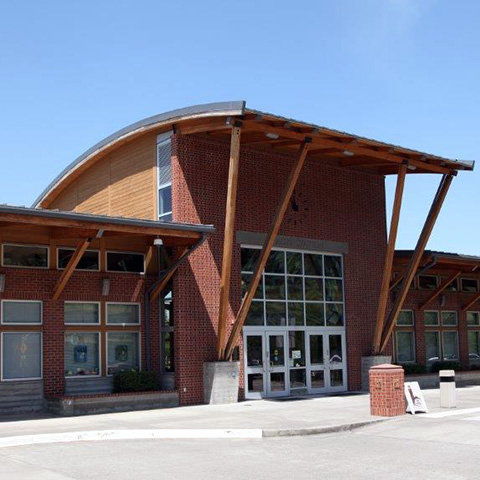
105 East Kincaid Street
Mount Vernon, WA 98273-4327
- Facility Ownership: Skagit Transit
- Parking Lot Ownership: Skagit Transit
- Platform Ownership: BNSF Railway
- Track Ownership: BNSF Railway
Alex Khalfin
Regional Contact
governmentaffairssea@amtrak.com
For information about Amtrak fares and schedules, please visit Amtrak.com or call 1-800-USA-RAIL (1-800-872-7245).
Mount Vernon’s modern and airy intermodal center was built in 2004, replacing a small shelter on the platform at the BNSF offices about two miles north of the present station. Skagit Transit operates from the new facility, which provides connections to intercity and Skagit Transit buses.
When the first European settlers arrived in the Skagit Valley area, they found a few prairie regions, but mostly a lush river delta of mud flats and salt marshes at the Skagit River’s mouth, surrounded by towering forests that came down to the water’s edge. The only route inland at that time was up the Skagit River, which was blocked at the site of present day Mount Vernon by a century-old log jam.
Jasper Gates and Joseph Dwelley first settled in 1870 on the banks of the Skagit River where Mount Vernon now sits. Later, Harrison Clothier came to teach school and join in business with a former student, E.G. English; they are credited with founding the town, which was incorporated on July 5, 1893. Mount Vernon was named for George Washington’s Virginia estate. Today, it is also the county seat.
When Mount Baker erupted in 1792, debris from the massive mudslides likely formed the two log jams. The lower log jam was a conglomeration of silt, vegetation, and driftwood about a half-mile long. The upper jam began a half-mile above the lower, and was about a mile long. Sediment was so thick on both jams that each had sprouted growths of brush and large trees above and below the waterline. This jam was utterly impenetrable by ordinary means, and difficult to bypass. In the summer of 1876, Joe Wilson and Donald McDonald partnered in the enterprise of removing the century-old log jams at the double-bend of the river at Mount Vernon. Clearing the jam was done by local volunteers and took two years.
Coal and logging were where the local wealth was made, and the delta was and is extremely fertile and agriculturally productive. Gigantic Douglas fir, western hemlock, and western red cedar trees grew hundreds of feet high, and often the stumps were large enough to use as living quarters—and sometimes were. One fir in nearby Sedro was recorded at 54 feet in diameter and 328 feet high.
Several rich veins of coke coal were also found, and these were mined until the 1920s. The Fairhaven and Southern Railway was part of a venture to bring the coal out, as well as to connect to the Great Northern Railroad via the Cascades Pass (which did not happen). However, James J. Hill of “Empire Builder” fame bought both the nearby mines and rail line and developed the town of Cokedale as well.
Mount Vernon is known today for its large and showy annual Tulip Festival visited by hundreds of thousand of people. The area is also home to many large flower bulb nurseries that ship nationwide.
The Amtrak Cascades are primarily financed through funds made available by the Washington State Department of Transportation and the Oregon Department of Transportation.
Station Building (with waiting room)
Features
- ATM not available
- No elevator
- Payphones
- Quik-Trak kiosks
- No Restrooms
- Unaccompanied child travel not allowed
- No vending machines
- No WiFi
- Arrive at least 30 minutes prior to departure
Baggage
- Amtrak Express shipping not available
- No checked baggage service
- No checked baggage storage
- Bike boxes not available
- No baggage carts
- Ski bags not available
- No bag storage
- Shipping boxes not available
- No baggage assistance
Parking
- Same-day parking is available; fees may apply
- Overnight parking is available; fees may apply
Accessibility
- Payphones
- Accessible platform
- Accessible restrooms
- No accessible ticket office
- Accessible waiting room
- Accessible water fountain
- Same-day, accessible parking is available; fees may apply
- Overnight, accessible parking is available; fees may apply
- No high platform
- No wheelchair
- Wheelchair lift available
Hours
Station Waiting Room Hours
| Mon | 08:30 am - 09:15 pm |
| Tue | 08:30 am - 09:15 pm |
| Wed | 08:30 am - 09:15 pm |
| Thu | 08:30 am - 09:15 pm |
| Fri | 08:30 am - 09:15 pm |
| Sat | 08:30 am - 06:00 pm |
| Sun | 08:30 am - 02:30 pm |
Ticket Office Hours
Passenger Assistance Hours
Checked Baggage Service
Parking Hours
Quik-Track Kiosk Hours
| Mon | 08:30 am - 09:15 pm |
| Tue | 08:30 am - 09:15 pm |
| Wed | 08:30 am - 09:15 pm |
| Thu | 08:30 am - 09:15 pm |
| Fri | 08:30 am - 09:15 pm |
| Sat | 08:30 am - 06:00 pm |
| Sun | 08:30 am - 02:30 pm |
 Amtrak established the Great American Stations Project in 2006 to educate communities on the benefits of redeveloping train stations, offer tools to community leaders to preserve their stations, and provide the appropriate Amtrak resources.
 Amtrak is seizing a once-in-a-lifetime opportunity to transform rail and Retrain Travel. By modernizing, enhancing and expanding trains, stations and infrastructure, Amtrak is meeting the rising demand for train travel. Amtrak offers unforgettable experiences to more than 500 destinations across 46 states and parts of Canada. Learn more at