

Marshall, TX (MHL)
Built in 1912 by the Texas & Pacific Railroad, the depot underwent a major rehabilitation in the 1990s. Today it houses a railroad museum, retail spaces, tourist center and offices.
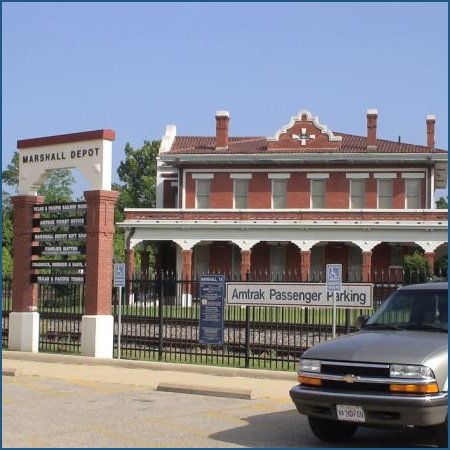
800 North Washington Street
Marshall, TX 75670-5330
- Facility Ownership: Missouri Pacific Railroad Company (Union Pacific)
- Parking Lot Ownership: Missouri Pacific Railroad Company (Union Pacific)
- Platform Ownership: Union Pacific Railroad
- Track Ownership: Union Pacific Railroad
Todd Stennis
Regional Contact
governmentaffairsnol@amtrak.com
For information about Amtrak fares and schedules, please visit Amtrak.com or call 1-800-USA-RAIL (1-800-872-7245).
The Marshall station was built in 1912 by the Texas & Pacific (T&P) Railroad and contained a waiting room as well as the company’s eastern regional administrative offices. The three-story, 7,500 square foot structure is the only survivor of a once bustling 66 acre shop complex comprised of 75 buildings that included a roundhouse, car shops, a water tower, and a warehouse. Today, the beautifully restored depot houses an Amtrak stop and the Texas & Pacific Railway Museum.
The exterior has remained essentially the same since its construction. The striking red brick building is outlined in white and features a projecting center bay with a prominent porch, giving the station a homey-feel. The interior has been significantly altered over the years to meet modern railroad needs. During a major rehabilitation in 1999, whitewash was removed and the original red brick restored.
The former T&P 2-8-2 Mikado #400 and a Union Pacific caboose stand on the surrounding grounds. From the depot’s upper level balcony, visitors can survey the town, including the Harrison County Courthouse (1901) and the historic Ginocchio Hotel (1896).
Marshall, which was named in honor of U.S. Chief Justice John Marshall, was founded on January 30, 1841. Located in a primarily agrarian area, Marshall grew wealthy and boasted the first telegraph office in the state. However, it was not until the arrival of the railroad that the town experienced its greatest prosperity.
The first railroad in Marshall was the Texas Western—chartered in 1852—which changed its name to the Southern Pacific Railway Company (no relation to the larger SP) in 1856. The Southern Pacific faced the loss of its charter if service did not begin in Marshall by 1878, and thus was forced to use oxen to pull the first train since the steam locomotive had not yet arrived.
Train travel was extremely hazardous in its early days. A German traveler, Theodore Kirchoff, recalled that on a journey from Marshall to Shreveport, the locomotive ran out of water and wood during a blinding snowstorm, and the train broke apart. The 40-mile trip took 40 hours to complete, and at a stop to load cotton, the drunken engineer started a brawl.
Although the first railroad in Marshall was the Southern Pacific, the T&P made Marshall a true railroad town. It was the only railroad in Texas with a federal charter. Realizing the economic benefits and jobs that a railroad headquarters would bring, Marshall donated land and $300,000 worth of bonds to persuade the railroad to base its operations in town.
The T&P moved its headquarters westward to Ft. Worth before the turn of the century, but the Marshall shops remained important until after World War II, when dieselization of the railroad occurred. In the years it functioned as a T&P passenger station, the Marshall depot housed immigration and telegraph offices. Thousands of passengers passed through, including troops during both World Wars.
The Marshall depot remained active until the discontinuance of T&P passenger trains in 1970. Newly formed Amtrak reinstituted service in 1974, but the empty depot fell into disrepair as basic maintenance was ignored. In 1988, the Union Pacific Railroad (UP)—successor to the T&P—applied for a permit to tear down the building; however, the citizens of Marshall were not ready to part with the historic station.
A chamber of commerce committee prevented the demolition of the station, and in 1990, a not-for-profit group called Marshall Depot, Inc. (MDI) secured a lease on the building from UP. MDI members successfully worked to have the depot designated as a Recorded Texas Historic Landmark.
In 1991, funds from individuals, businesses, and the Union Pacific Foundation were used to refurbish the station, and the grounds were cleaned by volunteers. In the mid-1990s, a large scale rehabilitation project was made possible through a $70,000 Intermodal Surface Transportation Enhancement Act (ISTEA) grant for architectural planning; $24,000 in contributions from MDI; and an additional $980,000 through the ISTEA with a required $244,000 match from MDI. The Meadows Foundation of Dallas also donated $84,000 in the form of a challenge grant.
The result is the current multi-modal facility, which features a waiting area for Amtrak passengers, snack shop, railroad museum, gift shop, tourist information center, and office space. The community effort preserved history, contributed to the city’s pleasing aesthetic qualities, and encouraged economic development and tourism.
Marshall is known by various nicknames, including the “Cultural Capital of Texas” and the “Athens of Texas.” It holds one of the largest light festivals in the U.S. and is the self-proclaimed “Pottery Capital of the World.” Marshall is also one of two communities in the country to poke fun at the fire ant (the other is in Georgia). The Fire Ant Festival has an ant calling contest; rubber chicken chunking; gurning (ugly face-making); a diaper derby, and a men’s Crazy Legs contest.
In 2015, the non-profit National Civic League awarded Marshall with one of ten All-America City Awards. The annual award “celebrates and recognizes communities that engage residents in innovative, inclusive and effective efforts to tackle critical challenges.”
Station Building (with waiting room)
Features
- ATM not available
- Elevator
- No payphones
- No Quik-Trak kiosks
- Restrooms
- Ticket sales office
- Unaccompanied child travel allowed
- Vending machines
- No WiFi
- Arrive at least 45 minutes prior to departure if you're checking baggage or need ticketing/passenger assistance
- Arrive at least 30 minutes prior to departure if you're not checking baggage or don't need assistance
Baggage
- Amtrak Express shipping not available
- No checked baggage service
- No checked baggage storage
- Bike boxes not available
- Baggage carts available
- Ski bags not available
- Bag storage
- Shipping Boxes for sale
- Baggage assistance provided by
Parking
- Same-day parking is available; fees may apply
- Overnight parking is available; fees may apply
Accessibility
- No payphones
- Accessible platform
- Accessible restrooms
- Accessible ticket office
- Accessible waiting room
- Accessible water fountain
- Same-day, accessible parking is available; fees may apply
- Overnight, accessible parking is available; fees may apply
- No high platform
- Wheelchair available
- Wheelchair lift available
Hours
Station Waiting Room Hours
| Mon | 07:00 am - 11:00 am 04:30 pm - 08:30 pm |
| Tue | 07:00 am - 11:00 am 04:30 pm - 08:30 pm |
| Wed | 07:00 am - 11:00 am 04:30 pm - 08:30 pm |
| Thu | 07:00 am - 11:00 am 04:30 pm - 08:30 pm |
| Fri | 07:00 am - 11:00 am 04:30 pm - 08:30 pm |
| Sat | 07:00 am - 11:00 am 04:30 pm - 08:30 pm |
| Sun | 07:00 am - 11:00 am 04:30 pm - 08:30 pm |
Ticket Office Hours
| Mon | 07:00 am - 11:00 am 04:30 pm - 08:30 pm |
| Tue | 07:00 am - 11:00 am 04:30 pm - 08:30 pm |
| Wed | 07:00 am - 11:00 am 04:30 pm - 08:30 pm |
| Thu | 07:00 am - 11:00 am 04:30 pm - 08:30 pm |
| Fri | 07:00 am - 11:00 am 04:30 pm - 08:30 pm |
| Sat | 07:00 am - 11:00 am 04:30 pm - 08:30 pm |
| Sun | 07:00 am - 11:00 am 04:30 pm - 08:30 pm |
Passenger Assistance Hours
| Mon | 07:00 am - 11:00 am 04:30 pm - 08:30 pm |
| Tue | 07:00 am - 11:00 am 04:30 pm - 08:30 pm |
| Wed | 07:00 am - 11:00 am 04:30 pm - 08:30 pm |
| Thu | 07:00 am - 11:00 am 04:30 pm - 08:30 pm |
| Fri | 07:00 am - 11:00 am 04:30 pm - 08:30 pm |
| Sat | 07:00 am - 11:00 am 04:30 pm - 08:30 pm |
| Sun | 07:00 am - 11:00 am 04:30 pm - 08:30 pm |
Checked Baggage Service
Parking Hours
| Mon | 24 HOURS |
| Tue | 24 HOURS |
| Wed | 24 HOURS |
| Thu | 24 HOURS |
| Fri | 24 HOURS |
| Sat | 24 HOURS |
| Sun | 24 HOURS |
Quik-Track Kiosk Hours
| Mon | 07:00 am - 11:00 am 04:30 pm - 08:30 pm |
| Tue | 07:00 am - 11:00 am 04:30 pm - 08:30 pm |
| Wed | 07:00 am - 11:00 am 04:30 pm - 08:30 pm |
| Thu | 07:00 am - 11:00 am 04:30 pm - 08:30 pm |
| Fri | 07:00 am - 11:00 am 04:30 pm - 08:30 pm |
| Sat | 07:00 am - 11:00 am 04:30 pm - 08:30 pm |
| Sun | 07:00 am - 11:00 am 04:30 pm - 08:30 pm |
 Amtrak established the Great American Stations Project in 2006 to educate communities on the benefits of redeveloping train stations, offer tools to community leaders to preserve their stations, and provide the appropriate Amtrak resources.
 Amtrak is seizing a once-in-a-lifetime opportunity to transform rail and Retrain Travel. By modernizing, enhancing and expanding trains, stations and infrastructure, Amtrak is meeting the rising demand for train travel. Amtrak offers unforgettable experiences to more than 500 destinations across 46 states and parts of Canada. Learn more at