

Memphis, TN - Central Station (MEM)
Anchoring the southern end of the popular South Main Arts District, Memphis Central Station – which first opened to rail passengers in 1914 – is a city landmark housing a hotel and Amtrak passenger facility.
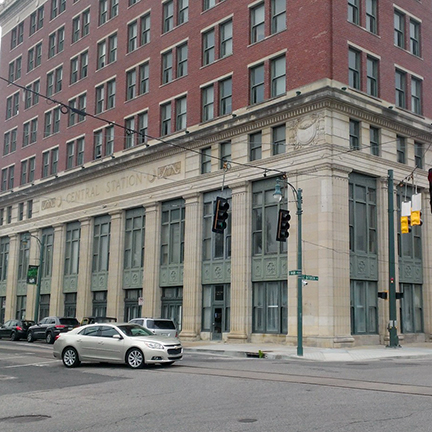
Central Station
545 South Main Street
Main and Carolina Entrance
Memphis, TN 38103
- Facility Ownership: City of Memphis / Memphis Area Transit Authority
- Parking Lot Ownership: City of Memphis / Memphis Area Transit Authority
- Platform Ownership: City of Memphis / Memphis Area Transit Authority
- Track Ownership: Canadian National Railway Company (CN) Illinois Central (IC) (A subsidiary of CN)
Todd Stennis
Regional Contact
governmentaffairsnol@amtrak.com
For information about Amtrak fares and schedules, please visit Amtrak.com or call 1-800-USA-RAIL (1-800-872-7245).
Anchoring the southern end of the popular South Main Arts District, Memphis Central Station is a city landmark housing a hotel and Amtrak passenger facility. It is served by the City of New Orleans and offers customers connections to taxi services, city buses and the historic Memphis trolley system.
Central Station, called Grand Central Station until 1944, opened in October 1914 to serve the Illinois Central Railroad (IC) and its subsidiary, the Yazoo & Mississippi Valley Railroad (Y&MV). The new facility allowed for consolidation of services that had previously been divided between two older IC depots, one of which – known as the Calhoun Street Station – was demolished to make way for Central Station. The Calhoun Street Station had in turn replaced the city’s first railroad depot, built on the same block by the Mississippi and Tennessee Railroad around 1855.
For more than half a century, Central Station shared Memphis passenger rail duties with its larger, older sister station a few blocks east on Calhoun Street – Memphis Union Station – until the latter was permanently abandoned in 1968 by the other railroads then serving the city and subsequently demolished the next year to make way for a postal facility.
The neoclassical Central Station, designed by the noted Chicago architectural firm of Graham, Burnham and Company, has a traditional three-part structure that includes a three-story base of buff colored Bedford limestone topped by a five-story red brick tower capped with an elaborate terracotta cornice. Along the street, the façade is broken into rhythmic bays divided by two-story fluted pilasters and large tripartite windows. A frieze with sculptural elements and “Central Station” carved on the Main Street side wraps around the building at the third story and is punctuated by windows.
Rail customers accessed the main waiting room, ticketing desk and other passenger areas from the street, and ascended two stories through the building to reach track level. Constructed at a time of racial segregation, there were separate entrances for white and African-American passengers, as well as separate waiting rooms, ticketing lobbies and eating facilities. The tower held offices for the IC and the Y&MV, including the passenger and freight departments, telegraphers and division and terminal superintendents.
The tracks – both through tracks and stub-end tracks that terminated at the station – were elevated above the local streets; adjacent to the station, they rested on a bed of fill held in place by retaining walls. In addition to increasing pedestrian and motorist safety by separating the busy tracks from the street network, the track elevation allowed for installation of a tunnel network beneath the tracks where baggage, freight, express and mail could be shuttled across the facility without interfering with passenger movement at track level. Goods were moved between the tunnels and platforms via hydraulic elevators. Altogether, the station building, track elevation and other site work cost about $1.4 million.
Over the years, Central Station was also served by the St. Louis-San Francisco Railway and the Chicago, Rock Island and Pacific Railway. After the initial abandonment of Union Station in 1964, the Louisville and Nashville Railroad also rerouted its trains to Central Station for a couple of years. By the time newly-created Amtrak took over most of the nation’s intercity passenger rail service in 1971, its daily City of New Orleans (Chicago-Memphis-New Orleans) was the only passenger train serving Memphis. Central Station, originally built to handle thousands of passengers daily, fell into a steady and noticeable structural and cosmetic decline, especially after the Illinois Central Gulf Railroad, successor to the IC, moved its divisional offices out of the building in the 1980s.
After acquiring ownership of the property, the Memphis Area Transportation Authority (MATA) broke ground in 1998 on an ambitious $23.2 million campaign, funded in large part through a federal grant, to completely renovate and restore Central Station as a premier transportation, commercial and residential center. Work was completed in 1999. In addition to an Amtrak facility, the refreshed station contained apartments, a full service police precinct and commercial space. The former grand waiting room was transformed into a first class ballroom available for rent.
The station’s renovation not only rejuvenated the structure itself, but also helped jumpstart development in the surrounding neighborhood. What was once a depressed area of Memphis marked by old warehouses and vacant lots gained a new lease on life in part thanks to Central Station’s proud story.
Across South Main Street is the famous Arcade Restaurant, considered the city’s oldest. Founded in 1919 by Greek immigrant Speros Zepatos, the diner has been featured in numerous movies such as The Client, The Firm and Walk the Line. The neighborhood is also home to the Memphis Farmers Market and various shops and galleries. One of the best known landmarks is the National Civil Rights Museum, which includes the Lorraine Motel, where Dr. Martin Luther King Jr. was assassinated in April 1968 while in the city to show support for striking sanitation workers. The museum, established in 1991, honors the legacy of Dr. King and chronicles the American Civil Rights Movement through interactive exhibits, oral histories, films and more.
In the 2010s, Central Station and 17 adjacent acres became the focus of a new $50+ million redevelopment plan led by the Henry Turley Company and Community Capital, working with MATA. The partners renovated and expanded the station complex’s old powerhouse into a movie theater, constructed new apartments on the southern end of the property, outfitted commercial space and redesigned public areas.
As before, Central Station was again a centerpiece of the redevelopment efforts. The development team of Kemmons Wilson Companies, Henry Turley Company and Valor Hospitality Partners converted the station into a 100+ room hotel with restaurant designed by Memphis-based Bounds Gillespie Killebrew Tushek Architects, PLLC. Opened in fall 2019, the hotel preserves historic elements of the station such as the arrival / departure board, neon signs and original finishes including marble floors and wainscoting and a central staircase, while upgrading the space for the 21st century.
The hotel’s interior design celebrates the city’s connection to railroading through original artwork in public spaces and guest rooms. The former Grand Hall – crowned by 33-foot ceilings – was reimagined as a grand ballroom. Amtrak’s passenger facility remains in the building, as does the Memphis Railroad and Trolley Museum, which houses exhibits including a history of the railroad bridges over the Mississippi River at Memphis, a look at the past and present city trolley system and a 1/8 scale live steam model of IC Hudson type locomotive No. 2499.
The Memphis region was first inhabited by the Mississippian Culture, a mound-building Native American people, prior to approximately 1450 AD; thereafter it was inhabited by the Chickasaw Nation and was an exploration port of call for European explorers such as Spaniard Hernando de Soto and Frenchman René Robert Cavalier Sieur de La Salle.
Andrew Jackson, John Overton and James Winchester founded Memphis, named for Egypt’s ancient capital, in 1819 on bluffs overlooking the Mississippi River. By 1857, Memphis was a major stop along the Memphis and Charleston Railroad, the South’s only long distance east-west railroad, linking the Atlantic Ocean to the Mississippi River. When the Civil War broke out in 1861, the railroad became a strategic asset of the South and Memphis became a Confederate stronghold; the city fell under Union control following the Battle of Memphis on June 6, 1862, however and remained in that state until the conclusion of the war.
Prior to the war, the region – and particularly the fertile Mississippi Delta southwest of the city – had developed into a major center for the growing of cotton. Memphis flourished as a hub for the buying, selling and shipping of the fiber. Although the American cotton business faced competition from other producers worldwide in the late 19th century, it remained an important economic force in the city’s life. As the 19th century gave over to the 20th, the city also developed as a center for the hardwood lumber industry. By 1910, more than 30 hardwood mills operated in Memphis.
Memphis has also made a significant impact on modern American culture, particularly music. It has been the place where several genres were established: Blues, Gospel, Rock ‘n’ Roll, and “rockabilly” Country music. Johnny Cash, Elvis Presley and B. B. King all got their starts in Memphis in the 1950s. They are respectively dubbed the “Kings” of Country, Rock ‘n’ Roll and Blues.
During the Big Band era of the 20th century, however, the rooftop Skyway Lounge of the Peabody Hotel in downtown Memphis was the place to be. The ballroom was one of only a handful of sites in America that CBS broadcast live from weekly. Regular headliners included Tommy Dorsey and the Andrews Sisters. Originally built in 1869 by Robert Campbell Brinkley, the hotel was named after noted philanthropist and entrepreneur, George Peabody. The current Peabody Hotel building, on Union Avenue, was built in 1925 and designed by Chicago architect Walter W. Ahlschlager in the Italian Renaissance style. It has been said that the Mississippi Delta “begins in the lobby of the Peabody Hotel and ends on Catfish Row in Vicksburg.”
The Peabody is also known for its daily Parade of Ducks, which dates back to the 1930s, and began with a prank by the then-general manager, Frank Schutt, who put his live decoy ducks in the hotel’s interior lobby fountain. In 1940, Edward Pembroke, a bellman, volunteered to care for the ducks. Pembroke was given the position of “Duckmaster” and served in that role until 1991. As a former circus animal trainer, he taught the ducks to march into the hotel lobby, which initiated the famous Peabody Duck March. Taking place daily at 11 a.m., the ducks are escorted to the lobby via elevator with musical accompaniment. The ducks live on the hotel’s roof in a small but lavish replica of the hotel, to which they ceremoniously return at 5 p.m.
Graceland, which was home to Elvis Presley, sits in the Whitehaven community about 12 miles from downtown Memphis. It was opened to the public in 1982 and placed on the National Register of Historic Places in 1991 and declared a National Historic Landmark in 2006. Graceland was originally owned by S. E. Toof, publisher of the newspaper, the Memphis Daily Appeal, and named for his daughter, Grace, who later inherited the property. Elvis purchased the house for $100,000 in 1957 and lived there until his death on August 16, 1977. The house is well known for its extensive modifications and decor, which have been faithfully preserved, as well as being a shrine to a beloved popular icon.
As in the past, Memphis continues to capitalize on its central location – 75 percent of the U.S. population lives within a two-day drive of the city – to dominate as a major North American logistics and distribution hub. It is well connected to the rest of the country by railroads and interstate highways, as well as the Mississippi River – Memphis has one of the nation’s largest inland river ports by tonnage, and its international airport – which ranks as the world’s second busiest cargo airport.
Memphis boasts the world headquarters, and is the main hub, of global shipping giant FedEx. Over time, it has been joined by other major freight corporations. Cotton and hardwood trading remain important to the economy, and the city also sits amid a region known for agricultural goods including soybeans, corn and grains, as well as livestock. With its rich culture, Memphis is a popular tourism and convention destination too.
Station Building (with waiting room)
Features
- ATM not available
- Elevator
- Payphones
- No Quik-Trak kiosks
- Restrooms
- Ticket sales office
- Unaccompanied child travel allowed
- No vending machines
- No WiFi
- Arrive at least 45 minutes prior to departure if you're checking baggage or need ticketing/passenger assistance
- Arrive at least 30 minutes prior to departure if you're not checking baggage or don't need assistance
Baggage
- Amtrak Express shipping not available
- Checked baggage service available
- Checked baggage storage available
- Bike boxes for sale
- No baggage carts
- Ski bags not available
- Bag storage with Fee
- Shipping Boxes for sale
- Baggage assistance provided by Station staff - No redcap service - limited resources
Parking
- Same-day parking is available for a fee
- Overnight parking is available for a fee
Accessibility
- Payphones
- Accessible platform
- Accessible restrooms
- Accessible ticket office
- Accessible waiting room
- Accessible water fountain
- Same-day, accessible parking is available; fees may apply
- Overnight, accessible parking is not available
- No high platform
- Wheelchair available
- No wheelchair lift
Hours
Station Waiting Room Hours
| Mon | 05:30 am - 01:00 pm 03:00 pm - 11:00 pm |
| Tue | 05:30 am - 01:00 pm 03:00 pm - 11:00 pm |
| Wed | 05:30 am - 01:00 pm 03:00 pm - 11:00 pm |
| Thu | 05:30 am - 01:00 pm 03:00 pm - 11:00 pm |
| Fri | 05:30 am - 01:00 pm 03:00 pm - 11:00 pm |
| Sat | 05:30 am - 01:00 pm 03:00 pm - 11:00 pm |
| Sun | 05:30 am - 01:00 pm 03:00 pm - 11:00 pm |
Ticket Office Hours
| Mon | 05:30 am - 01:00 pm 03:00 pm - 10:45 pm |
| Tue | 05:30 am - 01:00 pm 03:00 pm - 10:45 pm |
| Wed | 05:30 am - 01:00 pm 03:00 pm - 10:45 pm |
| Thu | 05:30 am - 01:00 pm 03:00 pm - 10:45 pm |
| Fri | 05:30 am - 01:00 pm 03:00 pm - 10:45 pm |
| Sat | 05:30 am - 01:00 pm 03:00 pm - 10:45 pm |
| Sun | 05:30 am - 01:00 pm 03:00 pm - 10:45 pm |
Passenger Assistance Hours
| Mon | 05:30 am - 01:00 pm 03:00 pm - 11:00 pm |
| Tue | 05:30 am - 01:00 pm 03:00 pm - 11:00 pm |
| Wed | 05:30 am - 01:00 pm 03:00 pm - 11:00 pm |
| Thu | 05:30 am - 01:00 pm 03:00 pm - 11:00 pm |
| Fri | 05:30 am - 01:00 pm 03:00 pm - 11:00 pm |
| Sat | 05:30 am - 01:00 pm 03:00 pm - 11:00 pm |
| Sun | 05:30 am - 01:00 pm 03:00 pm - 11:00 pm |
Checked Baggage Service
| Mon | 05:30 am - 01:00 pm 03:00 pm - 11:00 pm |
| Tue | 05:30 am - 01:00 pm 03:00 pm - 11:00 pm |
| Wed | 05:30 am - 01:00 pm 03:00 pm - 11:00 pm |
| Thu | 05:30 am - 01:00 pm 03:00 pm - 11:00 pm |
| Fri | 05:30 am - 01:00 pm 03:00 pm - 11:00 pm |
| Sat | 05:30 am - 01:00 pm 03:00 pm - 11:00 pm |
| Sun | 05:30 am - 01:00 pm 03:00 pm - 11:00 pm |
Parking Hours
Quik-Track Kiosk Hours
| Mon | 05:30 am - 01:00 pm 03:00 pm - 11:00 pm |
| Tue | 05:30 am - 01:00 pm 03:00 pm - 11:00 pm |
| Wed | 05:30 am - 01:00 pm 03:00 pm - 11:00 pm |
| Thu | 05:30 am - 01:00 pm 03:00 pm - 11:00 pm |
| Fri | 05:30 am - 01:00 pm 03:00 pm - 11:00 pm |
| Sat | 05:30 am - 01:00 pm 03:00 pm - 11:00 pm |
| Sun | 05:30 am - 01:00 pm 03:00 pm - 11:00 pm |
Lounge Hours
Amtrak Express Hours
| Mon | CLOSED |
| Tue | CLOSED |
| Wed | CLOSED |
| Thu | CLOSED |
| Fri | CLOSED |
| Sat | CLOSED |
| Sun | CLOSED |
 Amtrak established the Great American Stations Project in 2006 to educate communities on the benefits of redeveloping train stations, offer tools to community leaders to preserve their stations, and provide the appropriate Amtrak resources.
 Amtrak is seizing a once-in-a-lifetime opportunity to transform rail and Retrain Travel. By modernizing, enhancing and expanding trains, stations and infrastructure, Amtrak is meeting the rising demand for train travel. Amtrak offers unforgettable experiences to more than 500 destinations across 46 states and parts of Canada. Learn more at