

Lynchburg, VA (LYH)
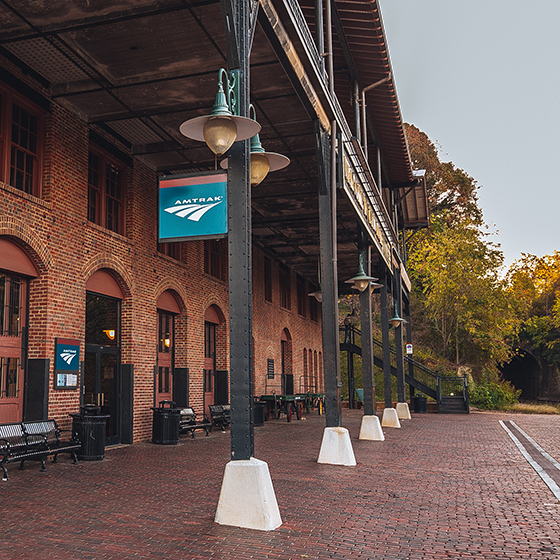
Located southwest of downtown, Kemper Street station was opened by the Southern Railway in 1912; a city-led rehabilitation was completed in 2002. Local bus connections and cycling trails are within easy walking distance.
- Facility Ownership: City of Lynchburg
- Parking Lot Ownership: City of Lynchburg
- Platform Ownership: Norfolk Southern Railway
- Track Ownership: Norfolk Southern Railway
Denise Miller
Regional Contact
governmentaffairsnyc@amtrak.com
For information about Amtrak fares and schedules, please visit Amtrak.com or call 1-800-USA-RAIL (1-800-872-7245).
The Kemper Street station, southwest of downtown, began serving passengers on the Southern Railway line when it opened in 1912. Originally, there was a walkway over the tracks to another platform, but it was later removed. Built into the side of a hill, the station can be entered from two levels. The top floor, which contains office space, fronts Kemper St. Rail customers access the Amtrak waiting room on the ground floor via a staircase on Kemper St., or by using a driveway on the north side of the station that leads to the lower level and platform.
Local bus connections are conveniently located across Kemper St. at the Greater Lynchburg Transit Company Transfer Station. Inspired by the neighborhood’s brick warehouse architecture, the bus station is a Leadership in Energy and Environmental Design (LEED) Platinum-certified structure, meaning it incorporates environmentally friendly materials and design solutions. Its roof is planted with vegetation to help cool the building, and solar panels generate electricity used by the facility. Kemper Street station is also accessible for cyclists via the Kemper Station Trail, which provides connections to the Midtown neighborhood and Miller Park.
Over the years, Kemper Street station was neglected and fell into disrepair. The Lynchburg City Council’s determination to save the structure led to a redevelopment effort. In 2000, work began on an extensive restoration including the roof, utilities, boiler system, a historic museum display and new visitors’ center. Emphasis in design was on maintaining period lighting, finishes and the existing historic fabric of the train station. On April 26, 2002, the city of Lynchburg celebrated the restoration of the building, which in addition to transportation uses included space that could be rented for offices.
The City Council worked with the Great American Stations Foundation to obtain one of the first ten $30,000 grants awarded by the foundation, which helped move restoration efforts along. Rehabilitation required $2 million, with another $750,000 to $1 million in site-related work. Other funding sources included the federal ISTEA program and the Virginia Department of Rail and Public Transportation (Virginia DRPT).
On October 1, 2009, Amtrak Virginia, a partnership between the Virginia DRPT and Amtrak, oversaw the extension of one daily roundtrip Northeast Regional train south from Washington, D.C., to Lynchburg. The popular new service provided communities along the US 29 corridor with more travel options and direct links to Northeast destinations as far north as Boston. In October 2017, service was extended south from Lynchburg to Roanoke.
This city was named for its founder, John Lynch, who at the age of 17 started a ferry service across the James River in 1757. In 1786, the Virginia General Assembly granted a town charter to Lynch. Lynchburg was incorporated as a town in 1805 and as a city in 1852. The Society of Friends was the first religious group to settle here. Lynchburg today is often called the “City of Churches” for the large number and variety of religious buildings found in the city.
Tobacco, iron, and steel were the chief industries in early Lynchburg, making it one of the wealthiest cities per capita in the United States in the latter part of the 19th century. Transportation facilities included the James River Batteau, and later the James River and Kanawha Canal, then four railroads through the city, including the Virginia and Tennessee Railroad and the Norfolk and Petersburg Railroad.
Lynchburg served as a major storage depot during the Civil War, as well as a burial place for many of the war’s casualties. The breastworks for the defense of the city can still be seen at Fort Early. Lynchburg is also close to the Appomattox Court House, where the Civil War ended on April 9, 1865.
Northeast Regional service within Virginia is funded in part through grants made available by the Commonwealth of Virginia.
Station Building (with waiting room)
Features
- ATM available
- Elevator
- No payphones
- Quik-Trak kiosks
- Restrooms
- Ticket sales office
- Unaccompanied child travel allowed
- Vending machines
- Amtrak WiFi available
- Arrive at least 60 minutes prior to departure if you're checking baggage or need ticketing/passenger assistance
- Arrive at least 30 minutes prior to departure if you're not checking baggage or don't need assistance
Baggage
- Amtrak Express shipping not available
- Checked baggage service available
- Checked baggage storage available
- Bike boxes for sale
- No baggage carts
- Ski bags not available
- Bag storage with Fee
- Shipping Boxes for sale
- Baggage assistance provided by Station Staff
Parking
- Same-day parking is available; fees may apply
- Overnight parking is available; fees may apply
Accessibility
- No payphones
- Accessible platform
- Accessible restrooms
- Accessible ticket office
- Accessible waiting room
- Accessible water fountain
- Same-day, accessible parking is available; fees may apply
- Overnight, accessible parking is available; fees may apply
- No high platform
- Wheelchair available
- Wheelchair lift available
Hours
Station Waiting Room Hours
| Mon | 06:15 am - 01:45 pm 03:45 pm - 11:15 pm |
| Tue | 06:15 am - 01:45 pm 03:45 pm - 11:15 pm |
| Wed | 06:15 am - 01:45 pm 03:45 pm - 11:15 pm |
| Thu | 06:15 am - 01:45 pm 03:45 pm - 11:15 pm |
| Fri | 06:15 am - 01:45 pm 03:45 pm - 11:15 pm |
| Sat | 06:15 am - 01:45 pm 03:45 pm - 11:15 pm |
| Sun | 06:15 am - 01:45 pm 03:45 pm - 11:15 pm |
Ticket Office Hours
| Mon | 06:15 am - 01:45 pm 03:45 pm - 11:15 pm |
| Tue | 06:15 am - 01:45 pm 03:45 pm - 11:15 pm |
| Wed | 06:15 am - 01:45 pm 03:45 pm - 11:15 pm |
| Thu | 06:15 am - 01:45 pm 03:45 pm - 11:15 pm |
| Fri | 06:15 am - 01:45 pm 03:45 pm - 11:15 pm |
| Sat | 06:15 am - 01:45 pm 03:45 pm - 11:15 pm |
| Sun | 06:15 am - 01:45 pm 03:45 pm - 11:15 pm |
Passenger Assistance Hours
| Mon | 06:15 am - 01:45 pm 03:45 pm - 11:15 pm |
| Tue | 06:15 am - 01:45 pm 03:45 pm - 11:15 pm |
| Wed | 06:15 am - 01:45 pm 03:45 pm - 11:15 pm |
| Thu | 06:15 am - 01:45 pm 03:45 pm - 11:15 pm |
| Fri | 06:15 am - 01:45 pm 03:45 pm - 11:15 pm |
| Sat | 06:15 am - 01:45 pm 03:45 pm - 11:15 pm |
| Sun | 06:15 am - 01:45 pm 03:45 pm - 11:15 pm |
Checked Baggage Service
| Mon | 06:15 am - 01:45 pm 03:45 pm - 11:15 pm |
| Tue | 06:15 am - 01:45 pm 03:45 pm - 11:15 pm |
| Wed | 06:15 am - 01:45 pm 03:45 pm - 11:15 pm |
| Thu | 06:15 am - 01:45 pm 03:45 pm - 11:15 pm |
| Fri | 06:15 am - 01:45 pm 03:45 pm - 11:15 pm |
| Sat | 06:15 am - 01:45 pm 03:45 pm - 11:15 pm |
| Sun | 06:15 am - 01:45 pm 03:45 pm - 11:15 pm |
Parking Hours
Quik-Track Kiosk Hours
| Mon | 06:15 am - 01:45 pm 03:45 pm - 11:15 pm |
| Tue | 06:15 am - 01:45 pm 03:45 pm - 11:15 pm |
| Wed | 06:15 am - 01:45 pm 03:45 pm - 11:15 pm |
| Thu | 06:15 am - 01:45 pm 03:45 pm - 11:15 pm |
| Fri | 06:15 am - 01:45 pm 03:45 pm - 11:15 pm |
| Sat | 06:15 am - 01:45 pm 03:45 pm - 11:15 pm |
| Sun | 06:15 am - 01:45 pm 03:45 pm - 11:15 pm |
 Amtrak established the Great American Stations Project in 2006 to educate communities on the benefits of redeveloping train stations, offer tools to community leaders to preserve their stations, and provide the appropriate Amtrak resources.
 Amtrak is seizing a once-in-a-lifetime opportunity to transform rail and Retrain Travel. By modernizing, enhancing and expanding trains, stations and infrastructure, Amtrak is meeting the rising demand for train travel. Amtrak offers unforgettable experiences to more than 500 destinations across 46 states and parts of Canada. Learn more at