

Little Rock, AR - Union Station (LRK)
Union Station, the third depot to stand on the site, opened to the public in 1921. Following a renovation, the building now includes commercial and office space in addition to a waiting room.
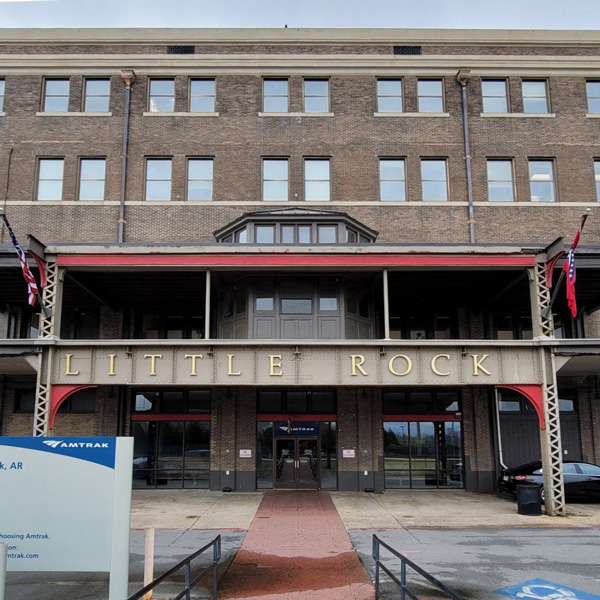
Union Station
1400 West Markham Street
Little Rock, AR 72201
- Facility Ownership: US Depot, LLC
- Parking Lot Ownership: US Depot, LLC
- Platform Ownership: Union Pacific Railroad
- Track Ownership: Union Pacific Railroad
Todd Stennis
Regional Contact
governmentaffairsnol@amtrak.com
For information about Amtrak fares and schedules, please visit Amtrak.com or call 1-800-USA-RAIL (1-800-872-7245).
Little Rock Union Station, the third depot to stand on the site, opened to the public in 1921. The first depot was built by the Cairo & Fulton Railroad in 1872-73. Twenty years earlier, in 1853, the state legislature had approved a charter for the company to build a line across Arkansas from northeast to southwest, but construction was delayed by financing troubles and the Civil War. The wood frame Cairo & Fulton depot included waiting rooms, ticket office, dining room and other passenger areas on the ground floor, while the second later housed hotel space.
In 1906, the St. Louis, Iron Mountain & Southern Railroad, which had been formed from the 1874 merger of the Cairo & Fulton and the St. Louis & Iron Mountain railroads, demolished the first depot in favor of a larger structure with a strong concrete foundation. St. Louis-based architect Theodore C. Link designed the new brick station, which cost approximately $750,000 and incorporated fashionable Renaissance Revival and Gothic Revival styling including a soaring clock tower and entrance loggia.
Only thirteen years after its completion, the second depot caught fire and was largely destroyed, although some of the exterior walls and the clock tower remained standing. The Missouri Pacific Railroad (MoPac), which had subsumed the St. Louis, Iron Mountain & Southern, vowed to rebuild. Intended to accommodate all three major railroads serving the state capital, including the MoPac, Cotton Belt and Rock Island, the building became known as “Union Station” – but in the end it was only used by the MoPac. Architect E.M. Tucker of St. Louis designed the new and current station for $1.25 million. It incorporates elements of its predecessor, in particular the clock tower and loggia.
The basement originally contained baggage, express and freight rooms while the main floor featured the lobby, segregated waiting rooms for white and African-American travelers, ticket windows and dining facilities. Upper stories contained railroad offices.
When Amtrak began operations on May 1, 1971, the nation’s new intercity passenger rail operator did not serve Little Rock. It was not until spring 1974, when the Inter-American was extended northward from Fort Worth, Texas, to St. Louis, that the city regained regular passenger rail service. At that time, the MoPac sold the building, and it passed through many hands until 1991, when it was purchased by Arkansas native John Bailey.
Previous investors had seen their dreams of the station as an entertainment-office-retail complex end unsuccessfully, and the building was in need of extensive renovations including new mechanical and electrical systems and a roof. When it rained, the leaky roof allowed water and debris into the upper levels; the walls were mildewed; and the floors were rotting. This, however, did not deter Bailey from his aspiration of restoring Union Station to its former glory.
He obtained a $30,000 grant from the city of Little Rock to restore the station’s façade. Bailey Properties, LLC moved its corporate headquarters into Union Station in January 1992. Two of the three former tenants (Amtrak and Slick Willy’s) remained as well. Bailey slowly renovated the building with the help of contractor Tom Harding, removing asbestos and making the building useable to lease. It now houses various offices and remains active throughout the day. During the renovations, Amtrak relocated from the main floor to the lower level where it remains today.
Little Rock is the capital and most populous city in Arkansas. The city derives its name from a small rock formation on the south bank of the Arkansas River. French explorer Jean-Baptiste Bénard de la Harpe named the formation la Petite Roche (“the little rock”) in 1722. In 1821, the state legislature chose Little Rock as the territorial capital, and the city was founded the same year. It was not until after the Civil War, in 1871, that a railroad line was established between Little Rock and Memphis.
In 1957, Little Rock was thrust into the national spotlight when a group of nine African-American students, under the orders of President Eisenhower and the protection of the 101st Airborne Division of the U.S. Army, entered Central High School. This marked the first important test of the Supreme Court decision, Brown v. Board of Education, which held that racial segregation of schools was unconstitutional.
In 1992, Little Rock garnered national attention once more, when then-governor Bill Clinton won the presidency, celebrating his victory at the Old State House. Little Rock is home to many museums, including the William J. Clinton Presidential Center, the Arkansas Art Center, the MacArthur Museum of Arkansas Military History, and the Arkansas Museum of Discovery.
Station Building (with waiting room)
Features
- ATM not available
- No elevator
- Payphones
- No Quik-Trak kiosks
- Restrooms
- Ticket sales office
- Unaccompanied child travel not allowed
- Vending machines
- No WiFi
- Arrive at least 45 minutes prior to departure if you're checking baggage or need ticketing/passenger assistance
- Arrive at least 30 minutes prior to departure if you're not checking baggage or don't need assistance
Baggage
- Amtrak Express shipping not available
- Checked baggage service available
- Checked baggage storage available
- Bike boxes for sale
- Baggage carts available
- Ski bags not available
- Bag storage with Fee
- Shipping Boxes for sale
- Baggage assistance provided by Station Staff
Parking
- Same-day parking is available; fees may apply
- Overnight parking is available; fees may apply
Accessibility
- Payphones
- Accessible platform
- Accessible restrooms
- Accessible ticket office
- Accessible waiting room
- Accessible water fountain
- Same-day, accessible parking is available; fees may apply
- Overnight, accessible parking is available; fees may apply
- No high platform
- Wheelchair available
- Wheelchair lift available
Hours
Station Waiting Room Hours
| Mon | 12:00 am - 08:00 am 10:30 pm - 11:59 pm |
| Tue | 12:00 am - 08:00 am 10:30 pm - 11:59 pm |
| Wed | 12:00 am - 08:00 am 10:30 pm - 11:59 pm |
| Thu | 12:00 am - 08:00 am 10:30 pm - 11:59 pm |
| Fri | 12:00 am - 08:00 am 10:30 pm - 11:59 pm |
| Sat | 12:00 am - 08:00 am 10:30 pm - 11:59 pm |
| Sun | 12:00 am - 08:00 am 10:30 pm - 11:59 pm |
Ticket Office Hours
| Mon | 12:00 am - 08:00 am 10:30 pm - 11:59 pm |
| Tue | 12:00 am - 08:00 am 10:30 pm - 11:59 pm |
| Wed | 12:00 am - 08:00 am 10:30 pm - 11:59 pm |
| Thu | 12:00 am - 08:00 am 10:30 pm - 11:59 pm |
| Fri | 12:00 am - 08:00 am 10:30 pm - 11:59 pm |
| Sat | 12:00 am - 08:00 am 10:30 pm - 11:59 pm |
| Sun | 12:00 am - 08:00 am 10:30 pm - 11:59 pm |
Passenger Assistance Hours
| Mon | 12:00 am - 08:00 am 10:30 pm - 11:59 pm |
| Tue | 12:00 am - 08:00 am 10:30 pm - 11:59 pm |
| Wed | 12:00 am - 08:00 am 10:30 pm - 11:59 pm |
| Thu | 12:00 am - 08:00 am 10:30 pm - 11:59 pm |
| Fri | 12:00 am - 08:00 am 10:30 pm - 11:59 pm |
| Sat | 12:00 am - 08:00 am 10:30 pm - 11:59 pm |
| Sun | 12:00 am - 08:00 am 10:30 pm - 11:59 pm |
Checked Baggage Service
| Mon | 12:00 am - 08:00 am 10:30 pm - 11:59 pm |
| Tue | 12:00 am - 08:00 am 10:30 pm - 11:59 pm |
| Wed | 12:00 am - 08:00 am 10:30 pm - 11:59 pm |
| Thu | 12:00 am - 08:00 am 10:30 pm - 11:59 pm |
| Fri | 12:00 am - 08:00 am 10:30 pm - 11:59 pm |
| Sat | 12:00 am - 08:00 am 10:30 pm - 11:59 pm |
| Sun | 12:00 am - 08:00 am 10:30 pm - 11:59 pm |
Parking Hours
| Mon | 24 HOURS |
| Tue | 24 HOURS |
| Wed | 24 HOURS |
| Thu | 24 HOURS |
| Fri | 24 HOURS |
| Sat | 24 HOURS |
| Sun | 24 HOURS |
Quik-Track Kiosk Hours
Lounge Hours
Amtrak Express Hours
| Mon | CLOSED |
| Tue | CLOSED |
| Wed | CLOSED |
| Thu | CLOSED |
| Fri | CLOSED |
| Sat | CLOSED |
| Sun | CLOSED |
 Amtrak established the Great American Stations Project in 2006 to educate communities on the benefits of redeveloping train stations, offer tools to community leaders to preserve their stations, and provide the appropriate Amtrak resources.
 Amtrak is seizing a once-in-a-lifetime opportunity to transform rail and Retrain Travel. By modernizing, enhancing and expanding trains, stations and infrastructure, Amtrak is meeting the rising demand for train travel. Amtrak offers unforgettable experiences to more than 500 destinations across 46 states and parts of Canada. Learn more at