

Hudson, NY (HUD)
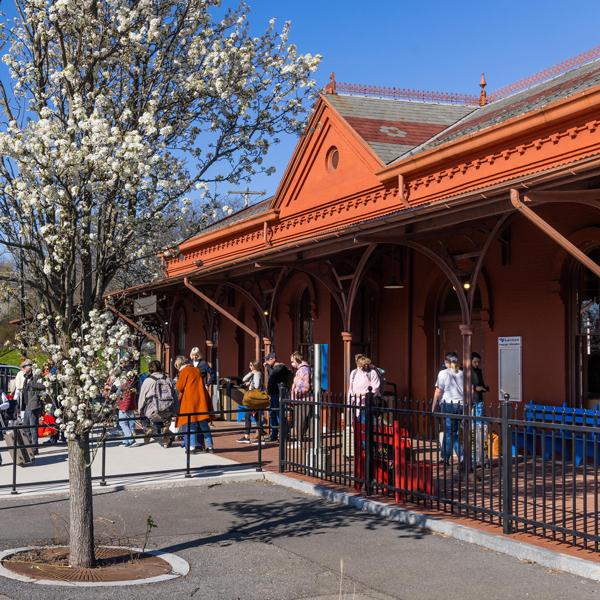
Built for the New York Central in 1874, the depot is within walking distance of the vibrant downtown, noted for its diverse architecture and variety of shops, galleries and restaurants.
- Facility Ownership: Amtrak
- Parking Lot Ownership: Amtrak, City of Hudson
- Platform Ownership: CSX Transportation
- Track Ownership: CSX Transportation
- Adirondack
- Berkshire Flyer (summer season)
- Ethan Allen Express
- Empire Service
- Maple Leaf
Margaret Clark
Regional Contact
governmentaffairsnyc@amtrak.com
For information about Amtrak fares and schedules, please visit Amtrak.com or call 1-800-USA-RAIL (1-800-872-7245).
The Amtrak stop in Hudson was originally built for the New York Central Railroad in 1874. This red-brick, single-story station features a decorative cornice, wide eaves and a hipped roof with tall arched windows. Volunteers have operated a snack bar inside the depot since 1975; proceeds support the local Hudson Day Care Center.
In the late 1980s, the parking lots on either side of the station were repaved. The next renovation took place between 1991 and 1992 with funds from New York State, after which the station had a grand re-opening. In the late 1990s, ridership at the Hudson station grew so much that the city opened an additional parking lot across the street. The city additionally created metered parking on Front Street in 2009, due to continuing demand.
In 1662, Dutch settlers came to this location on the Hudson River, founding a community known as Claverack Landing. The city was not laid out until 1783, when a group of merchants and whalers from Nantucket and Rhode Island arrived seeking an inland port safe from British harassment after the Revolution. This group, the self-proclaimed “Proprietors” (many of whom were Quakers), named their new community Hudson. It was the first city to receive a charter in New York State under the new federal government, in 1785.
Hudson is one of the last harbors on the Hudson River still usable by ocean-going ships, and provides access to the agricultural lands of Columbia County, of which Hudson is the seat. Whaling and mercantile provided boom times early on and much of the architecture in the city dates from that era and its taste for Greek revival.
William Jenkins Worth was born in Hudson in 1794, of Quaker parents, but rejected the pacifism of his upbringing and began his military career during the War of 1812, seeing action in New York in the Niagara Campaign where he was seriously wounded. Worth later served under Zachary Taylor in the Mexican American War, and for his service at the Battle of Chapultepec, the United States Congress awarded him with a sword of honor. Fort Worth, Texas, is named for General Worth, as are several other American cities.
Through the first half of the 19th century, Hudson grew as many port cities in New England did, their economies tied to whaling, sealing, and international trade. However, with the increasing use of petroleum instead of whale oil for lighting, and with the railroads replacing water transport in the 19th century, Hudson’s economy shifted from gristmills, tanneries, foundries and breweries as the railroad enabled new industries to take shape. Knitting and cotton mills opened, as did brickyards and other small industries.
The Hudson River Railroad Company incorporated in 1846 to build and operate a railroad from New York City to East Albany, now Rensselaer. By the time it reached Hudson, it had become the Hudson Division of the New York Central and Hudson River Railroad through a series of acquisitions.
The American art movement of the Hudson River School came to prominence in this locale in the mid-1830s to late 1870s. Frederic Edwin Church, one of the central figures of this unofficial “school” grew up in Connecticut. At eighteen, Church became a pupil of Thomas Cole in Catskill, New York, after being introduced by Daniel Wadsworth, family friend and founder of the Wadsworth Athenaeum. Church traveled extensively, and his paintings of the South American and American wilderness are familiar from museums and textbooks today. In 1860, Church bought a farm in Hudson, and married. Before leaving for a trip to the Middle East, he purchased the hilltop above his farm; today, his Persian-themed and personally eclectic Cozy Cottage at Olana is now the Olana State Historic Site, owned by the State of New York.
The city of Hudson stands out today in its success in historic preservation. Throughout its history, the town and its residents have been unwilling to destroy historic buildings or landmarks. One scholar describes Hudson as one of the richest dictionaries of architectural history in New York. An unusually large number of properties are either listed or eligible to be listed on the State and National Registers of Historic Places. Examples of all of the many architectural movements that have gone through periods of great fame in America are presented in Hudson’s extensive historic district, which includes the Hudson train station.
Today, Hudson is seeing a revival as a mecca for arts and tourism, as well as a suburb for New York City that provides relief from the stresses of big-city life.
Empire Service trains are supported by funds made available by the New York State Department of Transportation (NYSDOT). The Ethan Allen Express is financed primarily through funds made available by the Vermont Agency of Transportation and NYSDOT. The seasonal Berkshire Flyer (July-September) is supported by funds made available by the Massachusetts Department of Transportation and NYSDOT.
Station Building (with waiting room)
Features
- ATM available
- No elevator
- Payphones
- Quik-Trak kiosks
- Restrooms
- Ticket sales office
- Unaccompanied child travel allowed
- No vending machines
- No WiFi
- Arrive at least 45 minutes prior to departure if you're checking baggage or need ticketing/passenger assistance
- Arrive at least 30 minutes prior to departure if you're not checking baggage or don't need assistance
Baggage
- Amtrak Express shipping not available
- No checked baggage service
- No checked baggage storage
- Bike boxes not available
- No baggage carts
- Ski bags not available
- No bag storage
- Shipping boxes not available
- Baggage assistance provided by Ticket Agent
Parking
- Same-day parking is available; fees may apply
- Overnight parking is available; fees may apply
Accessibility
- Payphones
- Accessible platform
- Accessible restrooms
- Accessible ticket office
- Accessible waiting room
- Accessible water fountain
- Same-day, accessible parking is available; fees may apply
- Overnight, accessible parking is available; fees may apply
- No high platform
- Wheelchair available
- Wheelchair lift available
Hours
Station Waiting Room Hours
| Mon | 05:15 am - 11:30 pm |
| Tue | 05:15 am - 11:30 pm |
| Wed | 05:15 am - 11:30 pm |
| Thu | 05:15 am - 11:30 pm |
| Fri | 05:15 am - 11:30 pm |
| Sat | 05:15 am - 11:30 pm |
| Sun | 05:15 am - 11:30 pm |
Ticket Office Hours
| Mon | 05:15 am - 11:30 pm |
| Tue | 05:15 am - 11:30 pm |
| Wed | 05:15 am - 11:30 pm |
| Thu | 05:15 am - 11:30 pm |
| Fri | 05:15 am - 11:30 pm |
| Sat | 05:15 am - 11:30 pm |
| Sun | 05:15 am - 11:30 pm |
Passenger Assistance Hours
| Mon | 05:15 am - 11:30 pm |
| Tue | 05:15 am - 11:30 pm |
| Wed | 05:15 am - 11:30 pm |
| Thu | 05:15 am - 11:30 pm |
| Fri | 05:15 am - 11:30 pm |
| Sat | 05:15 am - 11:30 pm |
| Sun | 05:15 am - 11:30 pm |
Checked Baggage Service
Parking Hours
Quik-Track Kiosk Hours
| Mon | 05:15 am - 11:30 pm |
| Tue | 05:15 am - 11:30 pm |
| Wed | 05:15 am - 11:30 pm |
| Thu | 05:15 am - 11:30 pm |
| Fri | 05:15 am - 11:30 pm |
| Sat | 05:15 am - 11:30 pm |
| Sun | 05:15 am - 11:30 pm |
 Amtrak established the Great American Stations Project in 2006 to educate communities on the benefits of redeveloping train stations, offer tools to community leaders to preserve their stations, and provide the appropriate Amtrak resources.
 Amtrak is seizing a once-in-a-lifetime opportunity to transform rail and Retrain Travel. By modernizing, enhancing and expanding trains, stations and infrastructure, Amtrak is meeting the rising demand for train travel. Amtrak offers unforgettable experiences to more than 500 destinations across 46 states and parts of Canada. Learn more at