

Hammond-Whiting, IN (HMI)
With excellent rail and water connections, the area grew into an industrial powerhouse, hosting companies involved in meat packing, oil refining, steel manufacture and rail car construction.
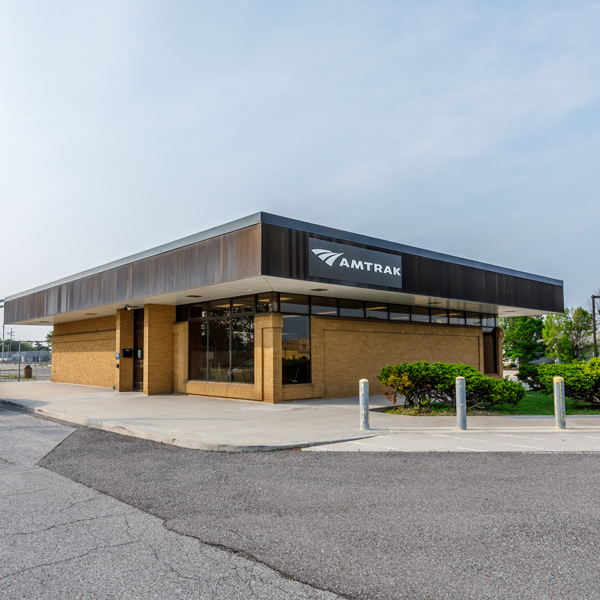
1135 North Calumet Avenue
Hammond, IN 46320-1044
- Facility Ownership: Amtrak
- Parking Lot Ownership: Amtrak
- Platform Ownership: Norfolk Southern Railway
- Track Ownership: Norfolk Southern Railway
Marty Sandoval
Regional Contact
governmentaffairschi@amtrak.com
For information about Amtrak fares and schedules, please visit Amtrak.com or call 1-800-USA-RAIL (1-800-872-7245).
The Hammond-Whiting station, opened in 1982, was built to an Amtrak standard plan and therefore shares characteristics of other Amtrak depots from that era. The one story building is composed of variegated buff brick with a prominent cantilevered flat roof of black metal; deep eaves provide protection from inclement weather. The waiting room is lighted by sun which streams through large floor-to-ceiling windows. A small band of clerestory windows wraps around the upper portion of the waiting room wall where it meets the roof; this has the visual effect of making the roof float above the structure, lightening the whole composition. Buff brick also forms the interior walls, and the floors are paved in a glazed deep-brown tile that grounds the space.
The station once also served the Capitol Limited and Lake Shore Limited since the location is very convenient for people living south and east of Chicago. However, it was built with only one platform and track, and due to the delays this caused to freight traffic, service was trimmed at the request of the host railroad.
Both Hammond (to the south and west) and Whiting (just to the east) sit abutting the Illinois-Indiana state line in the wetlands and dunes at the edge of Lake Michigan. In 1851, the Michigan Central Railroad came through the area that would become Hammond and Whiting; their yards along the lake shore would become some of the largest in the world. Convenient transportation and abundant fresh water—with Wolf Lake and George Lake just to the west, and Lake Michigan to the north—attracted the founders of the G. H. Hammond Company, who built a large meat packing complex there close to the rail yards. The Hammond Packing Company was the single largest employer in the city until 1901, when the plant was destroyed in a fire. Hammond was incorporated on April 21, 1884.
The Pullman-Standard plant, on the site of the former Standard Steel Car Manufacturing Company, opened in Hammond in 1929. This plant built steel passenger rail cars until 1981, when its last car was delivered to Amtrak.
Whiting acquired its name from an incident in 1869 when “Pop” Whiting, a train engineer, ditched his heavy freight train so a fast passenger train could have right-of-way. Until 1871 when a post office put the community on the map, it was called “Pop Whiting’s Siding.”
Standard Oil Company began buying land along the lakefront in the 1880s, as the company sought a location convenient to both water and rail transportation to refine their crude oil. Their presence was behind the formation of the town of Whiting in 1895 and then its incorporation in 1905, as it brought new services and amenities. Standard Oil, which eventually became Amoco and then BP, built an empire of refineries in lakeside Indiana. At one time, when Amoco maintained its corporate research facility in Whiting, the city claimed the highest concentration of PhDs per capita of any city in the United States. That former research center now houses various industrial concerns and the Calumet College of St. Joseph. The BP refinery in Whiting, which opened in 1889, is the second largest refinery in the BP refining system, and the fifth largest refinery in the United States employing approximately 1,700 people.
In nearby East Chicago, only a few blocks from the station, Mittal Steel’s Indiana Harbor Works steel plant stands, one of the largest in the nation. The Indiana Harbor facility employs 10,000 people, and is one of several major steel plants in this 20-mile stretch of Indiana Lake shore—the largest concentration of steel plants in the world. Directly next to this plant sits the LTV Steel facility, which employs 4,000 people.
Across the former Michigan Central tracks now owned by Norfolk Southern stands the Horseshoe Casino, opened in 1990 as the Empress Casino, providing a major attraction to the area as well as Whiting’s waterfront parks.
Station Building (with waiting room)
Features
- ATM not available
- No elevator
- No payphones
- No Quik-Trak kiosks
- Restrooms
- Unaccompanied child travel not allowed
- Vending machines
- No WiFi
- Arrive at least 0 minutes prior to departure
Baggage
- Amtrak Express shipping not available
- No checked baggage service
- No checked baggage storage
- Bike boxes not available
- No baggage carts
- Ski bags not available
- No bag storage
- Shipping boxes not available
- No baggage assistance
Parking
- Same-day parking is available; fees may apply
- Overnight parking is available; fees may apply
Accessibility
- No payphones
- Accessible platform
- Accessible restrooms
- No accessible ticket office
- No accessible waiting room
- No accessible water fountain
- Same-day, accessible parking is available; fees may apply
- Overnight, accessible parking is available; fees may apply
- No high platform
- No wheelchair
- Wheelchair lift available
Hours
Station Waiting Room Hours
| Mon | 12:00 pm - 03:00 pm |
| Tue | 12:00 pm - 03:00 pm |
| Wed | 12:00 pm - 03:00 pm |
| Thu | 12:00 pm - 03:00 pm |
| Fri | 12:00 pm - 03:00 pm |
| Sat | CLOSED |
| Sun | CLOSED |
 Amtrak established the Great American Stations Project in 2006 to educate communities on the benefits of redeveloping train stations, offer tools to community leaders to preserve their stations, and provide the appropriate Amtrak resources.
 Amtrak is seizing a once-in-a-lifetime opportunity to transform rail and Retrain Travel. By modernizing, enhancing and expanding trains, stations and infrastructure, Amtrak is meeting the rising demand for train travel. Amtrak offers unforgettable experiences to more than 500 destinations across 46 states and parts of Canada. Learn more at