

Gainesville, TX (GLE)
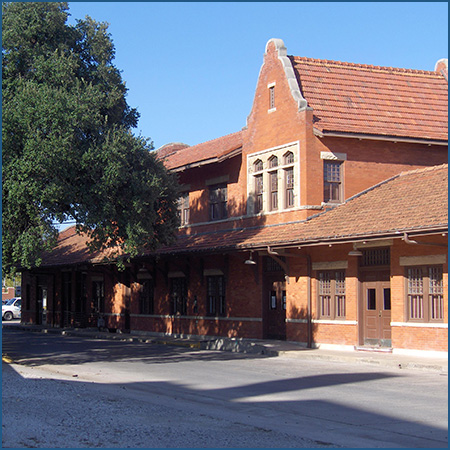
The Gulf Coast & Santa Fe Railroad built the depot in 1902, which originally housed a Fred Harvey restaurant. Restored by the community, it now houses a museum, offices and waiting area – and can be rented for events.
605 East California Street
Gainesville, TX 76240
Annual Station Ridership (FY 2023): 7,497
- Facility Ownership: City of Gainesville
- Parking Lot Ownership: City of Gainesville
- Platform Ownership: City of Gainesville, BNSF Railway
- Track Ownership: BNSF Railway
Todd Stennis
Regional Contact
governmentaffairsnol@amtrak.com
For information about Amtrak fares and schedules, please visit Amtrak.com or call 1-800-USA-RAIL (1-800-872-7245).
The brick Gainesville station was built in 1902 for the Gulf Coast & Santa Fe Railroad, a subsidiary of the Atchison, Topeka and Santa Fe Railway (ATSF). It originally housed a Harvey House restaurant until the restaurant closed in 1931. The station was unused by passenger trains from December 5, 1979, when the last Amtrak Lone Star train operated, until June 15, 1999, when the first Amtrak Heartland Flyer came through.
ATSF deeded the Gainesville depot to the city on October 19, 1981; however, its restoration was not completed until October 6, 2001. Restoration was accomplished by local fundraising efforts, a grant from the Community Preservation Foundation, funding from the city of Gainesville and state and federal transportation grants. A museum is located on the first floor, and upstairs are city offices and a replica of a Harvey House overnight stay quarters. The depot can also be rented for special events.
The Gainesville area, a valley five miles south of the Red River, saw its first Euro-American settlers after W.S. Peters and associates signed a contract with the Republic of Texas to settle what became known as the “Peters Colony” in north-central Texas. With constant threats of Indian attacks on the Red River frontier, the need for military protection became pressing, and the construction of Fort Fitzhugh, named for Colonel William Fitzhugh, became the first real settlement in the region. The following year, the state legislature created Cooke County there, named to honor William G. Cooke, a hero of the Texas War for Independence.
In 1850, Gainesville was established on a 40-acre tract of land donated by Mary E. Clark. At first, the residents called their community Liberty, but this was short-lived as there was already a Liberty, Texas. Colonel Fitzhugh suggested that the town be named after Edmund Pendleton Gaines, a U.S. General under whom Fitzhugh had served, and who had been sympathetic with the Texas Revolution.
Gainesville eventually found itself at the nexus of several major regional routes after the Civil War. The Butterfield Stagecoach began coming through in 1858, bringing passengers, mail, and freight; however, constant Indian attacks slowed growth of the town. In the decade after the Civil War, being only a few miles from the Oklahoma border, Gainesville became a major supply point for cowboys driving herd north to Kansas. The Chisholm and Shawnee Trials flanked Cooke County, and so Gainesville became a rowdy cow town for a time.
The last of the major Indian raids came in 1868, and after that, the Santa Fe came through in 1877, and the Missouri, Kansas and Texas Railway (the “Katy”) arrived in 1879. This—and the arrival of barbed wire—closed the open ranges and turned the economy toward farming, especially cotton.
The discovery of oil in nearby Callisburg in 1920 as well as the success of the Gainesville Community Circus provided a way for the region to weather the Great Depression. The Circus, which first performed in 1931, gained national attention when in 1939, Elliott Roosevelt, President Franklin Roosevelt’s second son, served as honorary ringmaster. They continued to perform until 1958. Many of the members of the circus were instrumental in starting and supporting the Frank Buck Zoo in Gainesville.
In 1944, Gainesville ranked 8th in passenger ticket sales of all ATSF-served cities, due to the beginning of World War II and the opening of the Camp Howze replacement training center outside of Gainesville in 1942. The camp closed after the end of the war in 1946. Today, the Gainesville municipal airport and various industries occupy the former land of the camp.
Today, Gainesville still benefits from tourism, as well as many horse ranches in Cooke County. The community holds an annual Depot Day on the second Saturday of October. Depot Day celebrates railroad history, and provides a car show, footrace, and other entertainment. Depot Day began in 1986 as a fundraising effort for the depot’s restoration, and has continued since as a city festival.
The Heartland Flyer is financed primarily through funds made available by the Oklahoma and Texas Departments of Transportation.
Station Building (with waiting room)
Features
- ATM not available
- No elevator
- Payphones
- No Quik-Trak kiosks
- No Restrooms
- Unaccompanied child travel not allowed
- No vending machines
- No WiFi
- Arrive at least 30 minutes prior to departure
Baggage
- Amtrak Express shipping not available
- No checked baggage service
- No checked baggage storage
- Bike boxes not available
- No baggage carts
- Ski bags not available
- No bag storage
- Shipping boxes not available
- No baggage assistance
Parking
- Same-day parking is available; fees may apply
- Overnight parking is available; fees may apply
Accessibility
- Payphones
- Accessible platform
- Accessible restrooms
- No accessible ticket office
- Accessible waiting room
- Accessible water fountain
- Same-day, accessible parking is available; fees may apply
- Overnight, accessible parking is available; fees may apply
- No high platform
- No wheelchair
- Wheelchair lift available
Hours
Station Waiting Room Hours
| Mon | 11:14 am - 06:45 pm |
| Tue | 11:14 am - 06:45 pm |
| Wed | 11:14 am - 06:45 pm |
| Thu | 11:14 am - 06:45 pm |
| Fri | 11:14 am - 06:45 pm |
| Sat | 11:14 am - 06:45 pm |
| Sun | 11:14 am - 06:45 pm |
 Amtrak established the Great American Stations Project in 2006 to educate communities on the benefits of redeveloping train stations, offer tools to community leaders to preserve their stations, and provide the appropriate Amtrak resources.
 For more than 50 years, Amtrak has connected America and modernized train travel. Offering a safe, environmentally efficient way to reach more than 500 destinations across 46 states and parts of Canada, Amtrak provides travelers with an experience that sets a new standard. Book travel, check train status, access your eTicket and more through the