

Grand Junction, CO (GJT)
The town is named for its location at the junction of the Gunnison and Colorado rivers. It is also a gateway to the monoliths, canyons and plateaus of Colorado National Monument.
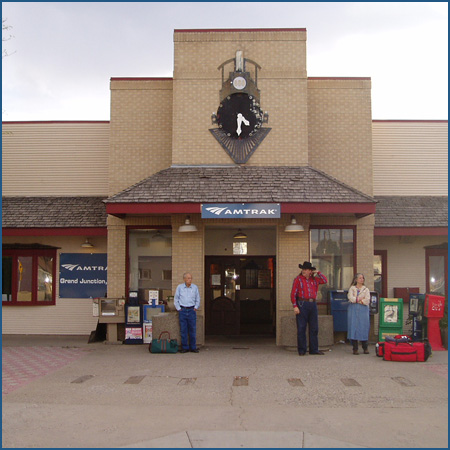
339 South 1st Street
Grand Junction, CO 81501-2207
- Facility Ownership: Arvan J. Leany
- Parking Lot Ownership: City of Grand Junction
- Platform Ownership: Union Pacific Railroad
- Track Ownership: Union Pacific Railroad
Alex Khalfin
Regional Contact
governmentaffairssea@amtrak.com
For information about Amtrak fares and schedules, please visit Amtrak.com or call 1-800-USA-RAIL (1-800-872-7245).
The current station, originally built in the 1970s as a restaurant, is constructed of cinder blocks and wood. In the late 2000s, building owner Geoff Leany undertook renovations that included replacing sections of flooring; improving bathrooms; applying stucco to the back wall; mounting new railings; and installing granite countertops at the ticket counter.
In 1992, Amtrak moved out of the adjacent historic station due to its continued deterioration. Designed in the French Renaissance style and constructed of buff brick with terracotta detailing, the older depot opened in 1906 under the ownership of the Denver & Rio Grande Western Railroad.
Throughout the 1990s and early 2000s, the historic station changed hands numerous times, but none of the owners were able to raise enough funds for a full rehabilitation. In 2009, a local bank foreclosed on the property. In response, a group of civic advocates and preservationists formed the “Friends of the Grand Junction Depot” to promote restoration and reuse of the building. While the station was under bank ownership, the Friends helped repair holes in the roof, held open houses so that the public could view the interior, and hired a landscape architecture student to prepare a study of the depot to explore how it could be better integrated into the downtown.
Most importantly, the Friends assisted the city and the Grand Junction Development Authority in winning two important grants: $10,000 from the Colorado Historic Society for a structural feasibility study and $135,000 from the Colorado Historic Fund for the rehabilitation of the station exterior. When taking into account local matches, the total potential investment amounted to $285,000, but a committed developer was needed in order for rehabilitation work to move forward. In October 2011, the former station was purchased by Grand Junction Railroad, Inc., which plans to eventually renovate the structure although a timeline has not been set.
Grand Junction is named for its location at the junction of the Gunnison and Colorado Rivers. The Colorado River, originally known as the Grand River, gives the city the other part of its name. Originally inhabited by the Ute Indians, farmers began to settle the area in the 1880s. For it initial 80 years, the town subsisted mainly on farming and cattle, though it was rumored to sit near large oil deposits. With the oil embargoes of the 1960s, the city was made a center of the oil industry and profited throughout the next two decades due to rising oil costs and the business in oil shale.
Grand Junction is the gateway to the Colorado National Monument and Grand Mesa National Forest. The Dinosaur Journey Museum also provides entertainment for the younger tourists.
Station Building (with waiting room)
Features
- ATM not available
- No elevator
- Payphones
- No Quik-Trak kiosks
- Restrooms
- Ticket sales office
- Unaccompanied child travel allowed
- Vending machines
- No WiFi
- Arrive at least 45 minutes prior to departure if you're checking baggage or need ticketing/passenger assistance
- Arrive at least 30 minutes prior to departure if you're not checking baggage or don't need assistance
Baggage
- Amtrak Express shipping not available
- Checked baggage service available
- Checked baggage storage available
- Bike boxes for sale
- Baggage carts available
- Ski bags for sale
- Bag storage with Fee
- Shipping Boxes for sale
- Baggage assistance provided by Station Staff
Parking
- Same-day parking is not available
- Overnight parking is not available
Accessibility
- Payphones
- Accessible platform
- Accessible restrooms
- Accessible ticket office
- Accessible waiting room
- Accessible water fountain
- Same-day, accessible parking is available; fees may apply
- Overnight, accessible parking is not available
- No high platform
- Wheelchair available
- Wheelchair lift available
Hours
Station Waiting Room Hours
| Mon | 09:00 am - 04:30 pm |
| Tue | 09:00 am - 04:30 pm |
| Wed | 09:00 am - 04:30 pm |
| Thu | 09:00 am - 04:30 pm |
| Fri | 09:00 am - 04:30 pm |
| Sat | 09:00 am - 04:30 pm |
| Sun | 09:00 am - 04:30 pm |
Ticket Office Hours
| Mon | 09:00 am - 04:30 pm |
| Tue | 09:00 am - 04:30 pm |
| Wed | 09:00 am - 04:30 pm |
| Thu | 09:00 am - 04:30 pm |
| Fri | 09:00 am - 04:30 pm |
| Sat | 09:00 am - 04:30 pm |
| Sun | 09:00 am - 04:30 pm |
Passenger Assistance Hours
| Mon | 09:00 am - 04:30 pm |
| Tue | 09:00 am - 04:30 pm |
| Wed | 09:00 am - 04:30 pm |
| Thu | 09:00 am - 04:30 pm |
| Fri | 09:00 am - 04:30 pm |
| Sat | 09:00 am - 04:30 pm |
| Sun | 09:00 am - 04:30 pm |
Checked Baggage Service
| Mon | 09:00 am - 04:30 pm |
| Tue | 09:00 am - 04:30 pm |
| Wed | 09:00 am - 04:30 pm |
| Thu | 09:00 am - 04:30 pm |
| Fri | 09:00 am - 04:30 pm |
| Sat | 09:00 am - 04:30 pm |
| Sun | 09:00 am - 04:30 pm |
Parking Hours
Quik-Track Kiosk Hours
Lounge Hours
Amtrak Express Hours
| Mon | CLOSED |
| Tue | CLOSED |
| Wed | CLOSED |
| Thu | CLOSED |
| Fri | CLOSED |
| Sat | CLOSED |
| Sun | CLOSED |
 Amtrak established the Great American Stations Project in 2006 to educate communities on the benefits of redeveloping train stations, offer tools to community leaders to preserve their stations, and provide the appropriate Amtrak resources.
 Amtrak is seizing a once-in-a-lifetime opportunity to transform rail and Retrain Travel. By modernizing, enhancing and expanding trains, stations and infrastructure, Amtrak is meeting the rising demand for train travel. Amtrak offers unforgettable experiences to more than 500 destinations across 46 states and parts of Canada. Learn more at