

Gastonia, NC (GAS)
Located in the south-central Piedmont region, Gastonia started as a junction settlement between the Charlotte & Atlanta Air Line Railroad and the Chester & Lenoir Narrow Gauge Line.
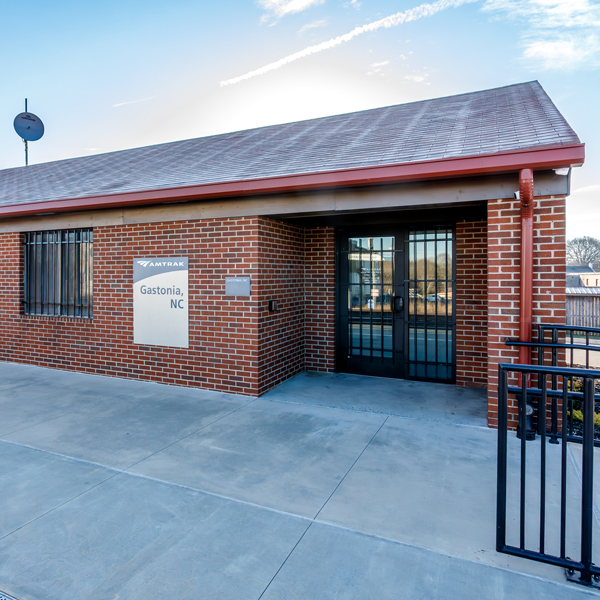
- Facility Ownership: Norfolk Southern Railway
- Parking Lot Ownership: Norfolk Southern Railway
- Platform Ownership: Norfolk Southern Railway
- Track Ownership: Norfolk Southern Railway
Denise Miller
Regional Contact
governmentaffairsnyc@amtrak.com
For information about Amtrak fares and schedules, please visit Amtrak.com or call 1-800-USA-RAIL (1-800-872-7245).
Passengers at Gastonia use a small brick structure located northeast of downtown and just south of Interstate 85. The city’s passenger rail service originated in 1873; however, the original train station on Air Line Avenue was bulldozed in the early 1960s. The stop was moved to its present location on Hancock Avenue in 1987, due to the city’s railroad relocation program, which Gastonia natives call “the ditch.” Planned since the 1960s to streamline traffic and eliminate accidents around railroad crossings, the program moved Southern Railway’s tracks about 200 feet north and eliminated Air Line Avenue. It created a 30-foot-deep trench, which removed ground-level train traffic from downtown.
In spring 2023, Amtrak completed a $3.2 million improvement project at the Gastonia station. Amtrak, working with the city, the North Carolina Department of Transportation and Norfolk Southern (NS), advanced a series of accessibility improvements that included the construction of a new concrete platform with all new lighting, guardrails and signage. Additional work was undertaken in the depot to create an accessible restroom, renovate the waiting room and replace the heating and cooling system. The parking lot was also paved with an entrance driveway and two accessible parking spaces for customers who use wheeled mobility devices. Three new ramps with railings ensure accessible paths of travel for passengers with disabilities between the platform, depot and parking.
Gastonia is located in the south-central Piedmont region of North Carolina, close to the South Carolina border. In the eighteenth century, early European-American settlers in the Gaston County area were Scottish-Irish, Pennsylvania Dutch and English, and made their livings on small, self-sufficient farms. Corn grew particularly well, and by 1870, Gaston County was known as the “Banner Corn Whiskey County of North Carolina.”
In addition to distilleries, mines in various parts of the county yielded gold, lime, sulfur and tin. But it was between 1848 and 1855 that Gaston County began to grow with the establishment of three cotton mills, and that is what eventually brought prosperity to Gastonia proper.
The city started out as a junction settlement between the Charlotte and Atlanta Air Line Railroad (now part of NS) and the Chester and Lenoir Narrow Gauge Line, shifting the focus in that location from agriculture to what would become one of the largest centers for textile production in the world. During the reconstruction era after the Civil War, Gastonia incorporated as a city on January 26, 1877.
By 1910, Gastonia was home to 11 cotton mills and a thriving population, with a public school system, electric lights and paved roads; and in 1911 it became the county seat. Gastonia, today the largest city in Gaston County, is part of the Charlotte metropolitan area and still retains its large manufacturing base and textile mills.
Also in 1911, the Piedmont & Northern Railway (P&N) ran the city’s first and only streetcar. It was retired in 1948, overwhelmed by competition from automobiles and their traffic. P&N also ran a 23-mile interurban freight and passenger railroad to Charlotte, constructed by James B. Duke of Duke Power in 1911. Passenger service on the P&N ceased in 1951, due to the popularity of automobile travel.
Station Building (with waiting room)
Features
- ATM not available
- No elevator
- No payphones
- No Quik-Trak kiosks
- No Restrooms
- Unaccompanied child travel not allowed
- No vending machines
- No WiFi
- Arrive at least 30 minutes prior to departure
Baggage
- Amtrak Express shipping not available
- No checked baggage service
- No checked baggage storage
- Bike boxes not available
- No baggage carts
- Ski bags not available
- No bag storage
- Shipping boxes not available
- No baggage assistance
Parking
- Same-day parking is available; fees may apply
- Overnight parking is available; fees may apply
Accessibility
- No payphones
- Accessible platform
- No accessible restrooms
- No accessible ticket office
- Accessible waiting room
- No accessible water fountain
- Same-day, accessible parking is available; fees may apply
- Overnight, accessible parking is available; fees may apply
- No high platform
- No wheelchair
- Wheelchair lift available
Hours
Station Waiting Room Hours
| Mon | 12:00 am - 01:10 am 02:10 am - 03:45 am 11:35 pm - 11:59 pm |
| Tue | 12:00 am - 01:10 am 02:10 am - 03:45 am 11:35 pm - 11:59 pm |
| Wed | 12:00 am - 01:10 am 02:10 am - 03:45 am 11:35 pm - 11:59 pm |
| Thu | 12:00 am - 01:10 am 02:10 am - 03:45 am 11:35 pm - 11:59 pm |
| Fri | 12:00 am - 01:10 am 02:10 am - 03:45 am 11:35 pm - 11:59 pm |
| Sat | 12:00 am - 01:10 am 02:10 am - 03:45 am 11:35 pm - 11:59 pm |
| Sun | 12:00 am - 01:10 am 02:10 am - 03:45 am 11:35 pm - 11:59 pm |
 Amtrak established the Great American Stations Project in 2006 to educate communities on the benefits of redeveloping train stations, offer tools to community leaders to preserve their stations, and provide the appropriate Amtrak resources.
 Amtrak is seizing a once-in-a-lifetime opportunity to transform rail and Retrain Travel. By modernizing, enhancing and expanding trains, stations and infrastructure, Amtrak is meeting the rising demand for train travel. Amtrak offers unforgettable experiences to more than 500 destinations across 46 states and parts of Canada. Learn more at