

Eugene, OR - Amtrak Station (EUG)
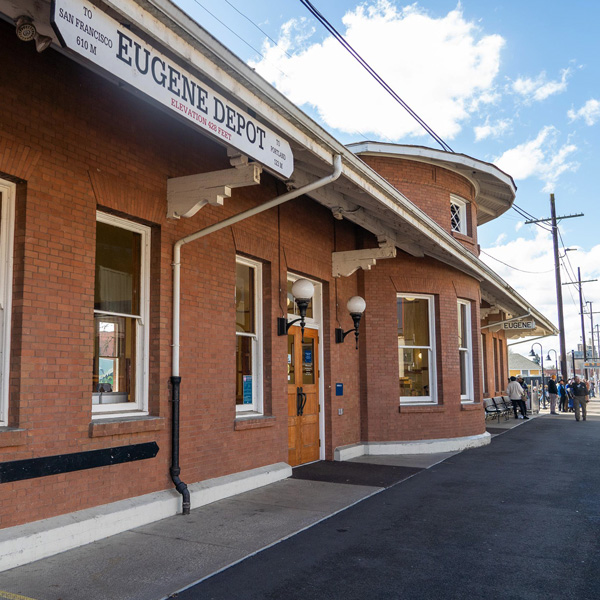
Located at the confluence of the McKenzie and Willamette rivers, the city was settled in the mid-19th century. The historic 1908 Southern Pacific depot has been rehabilitated by the city.
Amtrak Station
433 Willamette Street
Eugene, OR 97401-2613
- Facility Ownership: City of Eugene
- Parking Lot Ownership: City of Eugene
- Platform Ownership: Union Pacific Railroad
- Track Ownership: Union Pacific Railroad
Alex Khalfin
Regional Contact
governmentaffairssea@amtrak.com
For information about Amtrak fares and schedules, please visit Amtrak.com or call 1-800-USA-RAIL (1-800-872-7245).
Eugene’s masonry station, one of five such remaining along the original Southern Pacific Railroad west coast line, was built in 1908 for the Southern Pacific Railroad; it was listed on the National Register of Historic Places on August 16, 2008. Both the depot and the park that originally surrounded it were part of the City Beautiful movement of the early 20th century.
The brick structure is the third built on the spot: in 1908, with the city booming, local business leaders lobbied Southern Pacific to build a new, fancier station. The depot was constructed as an amalgam of several styles, though it consists of simple forms and is designed for utility. Its low horizontal appearance, wide eave overhangs, large wooden brackets, tall double-hung windows and diamond-paned dormers are reminiscent of the Craftsman style. The red brick construction and semi-circular bay window facing the track are characteristic of the Richardsonian Romanesque aesthetic. The city and the railroad shared the $40,000 cost of this project.
Southern Pacific sold the building to the Jenova Land Company in 1993 and in 2003 the city of Eugene bought the depot and the office/bunkhouse as part of a plan to develop a regional transportation center. The city oversaw the 2004 $4.5 million restoration with $3.5 million in federal money. Workers restored the exterior brickwork and trim and gutted and renovated the 5,346-square-foot interior, installing tile floors, oak and fir trim, covered ceilings, new wooden benches and expanded bathrooms.
Eugene lies in the southern part of the Willamette Valley in northwest Oregon, at the confluence of the McKenzie and Willamette rivers. Before the first European settlers arrived, it was occupied by the Kalapuya tribe, who were hunters and gatherers. The first cabin in what became Eugene was raised in 1846 by Eugene Franklin Skinner, and served as a general trading post and later, post office. Eugene City was platted and recorded in 1852; however, after heavy winter rains, it earned the name of “Skinner’s Mud Hole.” A revised town plat was made in 1853 on higher ground.
As soon as settlers arrived—the fertile Willamette Valley being the desired endpoint of the Oregon Trail—so did industry; and lumber, woolen and flour mills were established along the Willamette River. Eugene City was incorporated in 1862. However, the town is best known for being the home of the University of Oregon. Columbia College, founded in 1872, fell victim to two major fires in two years. When the legislature created the university, Eugene bested nearby Albany in competition for locating the university, and it was built on donated hilltop land in the city, opening on October 16, 1876. The former location of Columbia College is now part of the university.
Eugene and the University of Oregon are noted for their diversity, liberal attitudes and community inventiveness. This city is also noted for its large communities of artists and outdoor enthusiasts, as the weather is mild and Mediterranean.
The Amtrak Cascades are primarily financed through funds made available by the Washington State Department of Transportation and the Oregon Department of Transportation.
Station Building (with waiting room)
Features
- ATM not available
- No elevator
- Payphones
- Quik-Trak kiosks
- Restrooms
- Ticket sales office
- Unaccompanied child travel allowed
- Vending machines
- No WiFi
- Arrive at least 45 minutes prior to departure if you're checking baggage or need ticketing/passenger assistance
- Arrive at least 30 minutes prior to departure if you're not checking baggage or don't need assistance
Baggage
- Amtrak Express shipping not available
- Checked baggage service available
- Checked baggage storage available
- Bike boxes for sale
- Baggage carts available
- Ski bags for sale
- Bag storage with Fee
- Shipping Boxes for sale
- Baggage assistance provided by Station Staff
Parking
- Same-day parking is available for a fee
- Overnight parking is available for a fee
Accessibility
- Payphones
- Accessible platform
- Accessible restrooms
- Accessible ticket office
- Accessible waiting room
- Accessible water fountain
- Same-day, accessible parking is available for a fee
- Overnight, accessible parking is available for a fee
- No high platform
- Wheelchair available
- Wheelchair lift available
Hours
Station Waiting Room Hours
| Mon | 06:30 am - 09:00 pm |
| Tue | 06:30 am - 09:00 pm |
| Wed | 06:30 am - 09:00 pm |
| Thu | 06:30 am - 09:00 pm |
| Fri | 06:30 am - 09:00 pm |
| Sat | 06:30 am - 09:00 pm |
| Sun | 06:30 am - 09:00 pm |
Ticket Office Hours
| Mon | 06:30 am - 09:00 pm |
| Tue | 06:30 am - 09:00 pm |
| Wed | 06:30 am - 09:00 pm |
| Thu | 06:30 am - 09:00 pm |
| Fri | 06:30 am - 09:00 pm |
| Sat | 06:30 am - 09:00 pm |
| Sun | 06:30 am - 09:00 pm |
Passenger Assistance Hours
| Mon | 06:30 am - 09:00 pm |
| Tue | 06:30 am - 09:00 pm |
| Wed | 06:30 am - 09:00 pm |
| Thu | 06:30 am - 09:00 pm |
| Fri | 06:30 am - 09:00 pm |
| Sat | 06:30 am - 09:00 pm |
| Sun | 06:30 am - 09:00 pm |
Checked Baggage Service
| Mon | 06:30 am - 09:00 pm |
| Tue | 06:30 am - 09:00 pm |
| Wed | 06:30 am - 09:00 pm |
| Thu | 06:30 am - 09:00 pm |
| Fri | 06:30 am - 09:00 pm |
| Sat | 06:30 am - 09:00 pm |
| Sun | 06:30 am - 09:00 pm |
Parking Hours
| Mon | 24 HOURS |
| Tue | 24 HOURS |
| Wed | 24 HOURS |
| Thu | 24 HOURS |
| Fri | 24 HOURS |
| Sat | 24 HOURS |
| Sun | 24 HOURS |
Quik-Track Kiosk Hours
| Mon | 06:30 am - 09:00 pm |
| Tue | 06:30 am - 09:00 pm |
| Wed | 06:30 am - 09:00 pm |
| Thu | 06:30 am - 09:00 pm |
| Fri | 06:30 am - 09:00 pm |
| Sat | 06:30 am - 09:00 pm |
| Sun | 06:30 am - 09:00 pm |
Lounge Hours
Amtrak Express Hours
| Mon | CLOSED |
| Tue | CLOSED |
| Wed | CLOSED |
| Thu | CLOSED |
| Fri | CLOSED |
| Sat | CLOSED |
| Sun | CLOSED |
 Amtrak established the Great American Stations Project in 2006 to educate communities on the benefits of redeveloping train stations, offer tools to community leaders to preserve their stations, and provide the appropriate Amtrak resources.
 Amtrak is seizing a once-in-a-lifetime opportunity to transform rail and Retrain Travel. By modernizing, enhancing and expanding trains, stations and infrastructure, Amtrak is meeting the rising demand for train travel. Amtrak offers unforgettable experiences to more than 500 destinations across 46 states and parts of Canada. Learn more at