

Emeryville, CA (EMY)
When the station opened in 1994, it was the first new intercity passenger rail facility built in Northern California in more than half a century. Emeryville is an important transfer point for Amtrak Thruway Bus services.
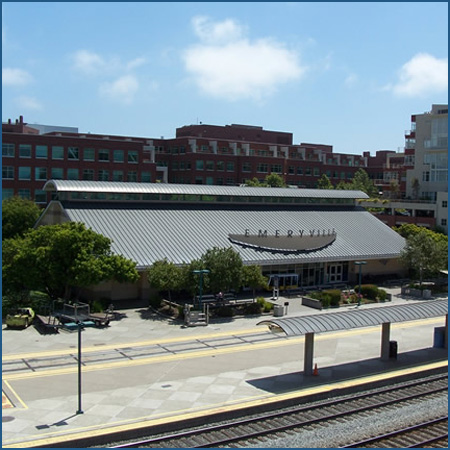
5885 Horton Street
Emeryville, CA 94608-2037
- Facility Ownership: Amtrak
- Parking Lot Ownership: Wareham Development
- Platform Ownership: Amtrak
- Track Ownership: Union Pacific Railroad Company (UP)
Alex Khalfin
Regional Contact
governmentaffairsoak@amtrak.com
For information about Amtrak fares and schedules, please visit Amtrak.com or call 1-800-USA-RAIL (1-800-872-7245).
Located between Berkeley and Oakland, this full-service station opened in 1994 to replace Amtrak’s 16th Street station in nearby Oakland, which was condemned after the 1989 Loma Prieta earthquake. Emeryville was the first new train station to be built in Northern California in more than 60 years, and it is an important transfer point for passengers using Amtrak Thruway Buses to reach destinations across the bay in San Francisco. It is also served by local buses.
Before colonization by the Spanish, the area that would become Emeryville was the site of extensive Native American settlements for more than 2,400 years, as the local mudflats had abundant shellfish, hunting, fishing, and oak trees; the acorns of which they used as food. Close by the present-day station lie the remnants, beneath the Bay Street Shopping Center, of a major native shell mound created from thousands of years of year-round ceremonial feasting and burial. This mound is the largest of more than 400 which lay in the Bay Area. It is estimated that more than 700 burials were made in the mound. The city, with the native Ohlone representatives, has incorporated memorialization and interpretive elements into the Bay Street project, and relocated many of the burials.
When the Spanish came to the area in the late 18th and early 19th centuries, the mound was about 40 feet high and 350 feet in diameter, rising well above the local mudflats. In 1876 an amusement park was started over top of the mound. Shellmound Park provided a race track, bars and dance pavilions; the top of the conical mound provided the site of a large dance pavilion sheltered in a ring of cypress trees. The adjacent Shellmound Park railway station, built in the 1870s, provided access for tourists, many of whom came across by ferry from San Francisco.
Max Uhle, an archaeologist associated with UC Berkeley anthropology department, pioneered some very advanced excavation techniques on this shell mound in 1902. The park remained in operation until 1924, when the mound was re-graded, destroying much of it, to make way for industrial development, specifically paint and pesticide manufacturing. In 1999, the mound was rediscovered and re-excavated, though the toxic industrial by-products found in the soil made the work dangerous and difficult.
Emeryville was named after Joseph Stickney Emery, who came during the Gold Rush and acquired large tracts of land on San Francisco Bay. In 1884, Emery was president of a narrow-gauge railroad that ran from Oakland to Orinda, to the Santa Fe right-of-way. The city was incorporated on December 2, 1896, and grew quickly into an industrial center, with meat-packing plants, Judson Iron Works, the Sherwin-Williams paint company, Shell Development (Shell Oil’s research arm) and International Harvester truck manufacturing among others.
Today, in the city’s post-industrial era, the old Santa Fe and Key System yards have been turned into large shopping and residential areas; biotechnology and software have replaced heavy industry; and the city is renowned as home of Pixar Studios, famous for its 3-D graphics films. Strong real estate development has occurred in the area surrounding the new station, spurred largely by the ideal location of Emeryville between Berkeley and Oakland, and adjacent to San Francisco. There has been tremendous commercial and residential growth around the station.
The Gold Runner service is primarily financed through funds made available by the State of California, Department of Transportation, and is managed by the San Joaquin Joint Powers Authority. The Capitol Corridor route is primarily financed and operated in partnership with the State of California. It is managed by the Capitol Corridor Joint Powers Authority (CCJPA), which partners with Amtrak, the Union Pacific Railroad, Caltrans and the communities comprising the CCJPA to continue development of a cost-effective, viable and safe intercity passenger rail service.
Station Building (with waiting room)
Features
- ATM available
- No elevator
- Payphones
- Quik-Trak kiosks
- Restrooms
- Ticket sales office
- Unaccompanied child travel allowed
- Vending machines
- No WiFi
- Boarding gates close 5 Min before train departure time
- Arrive at least 45 minutes prior to departure if you're checking baggage or need ticketing/passenger assistance
- Arrive at least 30 minutes prior to departure if you're not checking baggage or don't need assistance
Baggage
- Amtrak Express shipping not available
- Checked baggage service available
- Checked baggage storage available
- Bike boxes for sale
- No baggage carts
- Ski bags for sale
- Bag storage
- Shipping Boxes for sale
- Baggage assistance provided by Ticket Clerks / Baggagemen
Parking
- Same-day parking is available; fees may apply
- Overnight parking is available; fees may apply
Accessibility
- Payphones
- Accessible platform
- Accessible restrooms
- Accessible ticket office
- Accessible waiting room
- Accessible water fountain
- Same-day, accessible parking is available; fees may apply
- Overnight, accessible parking is available; fees may apply
- No high platform
- Wheelchair available
- Wheelchair lift available
Hours
Station Waiting Room Hours
| Mon | 05:45 am - 10:30 pm |
| Tue | 05:45 am - 10:30 pm |
| Wed | 05:45 am - 10:30 pm |
| Thu | 05:45 am - 10:30 pm |
| Fri | 05:45 am - 10:30 pm |
| Sat | 05:45 am - 10:30 pm |
| Sun | 05:45 am - 10:30 pm |
Ticket Office Hours
| Mon | 05:45 am - 10:30 pm |
| Tue | 05:45 am - 10:30 pm |
| Wed | 05:45 am - 10:30 pm |
| Thu | 05:45 am - 10:30 pm |
| Fri | 05:45 am - 10:30 pm |
| Sat | 05:45 am - 10:30 pm |
| Sun | 05:45 am - 10:30 pm |
Passenger Assistance Hours
| Mon | 05:45 am - 10:30 pm |
| Tue | 05:45 am - 10:30 pm |
| Wed | 05:45 am - 10:30 pm |
| Thu | 05:45 am - 10:30 pm |
| Fri | 05:45 am - 10:30 pm |
| Sat | 05:45 am - 10:30 pm |
| Sun | 05:45 am - 10:30 pm |
Checked Baggage Service
| Mon | 05:45 am - 10:30 pm |
| Tue | 05:45 am - 10:30 pm |
| Wed | 05:45 am - 10:30 pm |
| Thu | 05:45 am - 10:30 pm |
| Fri | 05:45 am - 10:30 pm |
| Sat | 05:45 am - 10:30 pm |
| Sun | 05:45 am - 10:30 pm |
Parking Hours
| Mon | 12:01 am - 11:59 pm |
| Tue | 12:01 am - 11:59 pm |
| Wed | 12:01 am - 11:59 pm |
| Thu | 12:01 am - 11:59 pm |
| Fri | 12:01 am - 11:59 pm |
| Sat | 12:01 am - 11:59 pm |
| Sun | 12:01 am - 11:59 pm |
Quik-Track Kiosk Hours
| Mon | 05:45 am - 10:30 pm |
| Tue | 05:45 am - 10:30 pm |
| Wed | 05:45 am - 10:30 pm |
| Thu | 05:45 am - 10:30 pm |
| Fri | 05:45 am - 10:30 pm |
| Sat | 05:45 am - 10:30 pm |
| Sun | 05:45 am - 10:30 pm |
 Amtrak established the Great American Stations Project in 2006 to educate communities on the benefits of redeveloping train stations, offer tools to community leaders to preserve their stations, and provide the appropriate Amtrak resources.
 Amtrak is seizing a once-in-a-lifetime opportunity to transform rail and Retrain Travel. By modernizing, enhancing and expanding trains, stations and infrastructure, Amtrak is meeting the rising demand for train travel. Amtrak offers unforgettable experiences to more than 500 destinations across 46 states and parts of Canada. Learn more at