

Dyer, IN (DYE)
Prussian farmers settled the area in the 1830s, and by the late 19th century the community was at the junction of several railroads, including the Michigan Central and Monon.
- Facility Ownership: Amtrak
- Parking Lot Ownership: Amtrak
- Platform Ownership: Amtrak
- Track Ownership: CSX Transportation
Marty Sandoval
Regional Contact
governmentaffairschi@amtrak.com
For information about Amtrak fares and schedules, please visit Amtrak.com or call 1-800-USA-RAIL (1-800-872-7245).
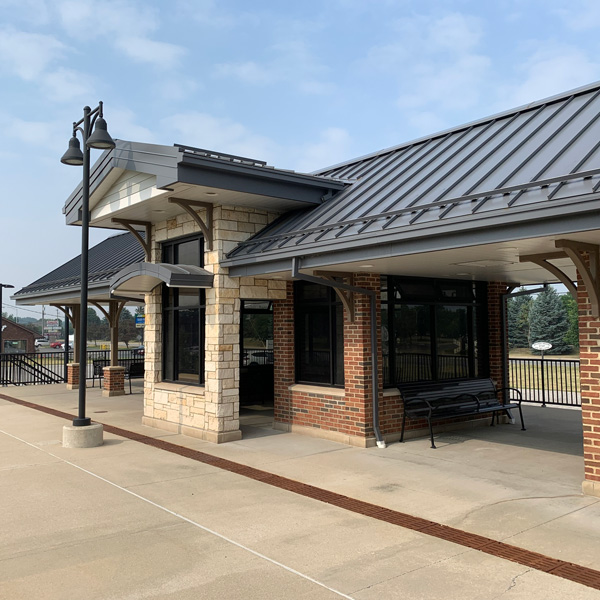
Amtrak opened a new ADA-compliant shelter at Dyer in the summer of 2014; it replaced a smaller aluminum and glass structure erected in 1986. In addition to the building, the station includes a new concrete platform with tactile edging, accessible parking stalls, light standards and improved signage. Developed by d+A design+Architecture, LLC of Yardley, Pennsylvania, the station design draws inspiration from historic late 19th and early 20th century depots found in small towns across the nation.
Composed primarily of red brick, the structure has an enclosed, one-story waiting room with large windows that not only keep out the wind, but also allow ample sunlight to flood and brighten the space. On the principal facades facing the street and the tracks, the waiting room is marked by stylized projecting bays with deep eaves. Their surfaces are covered in a rock-faced, coursed ashlar in a light beige tone that adds texture to the elevation and provides a strong contrast against the brick. Recessed canopies, supported by squared posts sporting curved brackets, flank the waiting room and visually expand the station’s presence along the tracks. Benches in the waiting room and beneath the canopies provide abundant seating throughout the year’s changing seasons.
Travelers with an eye for detail might notice that the Dyer shelter is a close cousin to those constructed in Alliance, Ohio; Connellsville, Pa.; Winnemucca, Nev. and Okeechobee, Fla.
The first European-descended settlers, primarily Prussian farmers, arrived in Northwest Indiana in approximately 1830. At that time, the area was home to the Potawatomi tribe. In 1838 the original State Line House was built on the much-used Sauk Trail to Chicago as an overnight stopping place. The town was first platted in June 1855.
Aaron Norton Hart, a Philadelphia publisher, moved his family to the area in 1857. The family, which originally owned 15,000 acres in the area, became a prominent employer in local business and commerce. Hart’s wife, Martha Dyer Hart, lent her maiden name to the town when it was incorporated on January 24, 1910.
Dyer found itself at the junction of several railroads, beginning in 1857 when the Michigan Central established a depot in this farming community and built a grain elevator nearby. The Monon Railroad (also known as the Chicago, Indianapolis and Louisville) operated through Dyer from around 1897 to about 1971, when the railroad merged with the Louisville and Nashville Railroad. Monon passenger trains operated until 1967 and were much used by the six colleges and universities along its line, now used by Amtrak. The wooden Monon depot and control tower sat at the at-grade junction of the Monon (now CSXT) and Elgin, Joliet and Eastern (EJ&E) lines until almost 1980; no building remains at that site today. The current station sits slightly to the north of that junction. While no business in town is now served directly by the freight lines, they remain very busy—so much so that an increase of freight traffic anticipated as the result of the acquisition of the EJ&E in 2008 was at one point a serious community issue.
During the early 1920s, Dyer achieved national focus when an experimental model highway section was constructed stretching three miles form Dyer to Schererville. Called the “Ideal Section of the Lincoln Highway,” the experiment, financed by federal, state, and county governments and the U.S. Rubber Company, set the standards for highway construction in the United States.
Platform with Shelter
Features
- ATM not available
- No elevator
- No payphones
- No Quik-Trak kiosks
- No Restrooms
- Unaccompanied child travel not allowed
- No vending machines
- No WiFi
- Arrive at least 0 minutes prior to departure
Baggage
- Amtrak Express shipping not available
- No checked baggage service
- No checked baggage storage
- Bike boxes not available
- No baggage carts
- Ski bags not available
- No bag storage
- Shipping boxes not available
- No baggage assistance
Parking
- Same-day parking is available; fees may apply
- Overnight parking is available; fees may apply
Accessibility
- No payphones
- Accessible platform
- No accessible restrooms
- No accessible ticket office
- Accessible waiting room
- No accessible water fountain
- Same-day, accessible parking is available; fees may apply
- Overnight, accessible parking is available; fees may apply
- No high platform
- No wheelchair
- Wheelchair lift available
Hours
 Amtrak established the Great American Stations Project in 2006 to educate communities on the benefits of redeveloping train stations, offer tools to community leaders to preserve their stations, and provide the appropriate Amtrak resources.
 Amtrak is seizing a once-in-a-lifetime opportunity to transform rail and Retrain Travel. By modernizing, enhancing and expanding trains, stations and infrastructure, Amtrak is meeting the rising demand for train travel. Amtrak offers unforgettable experiences to more than 500 destinations across 46 states and parts of Canada. Learn more at