

Chicago, IL - Union Station (CHI)
Best known for its majestic Great Hall, often bathed in soft light, Chicago Union Station is the hub for mid-western corridor services and long-distance trains serving the West.
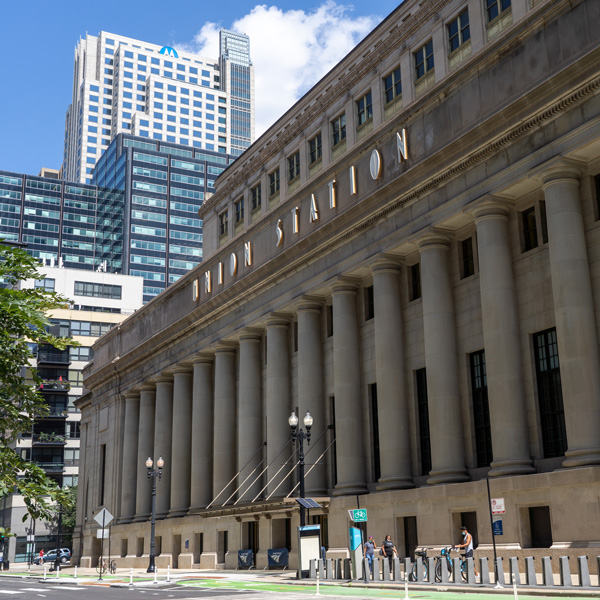
Union Station
255 South Clinton Street
Chicago, IL 60606-5702
- Facility Ownership: Amtrak
- Parking Lot Ownership: N/A
- Platform Ownership: Amtrak
- Track Ownership: Amtrak
Marty Sandoval
Regional Contact
governmentaffairschi@amtrak.com
For information about Amtrak fares and schedules, please visit Amtrak.com or call 1-800-USA-RAIL (1-800-872-7245).
Chicago Union Station, begun in 1913 and completed in 1925, was built through a partnership among four railroads: the Pennsylvania Railroad; Chicago, Burlington and Quincy Railroad; Michigan Central Railroad; and the Chicago, Milwaukee and St. Paul Railway. The Chicago and Alton Railroad also used the station as a tenant. Together, the railroads owned shares in the Chicago Union Station Company (CUSCo), which managed station operations.
They desired a grand station befitting the city’s status as a national railroad hub, and this $75 million facility replaced the city’s overcrowded 1881 Grand Passenger Station. Daniel Burnham, Chicago’s famous architect who was also responsible for designing Washington, D.C.’s Union Station, began designing this Beaux Arts structure, but he died before plans were completed. Successor firm Graham, Anderson, and Probst, later joined by White, took over the project.
Union Station is the only example in the United States of a “double-stub” station, where the 24 tracks approach from two directions and most do not continue under or through the station. The exterior of the building is clad in Bedford limestone quarried in Indiana. Together with the approach and storage tracks, the entire station facility takes up nearly 10 city blocks. The original complex incorporated two different buildings on either side of Canal Street, connected below street level.
The west side building, the headhouse, contains the Great Hall—the waiting room, if such a mundane term may be applied for this soaring, beautiful space. The Great Hall has a 219-foot long barrel-vaulted skylight that soars 115 feet above the floor. The skylight was blacked-out during World War II in order to make the station less of a target for enemy aircraft, since the station then served nearly 100,000 daily passengers and more than 300 daily arrivals and departures. Two figural sculptures by Henry Hering tower over the Great Hall on its east wall, one represents “Day” (holding a rooster) and the other represents “Night” (holding an owl), a recognition of the 24-hour nature of passenger railroading.
While the magnificent, historic Great Hall is used for major events and has been seen on TV and in films such as The Untouchables, My Best Friend’s Wedding, Chain Reaction, ER and Early Edition—it was always meant to be a working structure and was designed to accommodate large crowds and heavy daily use. Along with marble floors, long wooden benches, marble walls with large Corinthian columns, and the Great Hall’s grand staircase, the headhouse also has side halls and office space. According to the original plan, the building would have had 26 floors of office space, but only eight were completed.
The companion to the headhouse was the concourse building, on the east side of Canal Street. This glass-vaulted concourse was modeled upon that of the historic Pennsylvania Station in New York City. In the 1930s, CUSCo sold the air rights above the tracks to the north and south of the concourse building for the construction of facilities for the Chicago Daily News and what was then the nation’s largest post office. Both buildings have since changed owners and uses.
In 1969, the predecessor railroads that owned CUSCo sold the air rights above the tracks and platforms of the concourse for the construction of two office buildings. The concourse building was then demolished, resulting in limited floor space and ceiling height in what is now known as the Concourse Level of Chicago Union Station.
In 1991, work was completed on a $32 million passenger facilities improvement project that included renewal of the station’s waiting areas, new ticket windows and baggage handling system and the removal of the black-out paint from the Great Hall’s skylight. The renovation changed the flow of passenger traffic through the station to separate Amtrak customers from local passengers using Metra commuter trains. Lucien Lagrange & Associates handled the design of the project, which dramatically improved the facilities created when the concourse building was razed. On May 1, 2002, the station was designated a Chicago Landmark.
For many years, the upper stories of Union Station were vacant since they required extensive rehabilitation to bring them in accordance with modern building and life safety codes. In early 2012, Amtrak completed a $25 million infrastructure improvement project that included work in the sub-basement, Great Hall and the upper office floors. Located below the water-level of the nearby Chicago River, the sub-basement presented logistical challenges that were met by careful planning and advanced technology such as 3D laser scanning. Minneapolis-based Mortenson Construction had to carefully remove old mechanical systems from the space in order to install five industrial boilers and two 600-ton chillers.
A new air conditioning system was installed in the Great Hall to make it more comfortable for passengers during the warm summer months. With this improvement in place, the beautiful space is available for year-round rental for special events. In the upper office stories, crews replaced or upgraded mechanical, plumbing and electrical systems and also installed fire safety equipment such as sprinklers. Amtrak subsequently moved its regional offices back into the station, occupying two floors; the rest are available for lease to commercial tenants. The income produced from rent is dedicated to operating costs and maintenance.
Since 1972, all Amtrak services in Chicago originate and terminate at Chicago Union Station, fulfilling Burnham’s 1909 vision of all intercity trains using the same station without confusing station transfers, complicated rail car movements, difficult baggage forwarding and complex ticketing previously endured by generations of travelers. Union Station is also the largest of the downtown terminals used by Metra, which is formally known as the Northeast Illinois Regional Commuter Rail Corporation.
Metra operates commuter rail service between downtown Chicago and 240 stations in northeast Illinois, on 11 routes covering approximately 500 miles of service territory. Six of Metra’s 11 routes operate into and out of Union Station. On a typical weekday, approximately 120,000 Amtrak and Metra passengers pass through the station.
The railroads that formed CUSCo have since been absorbed by other lines and no longer exist as independent firms. The names of these founding railroads are remembered on windows between the Canal Street entrances to Union Station and the Great Hall. CUSCo was wholly owned by Amtrak from May 1984, when the remaining ownership shares were purchased from what are now BNSF and the Canadian Pacific Railway. In 2017, CUSCo was dissolved into the National Railroad Passenger Corporation—better known as Amtrak.
In May 2012, the Chicago Department of Transportation (CDOT)—in cooperation with Amtrak, Metra, the Chicago Transit Authority, Illinois Department of Transportation and other stakeholders—released the Chicago Union Station Master Plan Study. The product of extensive research and discussion, the document sets out short term plans to improve Union Station, and also explores mid-range (5-10 years) and long-term (10+ years) visions for the facility.
The goals of the master plan include: provide sufficient capacity for significant increases in Metra and intercity passenger train ridership; make the terminal more inviting for passengers; provide more direct and convenient intermodal transfers; and create a terminal that is a vibrant civic asset and a catalyst for growth in the West Loop and region. All of these planned and proposed projects are viewed as a way to prepare this major hub for additional train frequencies and potential high-speed rail services.
As part of the ongoing work to improve Union Station, Amtrak, Mayor Rahm Emanuel and Chicago area transportation leaders from Metra and the Regional Transportation Authority (RTA) gathered in October 2015 to announce a set of initiatives aimed at advancing the city-led master plan to redevelop the station.
Amtrak, the city of Chicago, Metra and the RTA agreed to jointly fund design services for improvements to address the most immediate passenger capacity, service, safety, accessibility and mobility issues at and around the station. This will advance work for renovation of an expanded concourse, expanded and added entrances, widening of platforms, disabilities compliance, pedestrian passageways and consider ventilation needs in the track and platform areas. In July 2016, Amtrak and its partners announced that Arup had been selected to lead these planning, historic review and preliminary engineering efforts. Work under this phase is expected to last approximately 18 months.
Amtrak completed a number of station improvements in 2015-2016, including replacement of door systems and heating system upgrades. In summer 2016, the new Metropolitan Lounge opened off of the Great Hall, more than doubling the space and adding amenities for customers who are ticketed in sleeping cars or in Business class, as well as Select Plus and Select Executive Amtrak Guest Rewards members. After stowing carry-on bags, customers may relax, enjoy complimentary snacks and beverages, work or even take a shower. At 13,500 square-feet and with seating for 360, the $7 million lounge replaced one opened in the Concourse in 1991. Moving this lounge into the historic headhouse enables Amtrak to reconfigure Concourse Level space in the future.
That fall, Amtrak celebrated the opening of the Burlington Room, a 3,900-square foot events space available for rent. Located in the former women’s lounge, the room had been shuttered for many years. Skilled craftspeople repaired water damage, deteriorating plasterwork, column capitals and colorful murals, and installed heating, air conditioning and modern audio-visual equipment. Lighting fixtures were also restored or recreated.
Due to these efforts, Landmarks Illinois, a statewide nonprofit agency that advocates for the protection of historic and architecturally significant properties, presented Amtrak with its 2016 Real Estate and Building Industries Council Award. It honors a recently redeveloped building or place and the project team responsible for the transformation.
In May 2017, Amtrak designated a team lead by Riverside Investment & Development Co. as the master developer for commercial elements of Union Station and neighboring Amtrak-owned properties. The initial conceptual design proposed by Riverside, in conjunction with co-developer and co-venture partner Convexity Properties – a DRW Company, includes three phases projected to be completed in about six years. Key project priorities include improved street entrances and pedestrian traffic flow entering and leaving Union Station, as well as improved pedestrian-friendly landscaping and open spaces.
Amtrak reached agreement in October 2018 with a group led by Riverside Development for an office tower on the block south of Union Station. The new building will connect to Union Station and the CTA’s Union Station Transit Center and include public green space, replacing a parking structure that is nearing the end of its useful life on the block bordered by Jackson Blvd., Clinton, Canal and Van Buren Streets.
Upon receipt of the proceeds, Amtrak will use some of the funds to activate remaining undeveloped spaces around the historic Great Hall for restaurants and other services, including the creation of a transformational new entrance to the headhouse on the western side of the station from Clinton Street. This will dramatically improve accessibility and allow the station to meet the needs of the fast growing business and residential areas in the West Loop.
In late 2018, Amtrak completed a self-funded $22 million project to restore the barrel-vaulted Great Hall skylight. Over the decades, it had deteriorated due to water damage and flaws within the original design. The work, undertaken by architect Goettsch Partners (GP) and contractor Berglund Construction, minimized disruption to the flow of people through the station by using a suspended working deck and swing stages, in lieu of much scaffolding.
In order to maintain the historic appearance of the skylight from within the Great Hall and to overcome the complications of the existing drainage system, the project team constructed a modern energy-efficient, outer skylight five feet above the historic skylight. The new skylight protects the historic skylight with a new drainage design and maintenance system. Natural light into the Great Hall increased by about 50 percent by replacing the 2,052 pieces of glass in the historic skylight with a textured glass surface matching the original look.
The overall project also included a new elevator from Canal Street, restoration of the “Day” and “Night” statues and 24 chandeliers, and installation of 27 reproduction light fixtures. Water-damaged plaster and stone was restored, and historic paint colors applied to the walls and ceiling.
In addition to its passenger-facing functions, Union Station is also home to the Joseph C. Szabo Chicago Control Center. This state-of-the-art facility manages and dispatches Amtrak and other rail traffic in four geographically separate areas, including Chicago Union Station North, Chicago Union Station South, New Orleans Terminal and the Amtrak Michigan District. Operations at the center involve interconnections with territories owned by the Metra, Norfolk Southern, BNSF and Canadian National railroads.
South of Union Station, Amtrak operates a switching yard that is responsible for maintaining coaches, sleeping and food service cars, baggage cars and locomotives used on all trains dispatched from Chicago. Trains are serviced, cleaned and stocked while locomotives are fueled and maintained on a regular cycle.
The name “Chicago” derives from a word in the language spoken by the Miami and Illinois native peoples meaning “striped skunk,” a word they also applied to the wild leek. This became the Indian name for the Chicago River, in recognition of the presence of wild leeks in the watershed. When early French explorers began adopting the word, with a variety of spellings, in the late 17th century, it came to refer to the site at the mouth of the Chicago River.
The short, swampy portage between the Chicago Rivers and the Des Plaines River—between the Great Lakes and the Mississippi River watershed—attracted the attention of French explorers in the 17th century. In 1696, French Jesuits built the Mission of the Guardian Angel in the area to Christianize the native peoples. The first permanent non-native settlement after this was Jean Baptiste Pointe du Sable, who built the first trading post on the Chicago River in the 1770s. The land was later ceded to the U.S. for a military outpost, used in the War of 1812. The Potawatomi ceded the land entirely in the 1816 Treaty of St. Louis. On August 12, 1833, the town of Chicago was incorporated, enclosing an area about 3/8 of a square mile. The state of Illinois granted the rapidly growing city its charter on March 4, 1837.
Since its inception, Chicago has been a trade nexus. The opening of the Illinois and Michigan Canal in 1848 permitted shipping from the Great Lakes through Chicago to the Mississippi River. The same year, the first rail line to Chicago, the Galena and Chicago Union Railroad, was completed; steam-powered grain elevators were introduced; the telegraph arrived; and the Chicago Board of Trade was founded.
In 1871, most of the city burned in the Great Chicago Fire. The damage from the fire was immense: 300 people died, 18,000 buildings were destroyed, and nearly a third of the residents were left homeless. The fire led to the incorporation of stringent fire-safety codes and a preference for masonry construction. However, the soft, swampy ground near the lake was unsuitable for tall masonry buildings, leading directly to the innovation of using steel frames in buildings and the invention of the skyscraper, making Chicago a leader in architecture and setting the model for achieving vertical city densities nationwide.
Between 1870 and 1900, Chicago grew from a city of 300,000 to nearly 1.7 million, the fastest-growing city ever at the time. The flourishing economy drew new residents from rural communities as well as immigrants from Europe. The city’s retail sectors came to dominate the Midwest and greatly influence the nation’s economy. The Chicago Union Stockyards dominated the meat-packing trade, and the city also became the world’s largest rail hub.
Many of the railroads built west of Chicago had corporate headquarters in the city, as well as their yards and shops. Chicago became a center of manufacture of freight cars, passenger cars (Pullman Company), and later, diesel locomotives (Electro-Motive, in suburban LaGrange). Until the 1960s, the Chicago Loop—the popular name for the Chicago business district located south of the main stem of the Chicago River—contained six major railroad terminals for intercity passenger traffic, as lines ended in Chicago, but did not pass through it.
Travelers would often take the necessary layover as an opportunity for sightseeing. Union Station is the busiest passenger terminal in Chicago and is most intact of the four remaining downtown train stations. Hundreds of thousands of area residents still commute to the Loop by train daily, via Metra’s numerous routes and on the Chicago Transit Authority trains that still circle the central business district on elevated tracks and in two subways on the eight route “L” system.
An early cultural high-point in the city’s history was the 1893 World’s Columbian Exposition, which was constructed on former marshland at the present location of Jackson Park, along Lake Michigan. The land was reclaimed according to a plan by architect Frederick Law Olmstead, and the pavilions, which followed a classical theme, were designed by a committee of the city’s architects under the direction of Daniel Burnham. This occasion was also the beginning of the Chicago School of Architecture, which continued to influence the world up through the middle of the 20th century.
Today, Chicago is the largest city in both Illinois and the Midwest, the third most populous city in the country, and a major transportation hub in the United States. The city is an important component of global trade, as it is the third largest intermodal port in the world after Hong Kong and Singapore. Additionally, it is the only city in North America where six Class I railroads meet, and about one-third of the nation’s freight trains move through Chicago.
The Amtrak Blue Water and Pere Marquette are financed primarily through funds made available by the Michigan Department of Transportation (DOT). Services on the Lincoln Service, Illinois Zephyr, Carl Sandburg, Illini, and Saluki are financed primarily through funds made available through the Illinois DOT. The Hiawatha Service is financed primarily through funds made available by the Wisconsin DOT, in a partnership with the Illinois DOT. The Borealis is financed primarily through funds made available by the Minnesota, Wisconsin and Illinois DOTs.
The following services are financed primarily through funds made available by the listed state departments of transportation (DOT):
- Blue Water and Pere Marquette – Michigan DOT.
- Lincoln Service, Illinois Zephyr, Carl Sandburg, Illini and Saluki – Illinois DOT.
- Hiawatha – Wisconsin and Illinois DOTs.
- Borealis – Minnesota, Wisconsin and Illinois DOTs.
Station Building (with waiting room)
Features
- ATM available
- Elevator
- Metropolitan Lounge
- Payphones
- Quik-Trak kiosks
- Restrooms
- Ticket sales office
- Unaccompanied child travel allowed
- Vending machines
- Amtrak WiFi available
- Boarding gates close 5 Min before train departure time
- Arrive at least 60 minutes prior to departure if you're checking baggage or need ticketing/passenger assistance
- Arrive at least 30 minutes prior to departure if you're not checking baggage or don't need assistance
Baggage
- Amtrak Express shipping not available
- Checked baggage service available
- No checked baggage storage
- Bike boxes for sale
- No baggage carts
- Ski bags for sale
- Bag storage with Fee
- Shipping Boxes for sale
- Baggage assistance provided by Red Caps
Parking
- Same-day parking is not available
- Overnight parking is not available
Accessibility
- Payphones
- Accessible platform
- Accessible restrooms
- Accessible ticket office
- Accessible waiting room
- Accessible water fountain
- Same-day, accessible parking is not available
- Overnight, accessible parking is not available
- No high platform
- Wheelchair available
- Wheelchair lift available
Hours
Station Waiting Room Hours
| Mon | 05:30 am - 11:59 pm |
| Tue | 05:30 am - 11:59 pm |
| Wed | 05:30 am - 11:59 pm |
| Thu | 05:30 am - 11:59 pm |
| Fri | 05:30 am - 11:59 pm |
| Sat | 05:30 am - 11:59 pm |
| Sun | 05:30 am - 11:59 pm |
Ticket Office Hours
| Mon | 06:00 am - 09:20 pm |
| Tue | 06:00 am - 09:20 pm |
| Wed | 06:00 am - 09:20 pm |
| Thu | 06:00 am - 09:20 pm |
| Fri | 06:00 am - 09:20 pm |
| Sat | 06:00 am - 09:20 pm |
| Sun | 06:00 am - 09:20 pm |
Passenger Assistance Hours
| Mon | 05:30 am - 11:30 pm |
| Tue | 05:30 am - 11:30 pm |
| Wed | 05:30 am - 11:30 pm |
| Thu | 05:30 am - 11:30 pm |
| Fri | 05:30 am - 11:30 pm |
| Sat | 05:30 am - 11:30 pm |
| Sun | 05:30 am - 11:30 pm |
Checked Baggage Service
| Mon | 08:00 am - 09:30 pm |
| Tue | 08:00 am - 09:30 pm |
| Wed | 08:00 am - 09:30 pm |
| Thu | 08:00 am - 09:30 pm |
| Fri | 08:00 am - 09:30 pm |
| Sat | 08:00 am - 09:30 pm |
| Sun | 08:00 am - 09:30 pm |
Parking Hours
| Mon | CLOSED |
| Tue | CLOSED |
| Wed | CLOSED |
| Thu | CLOSED |
| Fri | CLOSED |
| Sat | CLOSED |
| Sun | CLOSED |
Quik-Track Kiosk Hours
| Mon | 05:30 am - 11:59 pm |
| Tue | 05:30 am - 11:59 pm |
| Wed | 05:30 am - 11:59 pm |
| Thu | 05:30 am - 11:59 pm |
| Fri | 05:30 am - 11:59 pm |
| Sat | 05:30 am - 11:59 pm |
| Sun | 05:30 am - 11:59 pm |
Lounge Hours
| Mon | 08:00 am - 09:30 pm |
| Tue | 08:00 am - 09:30 pm |
| Wed | 08:00 am - 09:30 pm |
| Thu | 08:00 am - 09:30 pm |
| Fri | 08:00 am - 09:30 pm |
| Sat | 08:00 am - 09:30 pm |
| Sun | 08:00 am - 09:30 pm |
Amtrak Express Hours
| Mon | CLOSED |
| Tue | CLOSED |
| Wed | CLOSED |
| Thu | CLOSED |
| Fri | CLOSED |
| Sat | CLOSED |
| Sun | CLOSED |
 Amtrak established the Great American Stations Project in 2006 to educate communities on the benefits of redeveloping train stations, offer tools to community leaders to preserve their stations, and provide the appropriate Amtrak resources.
 Amtrak is seizing a once-in-a-lifetime opportunity to transform rail and Retrain Travel. By modernizing, enhancing and expanding trains, stations and infrastructure, Amtrak is meeting the rising demand for train travel. Amtrak offers unforgettable experiences to more than 500 destinations across 46 states and parts of Canada. Learn more at