

Carbondale, IL (CDL)
Named in recognition of local coal deposits, Carbondale developed as a mercantile and transport center in the late 19th century and subsequently became home to Southern Illinois University – Carbondale.
401 South Illinois Avenue
Carbondale, IL 62901
- Facility Ownership: City of Carbondale
- Parking Lot Ownership: City of Carbondale
- Platform Ownership: City of Carbondale
- Track Ownership: Canadian National Railway Company (CN) Illinois Central (IC) (A subsidiary of CN)
Marty Sandoval
Regional Contact
governmentaffairschi@amtrak.com
For information about Amtrak fares and schedules, please visit Amtrak.com or call 1-800-USA-RAIL (1-800-872-7245).
Amtrak began serving the new Southern Illinois Multimodal Station (SIMMS) in downtown Carbondale on May 19, 2025. The facility brings together Amtrak, local and regional buses, and the Southern Illinois University (SIU) Saluki Express shuttle in one convenient location. It is easily accessible by car and bicycle via bike lanes and a bikeway that runs parallel to the train tracks, connecting the station with the SIU campus about a half mile to the south.
The SIMMS was completed in two phases, the first of which brought together transportation functions with a spacious passenger waiting room, Amtrak ticket counter, restrooms and commercial space. Early tenants include an employment assistance and training program, followed by a co-working space. As part of the construction of Phase 2 that got underway in summer 2025 and concluded a year later, space was outfitted for JAX Mass Transit, Carbondale Tourism and an SIU Welcome Center.
An official grand opening for the SIMMS took place on August 28, 2026, and was attended by Illinois Governor JB Pritzker, U.S. Senators Tammy Duckworth and Dick Durbin, Carbondale Mayor Carolin Harvey, leaders from the Illinois Department of Transportation, and local and state officials. They joined with city residents to celebrate the occasion.
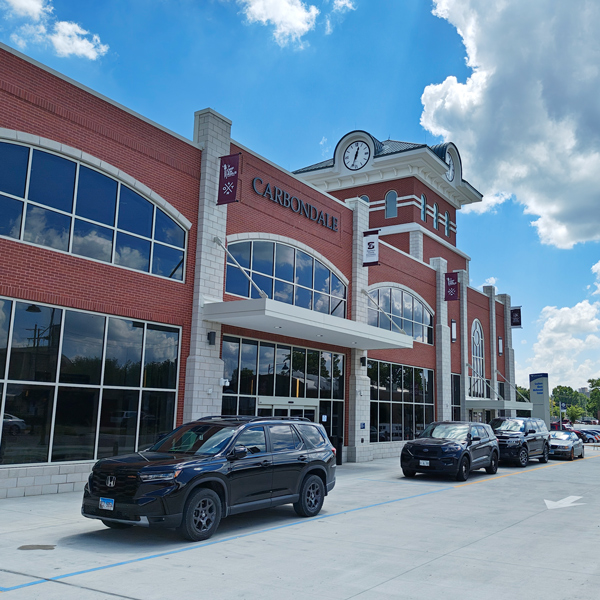
Designed by the team of Design Works/hmb Architects, LLC, the SIMMS is primarily built of red brick, and light grey masonry piers are used to divide the facades into a series of wide bays. Large banks of windows on the lower and upper levels of each bay allow ample natural light to enter the building interior. The grey masonry carries across the building at its base and in trim along the top edge of the upper-level windows, emphasizing their arched design. Marquees at the entryways protect visitors from inclement weather as they enter and exit the building. Terrazzo flooring used throughout the main floor provides an elegant yet durable surface, while the roof is covered in solar panels.
Located at W. Walnut Street and S. Illinois Avenue, the SIMMS sits catty corner to city hall. Facing the intersection, the building has a chamfered corner punctuated by a low tower with a hipped roof. The tower features an inset round medallion carved with the year the building opened; it is found above a brick panel with lettering spelling out “Carbondale.” By diagonally cutting off the northwest corner of the building, the designers allowed for installation of lanes used to drop off and pick up passengers, and a plaza with planting beds, benches and a gateway. The building’s southern end, completed as part of the Phase 2 buildout, is anchored by a clock tower that marks the principal entrance for Amtrak customers.
The approximately $26.2 million city-led project was more than a decade in the making, dating to when the city purchased the property in 2010 with the idea of creating a more modern transportation facility. The SIMMS was made possible through $18.3 million in federal funds, including a $14 million Better Utilizing Investments to Leverage Development (BUILD) transportation discretionary grant from the U.S. Department of Transportation (U.S. DOT); $2.8 million from the Illinois DOT Transit Improvement Program; $5.1 million in city funds; and a contribution from Amtrak to construct a new accessible platform.
American Indians had occupied the area around Carbondale for as long as 10,000 years prior to European American settlement. Now seen within the nearby Giant City State Park, the area’s large sandstone bluffs created an easily converted habitat that still bears traces of ancient building and the scars of ancient fires.
It was August 1852 when Daniel Harmon Brush, John Asgill Conner and Dr. William Richart bought a strategic 360-acre parcel between two proposed railroad sites – Makanda and DeSoto – and two county seats: Murphysboro and Marion. Brush named the new town “Carbondale” as he planned it to take advantage of the large coal deposits in the area. The town was incorporated by 1856.
The community’s first passenger and freight depot, built by Brush, opened on July 4, 1854, when the first train came north on Illinois Central Railroad’s (IC) main line. It was about two blocks north of the SIMMS, near where the Town Square Pavilion is today. The pavilion was assembled in 1992 using the hand-hewn beams from Brush’s first depot.
After the Civil War, the town observed one of the first Memorial Days, on April 29, 1866, honoring the 55 townsmen slain during the war. Economically, Carbondale developed as a mercantile and transport center, shipping both southern Illinois coal and fruit northward. The region gained the moniker “Little Egypt,” possibly because its fertile lands supplied grain to northern and central Illinois during times of poor harvests in the late 19th century. The SIU nickname, the “Salukis,” refers to the association with Egypt, as the saluki was the royal hunting dog of Ancient Egypt.
Carbondale grew into an important city along the IC, which opened a division office and was one of the city’s largest employers. Brush’s original depot served the community until 1903 when the IC built a new, larger depot a block to the south. This new building was the work of Francis T. Bacon, who also designed the IC depots at Champaign, Springfield and Decatur. Constructed of red brick with limestone trim and featuring a central section flanked by two lower wings, the depot served travelers until 1981, when the former Amtrak station opened.
The Amtrak depot, a one-story brick building, was constructed as part of a railroad relocation demonstration project, and it was located directly south of the SIMMS. Its architecture was in keeping with a standard station design then used by the railroad that incorporated floor-to-ceiling and clerestory windows, and a black cantilevered roof. It was demolished in June 2025 for construction of the SIMMS Phase 2.
Carbondale purchased the 1903 depot in 1990, and following extensive rehabilitation, it is now listed on the National Register of Historic Places and houses the Carbondale Train Museum. In addition to artifacts and other memorabilia related to the city’s railroading past and present, it offers visitors the opportunity to check out a caboose and diesel locomotive.
Educational opportunity has long been associated with Carbondale, which won the bid for the region’s new teacher training school in the late 19th century. Southern Illinois Normal University subsequently opened its doors in 1874. By 1943, the school had achieved limited university status with the ability to offer graduate degrees, and four years later it took on its present name. Over its history, SIU has been a prime motivating force in the city’s economy.
For many visitors to Carbondale, the university’s Sharp Museum is a key attraction. The institution traces its origins to the time of SIU’s founding and has long been open to the public. Its broad collection focuses on art, science and the humanities. Among its many holdings, visitors may view paintings, sculpture, decorative arts, regional folk arts, geological specimens and archaeological discoveries from Southern Illinois, Mexico, and Central and South America.
Carbondale proudly claims one of SIU’s professors, R. Buckminster Fuller, as its own; he taught at Carbondale from 1959 to 1970. Fuller was a pioneer of modern architecture and philosophy, believing that human societies should rely on renewable energy resources, such as solar and wind-derived electricity. He is very well known for his perfection of the geodesic dome as an architectural technique, inspiring the “Spaceship Earth” exhibit at Disney’s Epcot Center.
Fuller was awarded more than 20 U.S. patents and many honorary doctorates and other awards for his inventive thinking. Organic chemists honored him by naming a particular molecule of carbon after him because it formed a geodesic sphere: fullerene, or “buckyballs,” an amazing material that is making much of the advanced miniaturization of electronics possible, as well as being used to create extremely strong and light materials for machines, vehicles and buildings. Fuller and his wife, Anne Hewlitt Fuller, lived in a geodesic-domed house in Carbondale while he taught at the university. It was placed on the National Register of Historic Places in 2006.
In August 2017, Carbondale was one of the best locations in the United States from which to view a total solar eclipse, the first to stretch across the entire country from coast-to-coast since 1918. For 2 minutes and 38 seconds in Carbondale, the skies darkened as the moon passed between the sun and Earth. The city and SIU hosted a day-long party to celebrate the event, which attracted an estimated 60,000 visitors from around the world. Activities included a public viewing at the SIU football stadium, family-friendly games and scientific talks and presentations. Amtrak ran a special Eclipse Express from Chicago to Carbondale, supplementing regularly scheduled trains that serve the community.
In addition to its educational sector, Carbondale is also known as southern Illinois’ healthcare hub. It is home to Southern Illinois Healthcare (SIH) and SIH’s flagship hospital, Memorial Hospital of Carbondale. This facility houses practices in cardiac care, stroke, neurology, pediatrics and other specialties.
The Illini and Saluki are financed primarily through funds made available by the Illinois State Department of Transportation.
Station Building (with waiting room)
Features
- ATM not available
- No elevator
- No payphones
- Quik-Trak kiosks
- Restrooms
- Ticket sales office
- Unaccompanied child travel allowed
- Vending machines
- No WiFi
- Arrive at least 45 minutes prior to departure if you're checking baggage or need ticketing/passenger assistance
- Arrive at least 30 minutes prior to departure if you're not checking baggage or don't need assistance
Baggage
- Amtrak Express shipping not available
- Checked baggage service available
- Checked baggage storage available
- Bike boxes for sale
- No baggage carts
- Ski bags not available
- Bag storage with Fee
- Shipping Boxes for sale
- Baggage assistance provided by NO RED CAPS! ASST FROM T/O IF NOT BUSY WITH OTHER DUTIES!
Parking
- Same-day parking is available for a fee
- Overnight parking is available for a fee
Accessibility
- No payphones
- Accessible platform
- Accessible restrooms
- No accessible ticket office
- Accessible waiting room
- Accessible water fountain
- Same-day, accessible parking is available; fees may apply
- Overnight, accessible parking is available; fees may apply
- No high platform
- Wheelchair available
- Wheelchair lift available
Hours
Station Waiting Room Hours
| Mon | 12:00 am - 04:30 pm 09:45 pm - 11:59 pm |
| Tue | 12:00 am - 04:30 pm 09:45 pm - 11:59 pm |
| Wed | 12:00 am - 04:30 pm 09:45 pm - 11:59 pm |
| Thu | 12:00 am - 04:30 pm 09:45 pm - 11:59 pm |
| Fri | 12:00 am - 04:30 pm 09:45 pm - 11:59 pm |
| Sat | 12:00 am - 04:30 pm 09:45 pm - 11:59 pm |
| Sun | 12:00 am - 04:30 pm 09:45 pm - 11:59 pm |
Ticket Office Hours
| Mon | 12:00 am - 04:30 pm 09:45 pm - 11:59 pm |
| Tue | 12:00 am - 04:30 pm 09:45 pm - 11:59 pm |
| Wed | 12:00 am - 04:30 pm 09:45 pm - 11:59 pm |
| Thu | 12:00 am - 04:30 pm 09:45 pm - 11:59 pm |
| Fri | 12:00 am - 04:30 pm 09:45 pm - 11:59 pm |
| Sat | 12:00 am - 04:30 pm 09:45 pm - 11:59 pm |
| Sun | 12:00 am - 04:30 pm 09:45 pm - 11:59 pm |
Passenger Assistance Hours
| Mon | 12:00 am - 04:30 pm 09:45 pm - 11:59 pm |
| Tue | 12:00 am - 04:30 pm 09:45 pm - 11:59 pm |
| Wed | 12:00 am - 04:30 pm 09:45 pm - 11:59 pm |
| Thu | 12:00 am - 04:30 pm 09:45 pm - 11:59 pm |
| Fri | 12:00 am - 04:30 pm 09:45 pm - 11:59 pm |
| Sat | 12:00 am - 04:30 pm 09:45 pm - 11:59 pm |
| Sun | 12:00 am - 04:30 pm 09:45 pm - 11:59 pm |
Checked Baggage Service
| Mon | 12:00 am - 04:30 pm 09:45 pm - 11:59 pm |
| Tue | 12:00 am - 04:30 pm 09:45 pm - 11:59 pm |
| Wed | 12:00 am - 04:30 pm 09:45 pm - 11:59 pm |
| Thu | 12:00 am - 04:30 pm 09:45 pm - 11:59 pm |
| Fri | 12:00 am - 04:30 pm 09:45 pm - 11:59 pm |
| Sat | 12:00 am - 04:30 pm 09:45 pm - 11:59 pm |
| Sun | 12:00 am - 04:30 pm 09:45 pm - 11:59 pm |
Parking Hours
| Mon | 24 HOURS |
| Tue | 24 HOURS |
| Wed | 24 HOURS |
| Thu | 24 HOURS |
| Fri | 24 HOURS |
| Sat | 24 HOURS |
| Sun | 24 HOURS |
Quik-Track Kiosk Hours
| Mon | 12:00 am - 04:30 pm 09:45 pm - 11:59 pm |
| Tue | 12:00 am - 04:30 pm 09:45 pm - 11:59 pm |
| Wed | 12:00 am - 04:30 pm 09:45 pm - 11:59 pm |
| Thu | 12:00 am - 04:30 pm 09:45 pm - 11:59 pm |
| Fri | 12:00 am - 04:30 pm 09:45 pm - 11:59 pm |
| Sat | 12:00 am - 04:30 pm 09:45 pm - 11:59 pm |
| Sun | 12:00 am - 04:30 pm 09:45 pm - 11:59 pm |
Lounge Hours
Amtrak Express Hours
| Mon | CLOSED |
| Tue | CLOSED |
| Wed | CLOSED |
| Thu | CLOSED |
| Fri | CLOSED |
| Sat | CLOSED |
| Sun | CLOSED |
 Amtrak established the Great American Stations Project in 2006 to educate communities on the benefits of redeveloping train stations, offer tools to community leaders to preserve their stations, and provide the appropriate Amtrak resources.
 Amtrak is seizing a once-in-a-lifetime opportunity to transform rail and Retrain Travel. By modernizing, enhancing and expanding trains, stations and infrastructure, Amtrak is meeting the rising demand for train travel. Amtrak offers unforgettable experiences to more than 500 destinations across 46 states and parts of Canada. Learn more at