

Birmingham, AL (BHM)
Adjacent to popular Railroad Park, the Birmingham Intermodal Facility is also within close proximity to the University of Alabama at Birmingham.
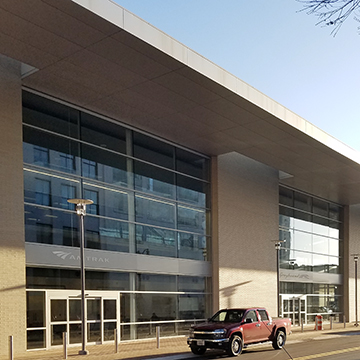
- Facility Ownership: Birmingham-Jefferson County Transit Authority
- Parking Lot Ownership: Birmingham-Jefferson County Transit Authority
- Platform Ownership: CSX Transportation (CSXT)
- Track Ownership: CSX Transportation (CSXT)
Todd Stennis
Regional Contact
governmentaffairsnol@amtrak.com
For information about Amtrak fares and schedules, please visit Amtrak.com or call 1-800-USA-RAIL (1-800-872-7245).
Amtrak moved into the new Birmingham Intermodal Facility in late January 2018. The modern station brings together Amtrak, local and intercity buses and shuttles in one convenient location on the southern end of downtown. The Birmingham City Council approved a contract to begin infrastructure work for the intermodal facility in October 2013. The complex, which spans the blocks between the railroad viaduct and Morris Avenue from 16th to 19th Streets, replaced smaller Amtrak and MAX bus stations. Amtrak was formerly located in a remnant of the old Louisville and Nashville Railroad (L&N) station.
Two structures stand on the eastern end of the property: one houses a large waiting area for Amtrak and intercity bus passengers while the other provides space for local MAX bus passengers; parking occupies the west end. Abundant natural light floods the interiors of the glass-enclosed buildings designed by Giattina Aycock Architecture Studio and Hoskins Architecture. A wide, overhanging roof protects travelers and pedestrians from the hot summer sun and inclement weather. Space for retail and restaurants will help generate activity throughout the day and evening. The Birmingham-Jefferson County Transit Authority also maintains offices at the station.
The approximately $32 million project was funded through $23.6 million in grants from the Federal Transit Administration’s Bus and Bus Facilities program and $6 million in city funds obtained through a voter-approved bond initiative.
On the south side of the railroad viaduct is Railroad Park, a transformation of former industrial land into a 19-acre greenspace that opened in 2010. The parcel was reshaped to create small hills and a lake, and more than 600 hardwoods, evergreens and flowering trees frame an amphitheater, playgrounds and grassy fields.
A walking path edged with native wildflowers follows the ridge of the hills and rises to the level of the viaduct, thereby affording railroad enthusiasts with sweeping views of the passing freight and passenger trains. Hand cast bricks and cobblestones unearthed on site were used to construct benches and other features, providing continuity between the past and present uses of the land. Wood paneled structures, including a park office and café, were designed to evoke the look of boxcars.
Birmingham began as the village of Elyton, which was a small pioneer farm settlement, little remarked upon and ignored in the battles of the Civil War. It was after the war that the railroads and land barons built a town they named after England’s industrial giant, Birmingham, when real estate promoters sold lots near the planned crossing of the Alabama & Chattanooga and South & North railroads. The original city plan encompassed over 1,160 acres, including an industrial zone and underpasses for the railroad beds.
On April 6, 1909, the magnificent Birmingham Passenger Terminal Station, having been built for the then-remarkable sum of $3 million, opened as a replacement for an older Union Station. Covering 10 square blocks, its free-standing dome was flanked by twin towers; this newer station was a magnificent example of Byzantine-Turkish style architecture.
The Birmingham Terminal served six railroads—all of those passing through the city except for the L&N and the Atlantic Coast Line—as well as the U.S. Post Office’s mail facility and Railway Express Agency. Even after the peak years during World War II, the terminal handled 42 daily train departures through much of the 1950s. After the terminal closed in 1969, this “Great Temple of Travel” was razed to the ground.
Through the mid-20th century, Birmingham was the industrial giant of the American South. Formally organized in 1871, the town quickly became a commercial center because of the natural abundance of coal, iron ore and limestone within the area—all necessary ingredients for making steel. Its rapid growth as an industrial hub earned it the nickname, “the Magic City.” In the later 20th century, its economy diversified: large-scale banking, insurance, medicine, publishing and biotechnology all have come to the city. Today, Birmingham is recognized as one of the top cities for income growth in the South.
Birmingham also became a center of the struggle for civil rights in the 1950s and 1960s. A watershed in the civil rights movement occurred in 1963, when Martin Luther King, Jr. and the Southern Christian Leadership Conference were invited to Birmingham for a series of protests that eventually led to the desegregation of public accommodations in Birmingham, as well as the Civil Rights Act of 1964. In 1978, then-Mayor David Vann proposed creating a civil rights museum in Birmingham; by 1990, the city council incorporated a 15-member board of directors for the Civil Rights Institute, which opened to the public in November 1992.
Birmingham has also been home to a long list of celebrities, including Willie Mays, Nat King Cole, Alice Faye, Phil Harris, Hank Williams Jr. and Fannie Flagg.
Station Building (with waiting room)
Features
- ATM available
- Elevator
- No payphones
- No Quik-Trak kiosks
- Restrooms
- Ticket sales office
- Unaccompanied child travel allowed
- Vending machines
- No WiFi
- Arrive at least 60 minutes prior to departure if you're checking baggage or need ticketing/passenger assistance
- Arrive at least 30 minutes prior to departure if you're not checking baggage or don't need assistance
Baggage
- Amtrak Express shipping not available
- Checked baggage service available
- Checked baggage storage available
- Bike boxes for sale
- No baggage carts
- Ski bags not available
- Bag storage with Fee
- Shipping Boxes for sale
- Baggage assistance provided by Station staff and train crew will assist.
Parking
- Same-day parking is available for free
- Overnight parking is available for free
Accessibility
- No payphones
- Accessible platform
- Accessible restrooms
- Accessible ticket office
- Accessible waiting room
- Accessible water fountain
- Same-day, accessible parking is available; fees may apply
- Overnight, accessible parking is available; fees may apply
- No high platform
- Wheelchair available
- Wheelchair lift available
Hours
Station Waiting Room Hours
| Mon | 24 HOURS |
| Tue | 24 HOURS |
| Wed | 24 HOURS |
| Thu | 24 HOURS |
| Fri | 24 HOURS |
| Sat | 24 HOURS |
| Sun | 24 HOURS |
Ticket Office Hours
| Mon | 10:00 am - 05:30 pm |
| Tue | 10:00 am - 05:30 pm |
| Wed | 10:00 am - 05:30 pm |
| Thu | 10:00 am - 05:30 pm |
| Fri | 10:00 am - 05:30 pm |
| Sat | 10:00 am - 05:30 pm |
| Sun | 10:00 am - 05:30 pm |
Passenger Assistance Hours
| Mon | 10:00 am - 05:30 pm |
| Tue | 10:00 am - 05:30 pm |
| Wed | 10:00 am - 05:30 pm |
| Thu | 10:00 am - 05:30 pm |
| Fri | 10:00 am - 05:30 pm |
| Sat | 10:00 am - 05:30 pm |
| Sun | 10:00 am - 05:30 pm |
Checked Baggage Service
| Mon | 10:00 am - 05:30 pm |
| Tue | 10:00 am - 05:30 pm |
| Wed | 10:00 am - 05:30 pm |
| Thu | 10:00 am - 05:30 pm |
| Fri | 10:00 am - 05:30 pm |
| Sat | 10:00 am - 05:30 pm |
| Sun | 10:00 am - 05:30 pm |
Parking Hours
| Mon | 24 HOURS |
| Tue | 24 HOURS |
| Wed | 24 HOURS |
| Thu | 24 HOURS |
| Fri | 24 HOURS |
| Sat | 24 HOURS |
| Sun | 24 HOURS |
Quik-Track Kiosk Hours
Lounge Hours
Amtrak Express Hours
| Mon | CLOSED |
| Tue | CLOSED |
| Wed | CLOSED |
| Thu | CLOSED |
| Fri | CLOSED |
| Sat | CLOSED |
| Sun | CLOSED |
 Amtrak established the Great American Stations Project in 2006 to educate communities on the benefits of redeveloping train stations, offer tools to community leaders to preserve their stations, and provide the appropriate Amtrak resources.
 Amtrak is seizing a once-in-a-lifetime opportunity to transform rail and Retrain Travel. By modernizing, enhancing and expanding trains, stations and infrastructure, Amtrak is meeting the rising demand for train travel. Amtrak offers unforgettable experiences to more than 500 destinations across 46 states and parts of Canada. Learn more at