

Anaheim, CA (ANA)
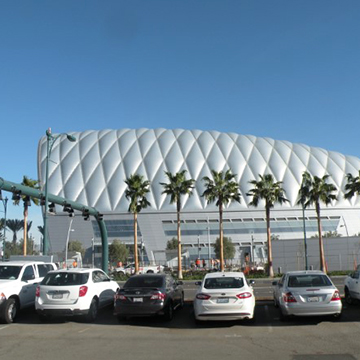
A stunningly modern intermodal center with a soaring arched form opened in late 2014; the building and site include numerous sustainable design elements.
2626 East Katella Avenue
Anaheim, CA 92806-5903
- Facility Ownership: City of Anaheim
- Parking Lot Ownership: City of Anaheim
- Platform Ownership: City of Anaheim
- Track Ownership: Metrolink
Alex Khalfin
Regional Contact
governmentaffairsoak@amtrak.com
For information about Amtrak fares and schedules, please visit Amtrak.com or call 1-800-USA-RAIL (1-800-872-7245).
The new Anaheim Regional Transportation Intermodal Center, better known as ARTIC, opened for service on December 6, 2014, approximately two years after construction began on the 67,000 square foot structure. Located downtown and along the Santa Ana River, the station sits between Angel Stadium of Anaheim and the Honda Center—respectively home to the Angels baseball team and the Anaheim Ducks hockey team. Disneyland and the Anaheim Convention Center are less than three miles away.
ARTIC is served by Amtrak, Metrolink commuter trains, Orange County Transportation Authority (OCTA) and intercity buses and Anaheim Resort Transportation shuttles. Bike racks, bike lockers and electric vehicle charging stations are also available. The Orange and Santa Ana Freeways provide convenient access for drivers from across the region, while the Santa Ana River Trail links the station to the city’s bike lane network. In addition to a passenger waiting area that offers Wi-Fi and charging stations, the facility includes dining and retail space that makes it a destination for non-travelers. Passengers cross a bridge to reach the raised tracks and platforms south of the building.
Stunningly modernistic, the station is envisioned as an anchor for the area around the two stadiums and the City National Grove of Anaheim, a live entertainment venue. Under a city master land use plan, light industrial uses are gradually being replaced with high-density office, entertainment and residential development. City leaders expect the amount of construction between ARTIC and the Platinum Triangle to contribute significantly to the economy of the area while reducing the amount of vehicular traffic in the busy downtown.
The city and OCTA began planning for the new intermodal station in 2006 and chose to build on the then county-owned Katella maintenance yard, a 16 acre parcel along the river. Three years later, the Anaheim City Council retained Irvine-based KTGY Group as Urban Design Advisor on the ARTIC project. Shortly thereafter, engineering and architectural firms Parsons Brinckerhoff and HOK won a contract to design and lay the groundwork for the station and site. The Southern California Association of Governments awarded the ARTIC plans the 2010 Compass Blueprint Recognition Award for Sustained Leadership. It honors plans and projects throughout Southern California that coordinate land use and transportation initiatives.
For ARTIC, HOK drew inspiration from classic stations such as the original New York Penn Station and Philadelphia Broad Street Station—early 20th century structures known for their lofty glass and steel train sheds. Through the selection and use of environmentally friendly materials and design solutions, ARTIC is expected to achieve a Leadership in Energy and Environmental Design (LEED) Platinum certification, the highest designation for new structures.
ARTIC’s defining feature is its soaring arched form, which reaches a maximum height of 120 feet and creates one open interior space devoid of structural columns. The form consists of crisscrossed metal ribs whose large diamond-shaped voids are filled with high-performance Ethylene Tetra Flouro Ethylene (EFTE) membrane that is layered and filled with air to create cushions. Not only is the material durable and lightweight, but it also allows ample sunlight to flood the interior, thereby cutting back on the use of electric light. To reduce solar heat gain, the outer EFTE layer includes a frit pattern. Bowed walls of glass enclose the north and south ends of the arch; louvers on their upper sections open for natural ventilation.
At the north end of the building, travelers approach via a grand plaza planted with elegant palm trees. Vegetation throughout the site is drought resistant, and storm water is collected in underground cisterns for irrigation use. Shade structures over the parking lots feature photovoltaics arrays that provide electricity for use on site.
The new regional intermodal center cost approximately $184.2 million, and was funded through the following federal, state and local sources: $143.1 million obtained through the voter-approved Measure M and Measure M2, half-cent sales taxes devoted to transit projects; $29.2 million from the 2008 State Transportation Improvement Program; $8.2 million through the Federal Transit Administration Bus and Bus Facilities program; and a $3.2 million federal earmark.
Amtrak began serving Anaheim in 1984 at a location owned by the Atchison, Topeka & Santa Fe Railway about a quarter mile west of ARTIC. A new Amtrak station was built near that stop in 1986; like other standardized depots constructed by Amtrak at the time, it featured brown brick walls, large expanses of glass and a black cantilevered roof. This facility closed with the opening of ARTIC.
In 1857 a group of German farmers and vintners came to settle the fertile area beside the Santa Ana River. Founder George Hansen surveyed the original 200 acres in what now comprises the city’s downtown, bounded by North, South, East and West Streets. From this original “home on the Santa Ana River” comes the city’s name. Grapes for wine were the principal crop until a pestilential infestation in the 1870s killed all the vineyards, and the farmers turned to growing oranges as well as olives and walnuts. Subsequently, the first commercially grown oranges in Orange County came from Anaheim, where the growers attributed their success to the protection of the local hills. This pastoral town grew quickly after the first Atchison, Topeka and Santa Fe Railway depot was built in 1875. The rail line linked Anaheim’s growers with the East and opened a vital market for their agricultural products.
In 1917, the Union Pacific Railroad (UP) began constructing a depot at East Lincoln Avenue and the train tracks, a few miles northwest of the current station. While a more modest station would have sufficed, this Mission style white-washed concrete depot, with its long arched colonnade and decorative center-gabled red-tiled roof, represented the railroad’s confidence in the growing city. World War I interrupted its construction, and it was not completed until 1923—in perfect time to handle that year’s Valencia orange crop.
Anaheim was the last city on the line, and two daily trains arrived from Los Angeles and returned to make connections to the rest of the country. For about 10 years, UP used the station for passengers and freight, but then it stopped running passenger trains to Anaheim, choosing to instead bus passengers from the depot to a station in East Los Angeles. When the UP dropped passenger service entirely in 1971, it turned part of the depot over to a school supply store and used the rest for its freight operations.
In 1990, the Anaheim City Council voted to restore the UP station and include it as part of a larger downtown redevelopment scheme. Subsequently, the building was moved about 600 yards south to make way for improvements to East Lincoln Ave. Now owned by the Anaheim Community Redevelopment Agency, the station contains leasable commercial space.
Meanwhile, Anaheim had begun to shed its rural origins by the mid-20th century when Walt Disney, disappointed at having his idea for a family-oriented Mickey Mouse Park turned down by the city of Burbank, took a drive. After coming down the new Santa Ana Freeway and stopping in a sleepy small town which reminded him of his boyhood home in Marceline, Mo., Disney decided to put his magical work in Anaheim amongst the colorful orange groves. The fledgling ABC Network invested in Disney’s project, and the Disneyland television show it hosted became integral to the park’s success. On July 17, 1955, Disneyland opened for business, and no one knew if it would succeed. But only seven weeks later the one-millionth visitor passed through the park’s turnstiles, through the tunnels and into Main Street and history.
For the balance of the decade, tourism and construction became the city’s mainstays, and by the 1960s, it had outgrown its original town center. Even the city’s historic Carnegie Library had become too small, and eventually became a city museum in 1987. However, much of Disneyland’s business was only seasonal at first, and this led to mid-year economic slumps in the city. In 1960, the Anaheim Visitor and Convention Bureau formed to capitalize on Disneyland’s success with a convention center that would be amenable to families and which would bring in business year round. The original center boasted 400,000 square feet and included a 19,000-seat arena when it opened in 1967. Further expansion was supported when the Angels moved to Anaheim, starting their stadium in 1964 and opening it for their 1966 season.
Rapid growth changed the city, and since the 1970s, leaders have worked to combat deterioration of the city center with a vision of phased urban renewal. The first was centered on the area of the original settlement, funded by proceeds from the stadium’s growth and expansion. Gradually, a new arts center, civic center, and expansions of the convention center began to reverse the trend. The development of the Platinum Triangle and Anaheim Resorts will continue the vision of a vibrant downtown into the future.
The Pacific Surfliner service is primarily financed through funds made available by the State of California, Department of Transportation, and is managed by the LOSSAN Joint Powers Authority.
Station Building (with waiting room)
Features
- ATM not available
- Elevator
- No payphones
- Quik-Trak kiosks
- Restrooms
- Ticket sales office
- Unaccompanied child travel allowed
- No vending machines
- No WiFi
- Arrive at least 45 minutes prior to departure if you're checking baggage or need ticketing/passenger assistance
- Arrive at least 30 minutes prior to departure if you're not checking baggage or don't need assistance
Baggage
- Amtrak Express shipping not available
- No checked baggage service
- No checked baggage storage
- Bike boxes not available
- No baggage carts
- Ski bags not available
- Bag storage
- Shipping Boxes for sale
- Baggage assistance provided by
Parking
- Same-day parking is available; fees may apply
- Overnight parking is available; fees may apply
Accessibility
- No payphones
- Accessible platform
- Accessible restrooms
- Accessible ticket office
- Accessible waiting room
- Accessible water fountain
- Same-day, accessible parking is available; fees may apply
- Overnight, accessible parking is available; fees may apply
- No high platform
- Wheelchair available
- Wheelchair lift available
Hours
Station Waiting Room Hours
| Mon | 04:00 am - 11:59 pm |
| Tue | 04:00 am - 11:59 pm |
| Wed | 04:00 am - 11:59 pm |
| Thu | 04:00 am - 11:59 pm |
| Fri | 04:00 am - 11:59 pm |
| Sat | 04:00 am - 11:59 pm |
| Sun | 04:00 am - 11:59 pm |
Ticket Office Hours
| Mon | 05:45 am - 10:15 pm |
| Tue | 05:45 am - 10:15 pm |
| Wed | 05:45 am - 10:15 pm |
| Thu | 05:45 am - 10:15 pm |
| Fri | 05:45 am - 10:15 pm |
| Sat | 05:45 am - 10:15 pm |
| Sun | 05:45 am - 10:15 pm |
Passenger Assistance Hours
| Mon | 05:45 am - 10:15 pm |
| Tue | 05:45 am - 10:15 pm |
| Wed | 05:45 am - 10:15 pm |
| Thu | 05:45 am - 10:15 pm |
| Fri | 05:45 am - 10:15 pm |
| Sat | 05:45 am - 10:15 pm |
| Sun | 05:45 am - 10:15 pm |
Checked Baggage Service
Parking Hours
Quik-Track Kiosk Hours
| Mon | 05:15 am - 10:15 pm |
| Tue | 05:15 am - 10:15 pm |
| Wed | 05:15 am - 10:15 pm |
| Thu | 05:15 am - 10:15 pm |
| Fri | 05:15 am - 10:15 pm |
| Sat | 05:15 am - 10:15 pm |
| Sun | 05:15 am - 10:15 pm |
Lounge Hours
Amtrak Express Hours
| Mon | CLOSED |
| Tue | CLOSED |
| Wed | CLOSED |
| Thu | CLOSED |
| Fri | CLOSED |
| Sat | CLOSED |
| Sun | CLOSED |
 Amtrak established the Great American Stations Project in 2006 to educate communities on the benefits of redeveloping train stations, offer tools to community leaders to preserve their stations, and provide the appropriate Amtrak resources.
 Amtrak is seizing a once-in-a-lifetime opportunity to transform rail and Retrain Travel. By modernizing, enhancing and expanding trains, stations and infrastructure, Amtrak is meeting the rising demand for train travel. Amtrak offers unforgettable experiences to more than 500 destinations across 46 states and parts of Canada. Learn more at