

Alpine, TX (ALP)
Alpine is known as the "Heart of Big Bend" in a nod to nearby Big Bend National Park—the largest protected area of Chihuahuan Desert ecology in the country.
- Facility Ownership: Union Pacific Railroad
- Parking Lot Ownership: Union Pacific Railroad
- Platform Ownership: Union Pacific Railroad
- Track Ownership: Union Pacific Railroad
Todd Stennis
Regional Contact
governmentaffairsnol@amtrak.com
For information about Amtrak fares and schedules, please visit Amtrak.com or call 1-800-USA-RAIL (1-800-872-7245).
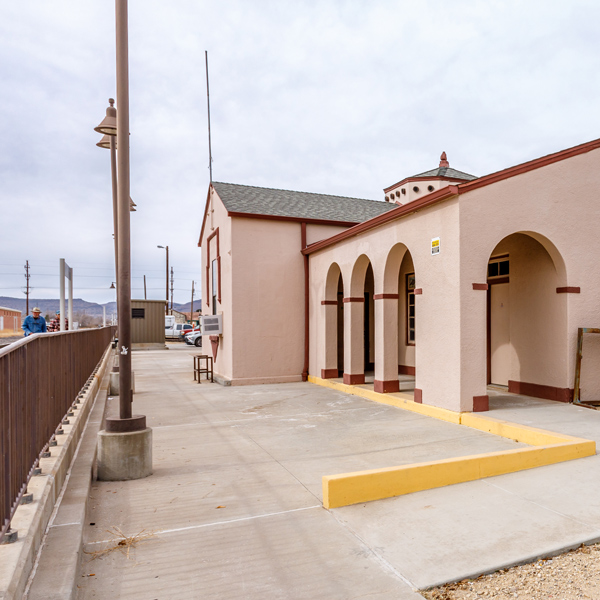
Alpine is served by a modest 1946 Spanish Mission Revival style station that features light Art Deco detailing. The façade facing the tracks has a projecting center bay with a large window framed by geometric rope detailing. To the side is a small arcade that shelters passengers from the Texas sun. The entire composition is topped by an octagonal cupola with a finial. The building surfaces are covered in tan stucco while architecturally prominent features are highlighted by brownish-red paint. The station was originally commissioned by the Texas and New Orleans Railroad. The T&NO was the largest railroad in the state before it was merged into the parent company, Southern Pacific Railroad (SP) in 1961.
Alpine calls itself the “Gateway to Big Bend National Park,” a large wilderness area in West Texas that lies south of the town. The area now occupied by the town was early inhabited by hunter gatherers who practiced limited agriculture. Local springs and grasses made the valley a popular resting spot for Native American groups, and later for travelers on the Chihuahua Trail, which connected Mexico City with Santa Fe during the Spanish colonial period. The old trail is today a major automobile route in Mexico and the United States, and is considered one of the oldest highways in America. Later, the grasslands proved popular with ranchers, who grazed their herds in a zone that covers what is now West Texas and northern Chihuahua, Mexico.
After the Southern Pacific (SP) railroad arrived in 1882, the town sprung up as a “jerk-water” post, so called because in the days of steam engines, the fireman would “jerk” a cord to release water from a water tower and into the tender located behind the locomotive; Alpine’s water tower still stands. Originally known as Osborne, the town gained a new name in 1883. The spring used by the SP was located on the property of Daniel and Thomas Murphy. In order to gain a contract for the water, the SP agreed to name the town after the men—and thus Murphyville found its way onto local maps. The brothers’ renown was short lived; only five years later the townsfolk voted to rename the town Alpine.
Ranching was the lifeblood of the community for many decades, with some modern estates containing more than 200,000 acres. In 1921, Sul Ross Normal College a teacher’s training school, opened on a prominent hill; named for a former Texas governor and Civil War general. In 1969, it became a university, and features many programs that focus on the region’s unique ecology, including the Chihuahuan Desert Research Institute, the Center for Big Bend Studies, and the Museum of the Big Bend where visitors can study the ecological and human forces that have shaped the region.
Alpine’s most famous neighbor is Big Bend National Park, which covers more than 800,000 acres, and is the largest protected area of Chihuahuan Desert ecology in the country. More than 1,200 species of plants, 450 species of birds, 56 species of reptiles, and 75 species of mammals can be found in the park, which features landscapes as diverse as river floodplain, desert, and mountains. The area exhibits more than 60 types of cacti and rare trees including the Chisos Oak, found nowhere else in the United States. In addition to natural wonders, archaeologists have also found human artifacts estimated to be 9,000 years old. In 1933, Texas set aside much of the area as a protected zone, and in 1944 it became a national park.
Also known as the “Heart of the Big Bend,” Alpine is popular with retirees attracted by its small town feel and preserved Main Street that features structures such as the 1928 Granada Theater, known for its colorful marquee. Consistently noted as one of the state’s best small towns, Alpine’s collection of restaurants, specialty shops, and galleries draws visitors, as does Sul Ross’ outdoor Theater of the Big Bend, first inaugurated in 1934, which presents musicals, comedies, dramas, and classical works underneath the star-filled sky.
Station Building (with waiting room)
Features
- ATM not available
- No elevator
- No payphones
- No Quik-Trak kiosks
- Restrooms
- Unaccompanied child travel not allowed
- No vending machines
- No WiFi
- Arrive at least 30 minutes prior to departure
Baggage
- Amtrak Express shipping not available
- No checked baggage service
- No checked baggage storage
- Bike boxes not available
- No baggage carts
- Ski bags not available
- No bag storage
- Shipping boxes not available
- No baggage assistance
Parking
- Same-day parking is available; fees may apply
- Overnight parking is available; fees may apply
Accessibility
- No payphones
- Accessible platform
- Accessible restrooms
- No accessible ticket office
- Accessible waiting room
- Accessible water fountain
- Same-day, accessible parking is available; fees may apply
- Overnight, accessible parking is available; fees may apply
- No high platform
- No wheelchair
- Wheelchair lift available
Hours
Station Waiting Room Hours
| Mon | 09:00 am - 09:00 pm |
| Tue | 09:00 am - 09:00 pm |
| Wed | CLOSED |
| Thu | 09:00 am - 09:00 pm |
| Fri | CLOSED |
| Sat | 09:00 am - 09:00 pm |
| Sun | 09:00 am - 09:00 pm |
 Amtrak established the Great American Stations Project in 2006 to educate communities on the benefits of redeveloping train stations, offer tools to community leaders to preserve their stations, and provide the appropriate Amtrak resources.
 Amtrak is seizing a once-in-a-lifetime opportunity to transform rail and Retrain Travel. By modernizing, enhancing and expanding trains, stations and infrastructure, Amtrak is meeting the rising demand for train travel. Amtrak offers unforgettable experiences to more than 500 destinations across 46 states and parts of Canada. Learn more at