

Alton, IL (ALN)
Located at the confluence of the Mississippi, Missouri and Illinois rivers, Alton developed as a regional trade center. Limestone cliffs along the Mississippi are home to bald eagle nests.
- Facility Ownership: City of Alton
- Parking Lot Ownership: City of Alton
- Platform Ownership: City of Alton
- Track Ownership: Union Pacific Railroad
Marty Sandoval
Regional Contact
governmentaffairschi@amtrak.com
For information about Amtrak fares and schedules, please visit Amtrak.com or call 1-800-USA-RAIL (1-800-872-7245).
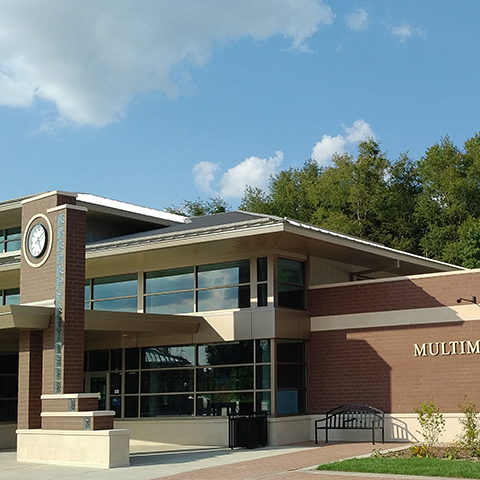
Amtrak began serving the new Alton Regional Multimodal Transportation Center on Sept. 13, 2017. The gleaming facility includes a bright and spacious waiting room, Madison County Transit (MCT) connections, bicycle facilities and ample parking. Alton is a popular place for St. Louis-area passengers to begin and end their trips, whether they are from the Illinois portion of the metro area or from the suburbs on the north side of St. Louis.
The multimodal center was developed by the Illinois Department of Transportation (Illinois DOT) in conjunction with the city and MCT. Constructed of reddish brown brick and large expanses of glass that allow in ample natural light, it also features a clock tower. Customers waiting for the train or local bus may take advantage of complimentary Wi-Fi or enjoy an exhibit tracing the area’s rich railroad history.
Constructed on the former Robert Wadlow Golf Course north of the city center, the multimodal center is easily accessible from regional highways. At approximately 9,000 square feet, it is ten times larger than the former station, a 1928 Chicago and Alton Railroad depot located about two miles to the southeast (subsequently demolished in Dec. 2017). According to city plans, the golf course property will be transformed into a new mixed-use center to include housing, commercial, office and cultural spaces; a portion of the site has also been designated as green space.
The $14.4 million facility was built using federal funding awarded to Illinois DOT, augmented by $13.85 million awarded to the city and MCT through the U.S. Department of Transportation’s Transportation Investments Generating Economic Recovery (TIGER) program. MCT, the city and the state also contributed project funds.
Under the Federal Railroad Administration’s High-Speed Intercity Passenger Rail (HSIPR) program, the state of Illinois received $1.2 billion to improve the Chicago-St. Louis rail corridor and reduce travel times. When completed in 2018, the upgraded line is expected to present an even stronger transportation alternative for drivers along the congested Interstate 55 corridor.
Alton is located at the confluence of the Mississippi, Missouri, and the Illinois Rivers. Mark Twain once referred to Alton as “a dismal little river town,” yet his description seems far from accurate. Today the city attracts many visitors with its numerous museums, outdoor recreational activities and vibrant history.
The first settlers in Alton were the Illiniwek or Illinois Confederacy Native Americans. Evidence of an early Native American settlement manifests itself in the legendary Piasa bird, a petroglyph on a cliff above the Mississippi River. The painting was first seen by Father Jacques Marquette in 1673. The Piasa bird was said to have the body of a calf covered in scales, horns on its head, a lion’s beard, and red eyes. Unfortunately, the painting was destroyed in the 1960s to make way for the Great River Road, yet visitors can see a replica painting created in 1998. The Piasa bird has become the symbol of Alton.
The present-day community was developed as a river town in 1818 by Rufus Easton, who named it for his son. Alton was once growing faster than St. Louis due to its prime location. The rail line from Alton to Springfield, Ill., opened in 1853, and was the first railroad to use George Pullman’s sleeping cars, which became immensely popular on lines throughout the country. The “Alton Route” nickname for the railroad has survived several owners.
Alton played a large role in the abolitionist movement prior to the Civil War. On November 7, 1837, the abolitionist printer Elijah P. Lovejoy was murdered by a mob of slavery supporters while trying to protect his press from being destroyed for a third time. Lovejoy became the first martyr of the movement. The Thirteenth Amendment of the U.S. Constitution was drafted in Alton in his honor. Also, many of the owners of Alton’s historic Queen Anne-style homes provided assistance to the Underground Railroad. Alton was the site of the seventh and final Lincoln-Douglas debate on October 15, 1858. A statue in downtown Alton depicts Lincoln and Douglas as they would have appeared during the debates.
Robert Wadlow, the world’s tallest man, was an Alton native and a pituitary giant, someone who grows enormously due to an overactive pituitary gland. When he was born in February 1918, he was a completely average baby, 8 ½ pounds. However, by the time he was a year old he weighed twice what was normal: 44 pounds. By nine years he’d reached 6′, 2″ and by sixteen he hit 7′, 10″ and weighed nearly 400 pounds. At the time of his death in 1940 he was 8′, 11.1″ tall and weighed 439 pounds making him the world’s tallest person in history, according to the Guinness Book of Records. Known as “Alton’s Gentle Giant,” his gravestone at the Upper Alton Cemetery simply reads “At Rest.” A life-size bronze statue of Wadlow was unveiled in 1985 on the grounds of Southern Illinois University Dental School.
Alton calls itself “the wedding capital of the Midwest,” as it has become a popular venue for weddings and receptions. Attractions include the Piasa bird painting, the cable-stayed Clark Bridge, a monument to Elijah P. Lovejoy, the Franklin House (where Abraham Lincoln once dined), and a monument to Confederate soldiers who died in the Alton Union prison.
Between 150 and 450 American bald eagles nest in the limestone cliffs lining the Mississippi River around the city, making Alton a popular spot for bird watching in the winter and spring.
The Lincoln Service is financed primarily through funds made available by the Illinois DOT as part of the Amtrak MidwestSM network.
Station Building (with waiting room)
Features
- ATM not available
- No elevator
- Payphones
- No Quik-Trak kiosks
- Restrooms
- Ticket sales office
- Unaccompanied child travel allowed
- Vending machines
- Amtrak WiFi available
- Arrive at least 45 minutes prior to departure if you're checking baggage or need ticketing/passenger assistance
- Arrive at least 30 minutes prior to departure if you're not checking baggage or don't need assistance
Baggage
- Amtrak Express shipping not available
- Checked baggage service available
- Checked baggage storage available
- Bike boxes for sale
- Baggage carts available
- Ski bags not available
- Bag storage
- Shipping Boxes for sale
- Baggage assistance provided by Station Agent can assist when not selling tickets.
Parking
- Same-day parking is available for a fee
- Overnight parking is available for a fee
Accessibility
- Payphones
- Accessible platform
- Accessible restrooms
- Accessible ticket office
- Accessible waiting room
- Accessible water fountain
- Same-day, accessible parking is available for free
- Overnight, accessible parking is available for free
- No high platform
- Wheelchair available
- Wheelchair lift available
Hours
Station Waiting Room Hours
| Mon | 04:45 am - 09:30 pm |
| Tue | 04:45 am - 09:30 pm |
| Wed | 04:45 am - 09:30 pm |
| Thu | 04:45 am - 09:30 pm |
| Fri | 04:45 am - 09:30 pm |
| Sat | 04:45 am - 09:30 pm |
| Sun | 04:45 am - 09:30 pm |
Ticket Office Hours
| Mon | 06:00 am - 09:30 pm |
| Tue | 06:00 am - 09:30 pm |
| Wed | 06:00 am - 09:30 pm |
| Thu | 06:00 am - 09:30 pm |
| Fri | 06:00 am - 09:30 pm |
| Sat | 06:00 am - 09:30 pm |
| Sun | 06:00 am - 09:30 pm |
Passenger Assistance Hours
| Mon | 06:00 am - 09:30 pm |
| Tue | 06:00 am - 09:30 pm |
| Wed | 06:00 am - 09:30 pm |
| Thu | 06:00 am - 09:30 pm |
| Fri | 06:00 am - 09:30 pm |
| Sat | 06:00 am - 09:30 pm |
| Sun | 06:00 am - 09:30 pm |
Checked Baggage Service
| Mon | 06:00 am - 09:30 pm |
| Tue | 06:00 am - 09:30 pm |
| Wed | 06:00 am - 09:30 pm |
| Thu | 06:00 am - 09:30 pm |
| Fri | 06:00 am - 09:30 pm |
| Sat | 06:00 am - 09:30 pm |
| Sun | 06:00 am - 09:30 pm |
Parking Hours
Quik-Track Kiosk Hours
Lounge Hours
Amtrak Express Hours
| Mon | CLOSED |
| Tue | CLOSED |
| Wed | CLOSED |
| Thu | CLOSED |
| Fri | CLOSED |
| Sat | CLOSED |
| Sun | CLOSED |
 Amtrak established the Great American Stations Project in 2006 to educate communities on the benefits of redeveloping train stations, offer tools to community leaders to preserve their stations, and provide the appropriate Amtrak resources.
 Amtrak is seizing a once-in-a-lifetime opportunity to transform rail and Retrain Travel. By modernizing, enhancing and expanding trains, stations and infrastructure, Amtrak is meeting the rising demand for train travel. Amtrak offers unforgettable experiences to more than 500 destinations across 46 states and parts of Canada. Learn more at