

Albany, OR (ALY)
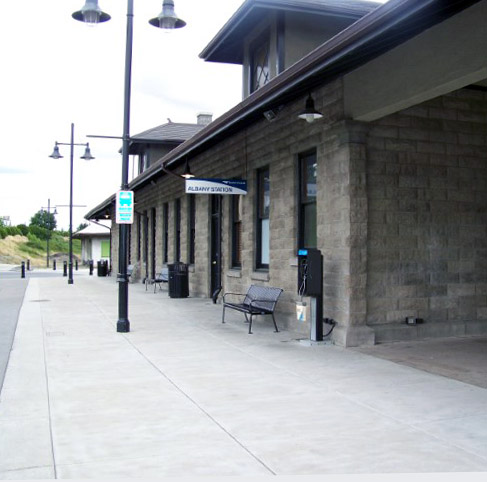
Constructed for the Southern Pacific Railroad in 1909, the depot was purchased by the city in 2003 and subsequently renovated. A clock tower and plaza were built and landscaping installed.
- Facility Ownership: City of Albany
- Parking Lot Ownership: City of Albany
- Platform Ownership: Union Pacific Railroad
- Track Ownership: Union Pacific Railroad
Alex Khalfin
Regional Contact
governmentaffairssea@amtrak.com
For information about Amtrak fares and schedules, please visit Amtrak.com or call 1-800-USA-RAIL (1-800-872-7245).
The masonry Albany station was constructed for the Southern Pacific Railroad in 1909, and is one of the oldest continuously-used passenger rail stations in the United States. After the purchase of the station by the city in 2003, it was restored and expanded. From 2004 to 2006, vacant commercial buildings were removed from the site, landscaping installed, a new parking lot created and period lighting added, providing a plaza and waiting area
The building was rededicated on April 18, 2006, and the initial restoration cost approximately $11.3 million provided by federal, state, local and Amtrak funds. In December of 2006, construction began on a 60-foot clock tower in the center of the roundabout at the depot’s Lyon Street entrance. The tower spells out, “Albany,” in illuminated letters and features two clocks donated by the Greater Albany Rotary Club. The city would also like to restore the former Railway Express building nearby.
The confluence of the Calapooia and Willamette Rivers in Oregon’s Willamette Valley is where Hiram Smead and Abner Hackleman staked a claim in 1845. They sold their stake to Walter and Thomas Monteith two years later—for $400 and a Cayuse pony. The Monteith brothers, whose family home still stands, christened their new town in honor of their New York hometown of Albany.
Named the Linn County seat in 1851, and linked to markets by regular steamboat service, Albany prospered as a political and commercial center, typifying much of the early development in the mid-Willamette Valley.
The arrival of the Oregon and California Railroad in 1871 greatly furthered Albany’s growth, as did the 1880 completion of a canal bringing drinking water and hydropower from the Cascade foothills to the growing city. The Oregon Pacific Railroad came in January of 1887. The railroad and the canal project also brought 70 to 80 Chinese-born residents, who occupied a one-block section of downtown. The city’s largely white workforce was employed by a number of small factories and food processing centers.
The U.S. Bureau of Mines established a research center on the old Albany College campus in 1942, focusing on the development of new metallurgical processes. First known as the Northwest Electro-development Facility, the site produced titanium and zirconium and fostered the growth of a new rare metals industry in Albany led by internationally recognized companies like the Oregon Metallurgical Company (Oremet) and Wah Chang. Today, Albany styles itself as “rare metals capital of the world,” as it produces zirconium, hafnium and titanium in quantity. Zirconium, for instance, is highly resistant to corrosion and is used in both jewelry and in nuclear reactors.
Albany has one of the largest and most varied collections of historic buildings in Oregon. Two residential neighborhoods and the downtown commercial district were placed on the National Register of Historic Places in the 1980s. Together they preserve the greatest variety of historic housing styles in Oregon and remain the cornerstones of the city’s identity.
The Amtrak Cascades are primarily financed through funds made available by the Washington State Department of Transportation and the Oregon Department of Transportation.
Station Building (with waiting room)
Features
- ATM not available
- No elevator
- No payphones
- No Quik-Trak kiosks
- Restrooms
- Ticket sales office
- Unaccompanied child travel allowed
- Vending machines
- No WiFi
- Arrive at least 45 minutes prior to departure if you're checking baggage or need ticketing/passenger assistance
- Arrive at least 30 minutes prior to departure if you're not checking baggage or don't need assistance
Baggage
- Amtrak Express shipping not available
- Checked baggage service available
- Checked baggage storage available
- Bike boxes for sale
- Baggage carts available
- Ski bags not available
- Bag storage with Fee
- Shipping Boxes for sale
- Baggage assistance provided by Station Staff
Parking
- Same-day parking is available; fees may apply
- Overnight parking is available; fees may apply
Accessibility
- No payphones
- Accessible platform
- No accessible restrooms
- Accessible ticket office
- Accessible waiting room
- No accessible water fountain
- Same-day, accessible parking is available; fees may apply
- Overnight, accessible parking is available; fees may apply
- No high platform
- Wheelchair available
- Wheelchair lift available
Hours
Station Waiting Room Hours
| Mon | 09:15 am - 05:30 pm |
| Tue | 09:15 am - 05:30 pm |
| Wed | 09:15 am - 05:30 pm |
| Thu | 09:15 am - 05:30 pm |
| Fri | 09:15 am - 05:30 pm |
| Sat | 09:15 am - 05:30 pm |
| Sun | 09:15 am - 05:30 pm |
Ticket Office Hours
| Mon | 09:15 am - 05:30 pm |
| Tue | 09:15 am - 05:30 pm |
| Wed | 09:15 am - 05:30 pm |
| Thu | 09:15 am - 05:30 pm |
| Fri | 09:15 am - 05:30 pm |
| Sat | 09:15 am - 05:30 pm |
| Sun | 09:15 am - 05:30 pm |
Passenger Assistance Hours
| Mon | 09:30 am - 05:15 pm |
| Tue | 09:30 am - 05:15 pm |
| Wed | 09:30 am - 05:15 pm |
| Thu | 09:30 am - 05:15 pm |
| Fri | 09:30 am - 05:15 pm |
| Sat | 09:30 am - 05:15 pm |
| Sun | 09:30 am - 05:15 pm |
Checked Baggage Service
| Mon | 09:15 am - 05:30 pm |
| Tue | 09:15 am - 05:30 pm |
| Wed | 09:15 am - 05:30 pm |
| Thu | 09:15 am - 05:30 pm |
| Fri | 09:15 am - 05:30 pm |
| Sat | 09:15 am - 05:30 pm |
| Sun | 09:15 am - 05:30 pm |
Parking Hours
Quik-Track Kiosk Hours
| Mon | CLOSED |
| Tue | CLOSED |
| Wed | CLOSED |
| Thu | CLOSED |
| Fri | CLOSED |
| Sat | CLOSED |
| Sun | CLOSED |
Lounge Hours
Amtrak Express Hours
| Mon | CLOSED |
| Tue | CLOSED |
| Wed | CLOSED |
| Thu | CLOSED |
| Fri | CLOSED |
| Sat | CLOSED |
| Sun | CLOSED |
 Amtrak established the Great American Stations Project in 2006 to educate communities on the benefits of redeveloping train stations, offer tools to community leaders to preserve their stations, and provide the appropriate Amtrak resources.
 Amtrak is seizing a once-in-a-lifetime opportunity to transform rail and Retrain Travel. By modernizing, enhancing and expanding trains, stations and infrastructure, Amtrak is meeting the rising demand for train travel. Amtrak offers unforgettable experiences to more than 500 destinations across 46 states and parts of Canada. Learn more at