

Osceola, IA (OSC)
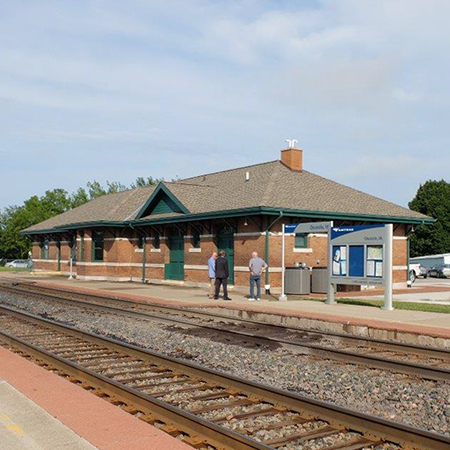
Built by the Chicago, Burlington and Quincy Railroad, the Prairie style depot opened in 1907. A century later, it was purchased by the city and underwent a careful, multi-year restoration.
Main & East Clay Streets
Osceola, IA 50213
Annual Station Ridership (FY 2023): 11,295
- Facility Ownership: City of Osceola
- Parking Lot Ownership: City of Osceola
- Platform Ownership: BNSF Railway
- Track Ownership: BNSF Railway
Derrick James
Regional Contact
governmentaffairschi@amtrak.com
For information about Amtrak fares and schedules, please visit Amtrak.com or call 1-800-USA-RAIL (1-800-872-7245).
Located 50 miles south of the state capital along the Interstate 35 corridor, Osceola is considered a “gateway” for rail passengers from both Des Moines and Kansas City who are headed west to Denver and California or east to Chicago by way of the California Zephyr. Subsequently, it is the busiest Amtrak stop in Iowa.
The citizens of Osceola and rail passengers from the surrounding area had much to celebrate as the depot marked its 100th birthday in 2007. After agreeing to construct new railroad offices for BNSF Railway, which then occupied much of the depot, the city gained full ownership of the historic building. It soon laid out a vision for a multi-phase rehabilitation that spanned nearly a decade, culminating with a ribbon cutting ceremony on Aug. 1, 2016. Partners included the Clarke County Development Corporation and the Osceola Chamber of Commerce. The non-profit Friends of the Osceola Depot also formed in 2012 to assist with fundraising and provide advice on preservation matters.
The city initially received $600,000 in federal funds through the Iowa Department of Transportation for restoration of the depot’s exterior. This project included the installation of a new roof, reconstruction of a damaged chimney, restoration of existing windows, installation of new historically-appropriate storm windows, manufacture of new entry doors that match the originals, re-pointing of the mortar that holds the bricks in place, and general rehabilitation and cleaning of the brick and stone surfaces.
Remaining funds were then combined with $150,000 from the city, $100,000 from a local non-profit development corporation and $750,000 from the Federal Highway Administration’s Transportation Enhancements program to cover the cost of interior rehabilitation, a restored brick platform, new hard-surface parking lot, improved lighting and landscaping around the building. The enhanced parking area also includes a designated bus and taxi drop-off zone while decorative fencing along the edge of the platform improves passenger safety.
Inside, the space has been restored to reflect its early 20th century appearance. Bead board covers the bottom third of the walls and a chair rail wraps around the waiting room. The original hanging light fixtures remain in place, as do the ticket windows, which have transoms with painted letters spelling out “Tickets” and “Conductors.” Large windows grouped in pairs and triplets allow natural light to flood the space. Offender employees from Iowa Prison Industries refurbished the six historic wood benches, which provide ample seating. Future plans call for commercial tenants at the depot.
During the 2016 ceremony marking completion of the depot restoration, city leaders honored Fred and Ann Diehl. Fred Diehl served as mayor when the project got underway, and Ann Diehl sits on the city’s Historic Preservation Commission where she has advocated for the preservation of the community’s historic assets. An adjacent park, in which large letters visible to train passengers spell out “OSCEOLA”, has been named for the couple. The city matched funding from the Iowa Living Roadways Project, a partnership between the Iowa DOT and the non-profit Trees Forever, to refurbish the landscape.
The Osceola depot was built by the Chicago, Burlington and Quincy Railroad (CB&Q), one of the major networks operating in the upper Midwest and West during much of the late 19th and 20th centuries. On a visit to Osceola in 1906, the CB&Q general manager noted that the existing frame depot “was a disgrace to the Q Road…,” and thus plans were drawn up for a structure more in keeping with the railroad’s desire to express its power and stability. Upon its dedication in May 1907, numerous civic leaders spoke, and the high school glee club provided musical entertainment.
The CB&Q engineering staff designed a $12,000, one-story reddish-brown brick building with a limestone water table and belt courses. One belt course sits at the level of the window sills, and the other at the base of the brackets that support the eaves. The water table and the belt courses wrap around the rectangular structure and visually emphasize its low slung, horizontal profile reminiscent of many contemporaneous structures that today are referred to as “Prairie Style.” The exterior woodwork—doors, window sashes and frames, brackets and gables—is painted deep green, complementing the subdued brown brick and drawing on colors of nature. The brackets sustain the deep eaves of the hipped roof which shelter waiting passengers from the elements.
Track side, the southwestern end of the building contained a freight storage area as indicated by the heavy, wide wood doors and the small, high windows that discouraged theft and promoted a sense of strength and security for the goods contained within its walls. The freight room door is marked by a gable covered in clapboard. A three sided bay also projects onto the platform area; from here the station agent would have monitored rail traffic through the windows. Comparing the current state of the building’s exterior to an early photograph, little has changed in a century of service; the two major alterations were the addition of the gable over the freight room door and a change in roofing material.
Due to its high level of physical integrity and the role it plays as a symbol of the railroad in the development of the town, the Osceola depot was placed on the National Register of Historic Places in 2009.
While Iowa hosted a number of railroads, the mainline running through the southern tier of the state was conceptualized and built by the Burlington and Missouri River Railroad. Incorporated in 1852, the owners hoped to build a line from the city of Burlington on the Mississippi River to Council Bluffs on the Missouri River, and then onto Omaha, Neb., where the railroad was headquartered—the two great rivers respectively formed the eastern and western boundaries of the state. The southern route was desirable due to the area’s potential for agricultural production, timber harvesting and finishing, and coal mining—all activities that would bring business to the railroad. In colorful posters aimed at settlers throughout the Midwest and on the East Coast, the railroad advertised the sale of the “Millions of Acres” it had received in federal land grants.
Commencing surveying in 1853, the 75 mile line from Burlington to Ottumwa was completed by 1859. After a delay due to the Civil War, construction started once again in 1865, passed through young Osceola by January 1868, and reached the Missouri River by 1869. The first 496 mile, 22 hour journey from Chicago to Council Bluffs was made in January 1870 and regular rail service began soon thereafter. Two years later, the Burlington and Missouri River Railroad was subsumed into the CB&Q. In the mid-1930s, the CB&Q began running its famous Zephyrs, articulated stainless steel, streamlined passenger trains that came to epitomize a new era of glamour for the railroads. The famed California Zephyr that ran between Chicago and San Francisco included a Vista-dome car that allowed glorious all-around views of the countryside, cities and towns through which the train sped.
Iowa was long settled by American Indian peoples including the Ioway, Sauk, Mesquaki, Sioux and Potawatomi. As European-American settlement encroached further west, many tribes were pushed to the west side of the Mississippi River and then toward the Missouri River. The first European-American settlers in the Osceola area were Mormons who were separated from their group as it moved from Illinois to the Great Salt Lake region of Utah in 1846-1847. They formed a small community but eventually it was abandoned.
Described as “beautifully situated on a high dry, rolling prairie between the valley of Squaw and Whitebreast creeks,” Osceola became the Clarke County seat in 1851 at the decision of the new county commissioners. A central square provided a public gathering space for the townspeople, and many of the first stores and businesses set up shop along its perimeter. With the arrival of the railroad, the area’s agricultural and livestock products could be shipped to Chicago and points east.
The name Osceola was chosen in honor of the Seminole leader of the same name. Osceola strongly resisted the removal of the Seminoles from Florida at the hands of the U.S. government in the 1830s. “Osceola” is an anglicization of the Creek “asi-yahola;” “asi” is the ceremonial black drink made from the yaupon holly, and “yahola” means “shout or shouter.” Osceola received much sympathy from the American public when he was invited to truce negotiations with U.S. officials but was instead captured. A cause célèbre, Osceola was painted by George Caitlin, and thus we have an idea of his likeness. Osceola died of malaria in 1838 while under arrest at Fort Moultrie, S.C. His story was early memorialized in histories and novels and many towns and counties were named for him.
Visitors to Osceola are delighted by its small town charms, particularly evident during its famous July 4th celebration; the multi-day festival includes a carnival, food stands and a parade. A walk around the central square gives an idea of the town’s rich architectural heritage. Lovers of Art Deco movie palaces head for the Lyric Theater on South Fillmore St. to admire its ziggurat façade; the buff yellow brick contrasts strongly with the black brick used at the base and in the four vertical, squared shafts that reach for the sky. Panels of bricks laid at an angle enliven the central bay and achieve the sense of movement elemental to Art Deco design.
The town was also given a compact Carnegie Library which opened in 1911. Wetherell and Gage architects of Des Moines turned an $11,000 grant into a Jacobean Revival palace for the people. The red brick structure exhibits an impressive projecting entrance bay topped with an undulating parapet trimmed in stone and highlighted by stylized quoins. The main door has a stone surround composed of pilasters supporting scroll work and a plaque carved with “Public Library.”
For the rail enthusiast, no stroll around town is complete without a visit to the 1935 post office. Inside, there is a 1936 oil-on-canvas mural by Des Moines-based architect, artist and playwright Byron Ben Boyd entitled “Arrival of the First Train.” The New Deal era work depicts the excitement surrounding the arrival of the first locomotive in Osceola; thick black smoke erupts from the smokestack and dramatically swirls around the “iron horse” while the people cheer and look on in amazement—a new age has arrived that will forever change the community.
Station Building (with waiting room)
Features
- ATM not available
- No elevator
- Payphones
- No Quik-Trak kiosks
- No Restrooms
- Unaccompanied child travel not allowed
- Vending machines
- No WiFi
- Arrive at least 30 minutes prior to departure
Baggage
- Amtrak Express shipping not available
- No checked baggage service
- No checked baggage storage
- Bike boxes not available
- No baggage carts
- Ski bags not available
- No bag storage
- Shipping boxes not available
- No baggage assistance
Parking
- Same-day parking is available; fees may apply
- Overnight parking is available; fees may apply
Accessibility
- Payphones
- Accessible platform
- Accessible restrooms
- No accessible ticket office
- Accessible waiting room
- Accessible water fountain
- Same-day, accessible parking is available; fees may apply
- Overnight, accessible parking is available; fees may apply
- No high platform
- No wheelchair
- No wheelchair lift
Hours
Station Waiting Room Hours
| Mon | 07:00 am - 10:00 am 07:00 pm - 09:00 pm |
| Tue | 07:00 am - 10:00 am 07:00 pm - 09:00 pm |
| Wed | 07:00 am - 10:00 am 07:00 pm - 09:00 pm |
| Thu | 07:00 am - 10:00 am 07:00 pm - 09:00 pm |
| Fri | 07:00 am - 10:00 am 07:00 pm - 09:00 pm |
| Sat | 07:00 am - 10:00 am 07:00 pm - 09:00 pm |
| Sun | 07:00 am - 10:00 am 07:00 pm - 09:00 pm |
 Amtrak established the Great American Stations Project in 2006 to educate communities on the benefits of redeveloping train stations, offer tools to community leaders to preserve their stations, and provide the appropriate Amtrak resources.
 For more than 50 years, Amtrak has connected America and modernized train travel. Offering a safe, environmentally efficient way to reach more than 500 destinations across 46 states and parts of Canada, Amtrak provides travelers with an experience that sets a new standard. Book travel, check train status, access your eTicket and more through the