

Durham, NC (DNC)
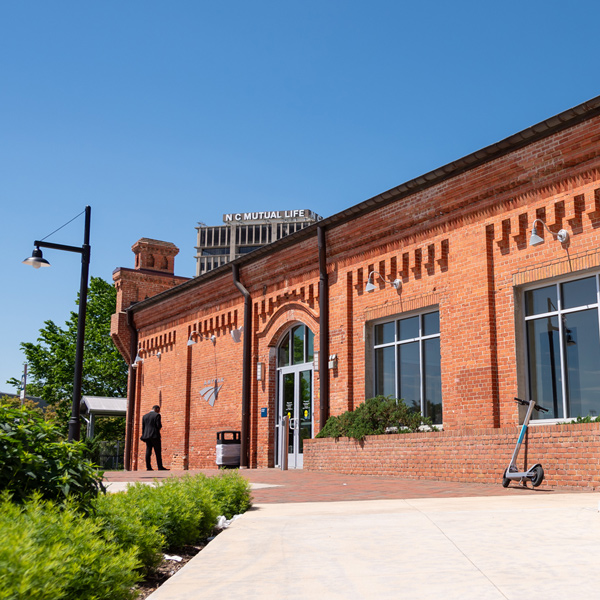
Through the cooperation of the North Carolina DOT and the city, Amtrak relocated to the current facility in the rehabilitated Walker Warehouse, built by the American Tobacco Company in 1897.
- Facility Ownership: West Village Durham II, LLC
- Parking Lot Ownership: West Village Durham II, LLC
- Platform Ownership: North Carolina Department of Transportation (NCDOT)
- Track Ownership: North Carolina Railroad
Denise Miller
Regional Contact
governmentaffairsnyc@amtrak.com
For information about Amtrak fares and schedules, please visit Amtrak.com or call 1-800-USA-RAIL (1-800-872-7245).
On July 8, 2009, Amtrak began serving the current station in Durham located in the restored Walker Warehouse, a historic brick structure erected in 1897 by the American Tobacco Company trust. Included in the Bright Leaf National Register Historic District, the former warehouse is marked by impressive decorative brickwork such as corbeled pendants and mousetoothing at the cornice and parapet. The Walker Warehouse is part of the West Village redevelopment project, which encompasses seven former tobacco warehouses, constructed between 1884 and 1949, that are being converted into loft apartments and office, laboratory, retail and entertainment space.
The new station was a joint venture of the North Carolina Department of Transportation (NCDOT) and the city of Durham. The former entered into an agreement with developer Blue Devil Partners to lease and up-fit one third of the Walker Warehouse, while the city was responsible for 25 percent of the lease costs. The NCDOT also constructed a 600-foot long boarding platform with a 300-foot canopy and a covered walkway extending from the station building; this work was funded with $1.25 million in federal Congestion Mitigation and Air Quality Improvement Program (CMAQ) funds. Across the tracks from the Amtrak depot is “Durham Station,” a transit terminal served by city, regional and intercity bus providers.
Prior to the renovation of the Walker Warehouse, the NCDOT and Durham jointly opened an interim modular station in 1996 to provide accessible ticketing, a waiting room, baggage handling and restrooms. Staffed by a full-time Amtrak station agent, it in turn had replaced a small shelter used by passengers since 1990.
In April 2024, Amtrak completed a $1.5 million project to improve the Durham station as part of an ongoing and companywide commitment to ensure a safe, efficient and comfortable travel experience for customers. The work included installation of new doors and an automatic system for customers to enter and exit the station, and upgrades to the restrooms. A new fire alarm system and signs were also installed, as was a cane detection rail at the bottom of the ticket counter. This horizontal bar is detectable by a person who uses a cane, and it alerts them that the counter is within their path. Customers gained new accessible pathways extending from the parking lot to the station and platform, and accessible parking spaces. The station also features new signs along the platform, parking lot and customer drop off area.
Durham began as a depot for the North Carolina Railroad in 1853. A country physician, Bartlett S. Durham, donated land to the railroad, and that depot was subsequently named Durham station. Prior to the arrival of the railroad, the area was primarily agricultural, with a few businesses catering to travelers along the Hillsborough Road.
The community of Durham grew slowly before the American Civil War, but expanded rapidly afterwards; the city was chartered in 1869. Much growth was due to the expanding tobacco industry. During the war, soldiers had become fond of the area’s mild Brightleaf tobacco, and its popularity spread. Numerous orders came to Green’s tobacco company; W.T. Blackwell partnered with Green and renamed the company the Bull Durham Tobacco Company. The name “Bull Durham” is supposedly taken from the bull on the British Coleman’s Mustard, which Mr. Blackwell, who was fond of it, mistakenly thought was manufactured in Durham, England. The other dominant tobacco company in the city was Washington Duke, Sons & Company. Much of the city’s architecture dates from this period of 1890 to 1930 when tobacco was central to the local and regional economies.
In 1910 Dr. James E. Shepherd founded North Carolina Central University, the nation’s first publicly-supported liberal arts college for African Americans. In 1924 James Buchanan Duke established a philanthropic foundation in honor of his father, Washington Duke, to support Trinity College in Durham. This college changed its name to Duke University and built a large campus and hospital a mile west of Trinity College (now Duke’s East Campus).
Durham’s growth rekindled in the 1970s and 1980s with the growth of the Research Triangle Park to its south, as well as the beginnings of downtown revitalization. Durham has come to style itself as the “City of Medicine,” due, among other things, to the renown of the Duke University Hospital and the biotechnology and scientific research companies located in Research Triangle Park.
Duke University hosts many unique research establishments, including the Duke Lemur Center, which is a research and study center housing over 260 prosimian primates, the largest collection of lemurs outside of Madagascar. The Duke University Phytotron conducts research on global climatic changes. Durham is also home to the Rhine Center, the foremost institute studying experimental parapsychology and ESP. The 1983 science fiction movie about memory transferal, Brainstorm, was set at the Research Triangle Park, and was actress Natalie Wood’s last film.
The Piedmont and Carolinian services are financed primarily through funds made available by the State of North Carolina.
Station Building (with waiting room)
Features
- ATM not available
- No elevator
- Payphones
- Quik-Trak kiosks
- Restrooms
- Ticket sales office
- Unaccompanied child travel allowed
- Vending machines
- No WiFi
- Arrive at least 60 minutes prior to departure if you're checking baggage or need ticketing/passenger assistance
- Arrive at least 30 minutes prior to departure if you're not checking baggage or don't need assistance
Baggage
- Amtrak Express shipping not available
- No checked baggage service
- Checked baggage storage available
- Bike boxes for sale
- Baggage carts available
- Ski bags not available
- Bag storage
- Shipping Boxes for sale
- Baggage assistance provided by Station Staff
Parking
- Same-day parking is available; fees may apply
- Overnight parking is available; fees may apply
Accessibility
- Payphones
- Accessible platform
- Accessible restrooms
- Accessible ticket office
- Accessible waiting room
- Accessible water fountain
- Same-day, accessible parking is available; fees may apply
- Overnight, accessible parking is available; fees may apply
- No high platform
- Wheelchair available
- Wheelchair lift available
Hours
Station Waiting Room Hours
| Mon | 06:15 am - 10:00 pm |
| Tue | 06:15 am - 10:00 pm |
| Wed | 06:15 am - 10:00 pm |
| Thu | 06:15 am - 10:00 pm |
| Fri | 06:15 am - 10:00 pm |
| Sat | 06:15 am - 10:00 pm |
| Sun | 06:15 am - 10:00 pm |
Ticket Office Hours
| Mon | 06:15 am - 10:00 pm |
| Tue | 06:15 am - 10:00 pm |
| Wed | 06:15 am - 10:00 pm |
| Thu | 06:15 am - 10:00 pm |
| Fri | 06:15 am - 10:00 pm |
| Sat | 06:15 am - 10:00 pm |
| Sun | 06:15 am - 10:00 pm |
Passenger Assistance Hours
| Mon | 06:15 am - 10:00 pm |
| Tue | 06:15 am - 10:00 pm |
| Wed | 06:15 am - 10:00 pm |
| Thu | 06:15 am - 10:00 pm |
| Fri | 06:15 am - 10:00 pm |
| Sat | 06:15 am - 10:00 pm |
| Sun | 06:15 am - 10:00 pm |
Checked Baggage Service
| Mon | 06:15 am - 10:00 pm |
| Tue | 06:15 am - 10:00 pm |
| Wed | 06:15 am - 10:00 pm |
| Thu | 06:15 am - 10:00 pm |
| Fri | 06:15 am - 10:00 pm |
| Sat | 06:15 am - 10:00 pm |
| Sun | 06:15 am - 10:00 pm |
Parking Hours
Quik-Track Kiosk Hours
| Mon | 06:15 am - 10:00 pm |
| Tue | 06:15 am - 10:00 pm |
| Wed | 06:15 am - 10:00 pm |
| Thu | 06:15 am - 10:00 pm |
| Fri | 06:15 am - 10:00 pm |
| Sat | 06:15 am - 10:00 pm |
| Sun | 06:15 am - 10:00 pm |
Lounge Hours
Amtrak Express Hours
| Mon | CLOSED |
| Tue | CLOSED |
| Wed | CLOSED |
| Thu | CLOSED |
| Fri | CLOSED |
| Sat | CLOSED |
| Sun | CLOSED |
 Amtrak established the Great American Stations Project in 2006 to educate communities on the benefits of redeveloping train stations, offer tools to community leaders to preserve their stations, and provide the appropriate Amtrak resources.
 Amtrak is seizing a once-in-a-lifetime opportunity to transform rail and Retrain Travel. By modernizing, enhancing and expanding trains, stations and infrastructure, Amtrak is meeting the rising demand for train travel. Amtrak offers unforgettable experiences to more than 500 destinations across 46 states and parts of Canada. Learn more at